
Orchestia
Leach, 1814
Species Guides
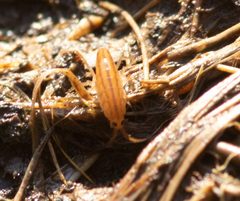
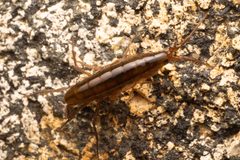
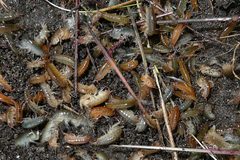
1- Orchestia grillus(beach hopper)
Orchestia is a of talitrid amphipods comprising approximately 10-15 marine supralittoral . The genus was revised in 2014, with three new species described from the North Atlantic and South America, and has been redefined to exclude terrestrial species now placed in Cryptorchestia. Species in this genus inhabit coastal environments including sandy beaches, driftwood, and estuaries, with some showing specialized ecological associations. Orchestia species serve as intermediate for and play roles in wrack decomposition.
Pronunciation
How to pronounce Orchestia: //ɔɹˈkɛstiə//
These audio files are automatically generated. While they are not always 100% accurate, they are a good starting point.
Identification
Talitrid amphipods are notoriously difficult to identify, contributing to historical taxonomic confusion and overlooked . Orchestia species can be distinguished from terrestrial Cryptorchestia by their marine supralittoral association. driftwood-associated species within Talitridae (some Orchestia) exhibit dwarfism ( <15mm, some <8mm) achieved through —fewer moults, earlier sexualization, and constant size increments per moult. Accurate identification requires examination of morphological characters and often molecular data; museum specimen re-examination has led to elevation of former to species rank.
Images
Habitat
Marine supralittoral zone: sandy beaches, banquette beaches, mixed sand/gravel/cobble beaches, and estuaries. Some are obligately associated with driftwood for food and shelter. fragmentation and substrate patchiness correlate with species distribution at local .
Distribution
Temperate Atlantic (both hemispheres), Pacific coast of South America, Baltic Sea, Mediterranean Sea, North-eastern Atlantic islands, eastern North America, Iceland, Chile, Argentina, New Zealand, and Britain. The type O. gammarellus was originally described from a garden in Leiden, Netherlands, far from the sea—its true identity remains unknown with no existing type material.
Seasonality
Activity patterns vary seasonally; O. montagui shows greater winter activity while O. gammarellus maintains more consistent year-round activity. This temporal partitioning allows sympatric coexistence.
Diet
Feeding habits vary by and : consuming wrack and decaying organic matter; driftwood-associated species feed obligately on decomposing marine driftwood.
Host Associations
- Txikispora philomaios - Filozoan that parasitizes Orchestia species
- Hymenolepis exigua - intermediate Tapeworm of chickens; O. platensis documented as intermediate in Hawaii
Life Cycle
Neotenous development in driftwood-associated : fewer moults per , sexualization beginning at earlier moult number, and constant size increment at each moult. Post-embryonic growth patterns have been documented in littoral .
Behavior
Locomotor activity shows seasonal variation under aperiodic light regimens. Driftwood-associated use floating logs for passive across oceanic distances, with driftwood serving as both transportation and food source. Wrack-associated species occupy burrows or occur as non-burrowers in tidal deposits.
Ecological Role
Decomposer of beach wrack and driftwood; contributes to nutrient cycling in coastal . Serves as intermediate for parasitic worms affecting vertebrates including poultry.
Human Relevance
Intermediate for Hymenolepis exigua, a tapeworm of chickens in Hawaii. Subject of taxonomic research due to identification difficulties and biogeographic interest.
Similar Taxa
- CryptorchestiaFormerly included in Orchestia; now separated containing nine terrestrial from western Europe, Mediterranean, Azores and Canary Islands. Orchestia is confined to marine supralittoral species.
- TalitrusCo-occurring talitrid ; T. saltator occurs strictly on sandy beaches while sympatric Orchestia occupy banquette or mixed substrate beaches, demonstrating partitioning.
More Details
Taxonomic instability
The has undergone substantial revision, with the 2014 redefinition excluding terrestrial and the 2012 redefinition confining Orchestia to 15 marine supralittoral species. Historical descriptions based on atypical localities (e.g., O. gammarellus from a garden in Leiden) have complicated type material issues.
Biogeographic history
A hypothesis for current Orchestia distribution extending back to the Cretaceous has been proposed, involving long-distance on driftwood and subsequent diversification in the North Atlantic and South America.
Sources and further reading
- BugGuide
- Wikipedia
- GBIF taxonomy match
- iNaturalist taxon
- NCBI Taxonomy
- Catalogue of Life
- Tiny travellers of the animal world: Hitchhikers on marine driftwood | Blog
- Estuarine species of Orchestia (Crustacea: Amphipoda: Talitroidea) from Britain
- Seasonal variation of the locomotor behavior of two sympatric species,Orchestia montaguiandOrchestia gammarellus(Amphipoda, Talitridae), under aperiodic regimens
- A revision of the genus Orchestia Leach, 1814 with the reinstatement of O. inaequalipes (K.H. Barnard, 1951), the designation of a neotype for Orchestia gammarellus (Pallas, 1776) and the description of three new species (Crustacea: Amphipoda: Talitridae: Talitrinae)
- Substrate dependent talitrid amphipods from fragmented beaches on the north coast of Crete (Crustacea, Amphipoda, Talitridae), including a redefinition of the genus Orchestia and descriptions of Orchestia xylino sp. nov. and Cryptorchestia gen. nov.
- GROWTH AND REPRODUCTION IN TWO BRACKISH WATER POPULATIONS OF ORCHESTIA GAMMARELLUS (AMPHIPODA: TALITRIDAE) IN THE BALTIC SEA
- The Amphipod, Orchestia platensis, an Intermediate Host for Hymenolepis exigua, a Tapeworm of Chickens in Hawaii
- Ecology of beach wrack in northern New England with special reference to Orchestia platensis
- A new terrestrial talitrid genus, Kachinorchestia, with a new species from Myanmar (Crustacea, Amphipoda, Arcitalitridae).