
Orchestia grillus
(Bosc, 1802)
beach hopper, saltmarsh amphipod
Orchestia grillus is a saltmarsh amphipod in the Talitridae, found in South America. It is notable for its role in studies of -manipulated , specifically involving by the trematode Levinseniella byrdi. Infected individuals display bright orange coloration and altered use compared to uninfected individuals. The is currently recognized as a synonym of Speziorchestia grillus in some taxonomic databases.
Pronunciation
How to pronounce Orchestia grillus: //ɔːrˈkɛstiə ˈɡrɪləs//
These audio files are automatically generated. While they are not always 100% accurate, they are a good starting point.
Identification
Bright orange coloration indicates by Levinseniella byrdi trematode. Uninfected individuals typically found under vegetation; infected individuals observed in open, unvegetated . Photophobic in uninfected state; photophobia neutralized (not reversed) when infected.
Images
Appearance
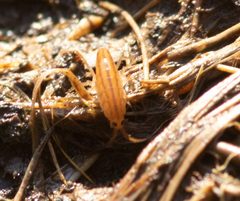
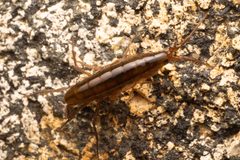
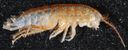
Small amphipod with typical laterally compressed talitrid body form. Infected individuals with Levinseniella byrdi display bright orange coloration; uninfected individuals are not described as brightly colored in available sources.
Habitat
Saltmarsh environments. Uninfected individuals typically found under vegetation. Infected individuals observed in open, unvegetated .
Distribution
South America.
Host Associations
- Levinseniella byrdi - Trematode that infects Orchestia grillus. causes bright orange coloration and neutralizes photophobia. Definitive hosts are birds; parasite likely manipulates host to increase susceptibility.
Behavior
Photophobic in uninfected state; actively avoids light. When infected with Levinseniella byrdi, photophobia is neutralized (not reversed to photophilia), resulting in random movement into open . Infected individuals show reduced escape response and can be easily approached and touched.
Ecological Role
Intermediate for trematode Levinseniella byrdi, which requires bird definitive hosts to complete its .
Human Relevance
Subject of research on -manipulated . Used as model system for studying how parasites alter host phenotypes to facilitate transmission.
Similar Taxa
- Chelorchestia forcepsAlso infected by Levinseniella byrdi; shares same relationship.
- Uhlorchestia spartinophilaAlso infected by Levinseniella byrdi; shares same relationship.
- Uhlorchestia uhleriAlso infected by Levinseniella byrdi; shares same relationship.
Misconceptions
Infected individuals are not drawn to light (photophilic); rather, their innate photophobia is neutralized, resulting in random movement rather than directed light-seeking.
More Details
Taxonomic status
Currently recognized as a synonym of Speziorchestia grillus in Catalogue of Life and GBIF, though retained as Orchestia grillus in NCBI and some literature. Basionym: Talitrus grillus Bosc, 1802.
Parasite manipulation research
One of four known amphipod for Levinseniella byrdi. The -manipulation hypothesis suggests that conspicuous coloration and altered make infected amphipods more visible and catchable by bird , facilitating parasite transmission to definitive hosts.
Sources and further reading
- BugGuide
- Wikipedia
- GBIF taxonomy match
- iNaturalist taxon
- NCBI Taxonomy
- Catalogue of Life
- Tiny travellers of the animal world: Hitchhikers on marine driftwood | Blog
- Are amphipodsOrchestia grillus(Bosc, 1802) (Amphipoda: Talitridae) infected with the trematodeLevinseniella byrdi(Heard, 1968) drawn to the light?