
Uhlorchestia
Bousfield, 1984
beach hoppers
Species Guides
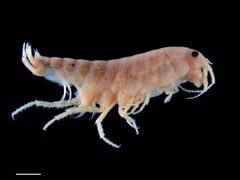
1- Uhlorchestia uhleri(beach hopper)
Uhlorchestia is a of talitrid amphipods to salt marshes along the Atlantic coast of North America. The genus contains two described : U. spartinophila and U. uhleri. These amphipods are closely associated with smooth cordgrass (Spartina alterniflora) and function as in salt marsh . studies indicate high turnover rates and year-round with seasonal peaks.
Pronunciation
How to pronounce Uhlorchestia: /ˌjuːlɔːrˈkɛstiə/
These audio files are automatically generated. While they are not always 100% accurate, they are a good starting point.
Images
Habitat
Salt marsh intertidal zones, specifically levee (vegetated creekbank), high marsh, and low marsh . Closely associated with standing-dead leaves of smooth cordgrass Spartina alterniflora.
Distribution
Salt marshes along the Atlantic coast of North America; documented from Georgia, USA and distributed more broadly along the U.S. Atlantic coast.
Seasonality
densities highest March–May and lowest November–December. occurs year-round with peak output January–May.
Diet
and dead Spartina alterniflora leaves (both and blade portions), including decomposing cordgrass with associated fungal . Laboratory studies demonstrate survival and on these natural diets, with performance varying by leaf portion and decomposition state.
Life Cycle
Growth rates decrease with increasing body size and are lowest in winter. Minimum female size 5.4 mm total length. size ranges 1–28 or young, increasing with female body size; average 7.4 young for 7.6 mm TL female. Sex ratio typically favors females.
Behavior
Functions as a trophic link to decomposition processes in detrital-based salt marsh . Access to plant production made available by decomposers is influenced by structural characteristics and fungal occupation rates within different leaf portions.
Ecological Role
contributing to salt marsh decomposition processes. Prey resource for secondary consumers. High turnover rates (production: ratios 15.4–17.3) with broad intertidal distribution suggest greater contribution to trophic dynamics than standing stock biomass alone implies.
More Details
Population dynamics
production estimated at 0.769–1.444 g AFDW m⁻², with lowest values in low marsh and highest in levee .
Laboratory performance
Six-week laboratory rearing demonstrated 56–84% survival on most natural diets; yielded only 20% survival and no offspring. Starved amphipods survived no longer than 11 days.
Sources and further reading
- BugGuide
- Wikipedia
- GBIF taxonomy match
- iNaturalist taxon
- Catalogue of Life
- Intertidal distribution, population dynamics and production of the amphipod Uhlorchestia spartinophila in a Georgia, USA, salt marsh
- Survival, growth and reproduction of the salt-marsh amphipod Uhlorchestia spartinophila reared on natural diets of senescent and dead Spartina alterniflora leaves
- SYSTEMATICS, DISTRIBUTIONAL ECOLOGY, AND SOME HOST-PARASITE RELATIONSHIPS OF UHLORCHESTIA UHLERI (SHOEMAKER) AND U. SPARTINOPHILA, NEW SPECIES (CRUSTACEA: AMPHIPODA), ENDEMIC TO SALT MARSHES OF THE ATLANTIC COAST OF NORTH AMERICA
- Systematics, Distributional Ecology, and Some Host-Parasite Relationships of Uhlorchestia uhleri (Shoemaker) and U. spartinophila, New Species (Crustacea: Amphipoda), Endemic to Salt Marshes of the Atlantic Coast of North America