
Paravaejovis spinigerus
(Wood, 1863)
stripe-tailed scorpion, devil scorpion
Paravaejovis spinigerus, commonly known as the stripe-tailed scorpion or devil , is a medium-sized scorpion native to the Sonoran Desert region. reach 60–70 mm in length and weigh approximately 9.5 g. The was transferred from the Hoffmannius to Paravaejovis in 2013. Its venom is not medically significant to humans.
Pronunciation
How to pronounce Paravaejovis spinigerus: /ˌpærəˈviːdʒoʊvɪs spɪˈnɪdʒərəs/
These audio files are automatically generated. While they are not always 100% accurate, they are a good starting point.
Identification
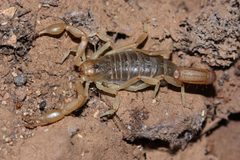
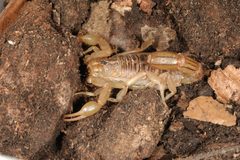
Distinguished from the Arizona bark scorpion (Centruroides sculpturatus) by: (1) brownish-tan stripes on the keels of the tail versus unstriped tail in bark scorpions; (2) thicker tail relative to the versus slender tail and pedipalps in bark scorpions; (3) more robust overall build. The striped tail pattern is diagnostic for field identification in its range.
Images
Appearance
Medium-sized with males and females reaching 60–70 mm in body length and approximately 9.5 g in weight. Body base color ranges from light yellow to golden brown with variable darker markings. The metasoma (tail) displays distinctive brownish-tan stripes running along the keels or ridges—this striping is the source of both the and the specific epithet. The tail is thicker than the (claws), which are relatively slender. The name spinigerus refers to the spiniform present at the ends of the dorsal keels of the tail. Some individuals exhibit dusky underlying markings along the tail.
Habitat
Occurs in the Sonoran Desert from desert floor to rocky hillsides. Found under rocks and surface objects including sleeping bags and shoes. Also occurs on sandy soils. Actively seeks the most humid microhabitats available within its arid environment.
Distribution
Native to the southwestern United States (Arizona, New Mexico, and parts of California) and northwestern Mexico (Sonora, Baja California, and Baja California Sur).
Diet
Life Cycle
Gestation lasts 3–8 months. Females give birth to live young (scorplings), with litter sizes ranging from 1 to 100 individuals. Birth may occur as single offspring emerging at intervals or as a continuous flow. Females exhibit a distinctive rigid, inflexible posture during late gestation, with front legs lowered to allow offspring . Mothers carry young on their backs until the first . Some females may cannibalize offspring; the factors determining maternal care versus are unknown.
Behavior
. Males and females engage in a courtship dance lasting from minutes to hours prior to mating; if the male persists longer than the female desires, the female may attack and consume him. Females use smell and vibrations to locate mates. Seeks humid microhabitats within arid environments.
Ecological Role
Human Relevance
Commonly encountered by humans in its range due to habit of sheltering under rocks, sleeping bags, and shoes. Venom is not medically significant and the is not considered dangerous to humans or other mammals. Frequently misidentified as more dangerous species.
Similar Taxa
- Centruroides sculpturatus (Arizona bark scorpion)Sympatric in Arizona; distinguished by slender tail and , lack of tail striping, and medically significant venom.
Misconceptions
Often feared due to confusion with the Arizona bark scorpion (Centruroides sculpturatus), which has medically significant venom. The stripe-tailed scorpion's venom is not dangerous to humans, though stings may cause local pain.
More Details
Taxonomic History
Formerly classified in the Hoffmannius; transferred to Paravaejovis in 2013 based on phylogenetic analysis.