
Buthidae
C.L. Koch, 1837
fat-tailed scorpions, bark scorpions, arrowbreasted scorpions
Genus Guides
1- Centruroides(bark scorpion)
Buthidae is the largest of scorpions, containing approximately 100 and 1300 as of 2025. Members are typically mid-sized to small, with weak, slender and characteristically thickened tails. The family has a distribution throughout tropical and subtropical environments worldwide. Buthidae includes nearly all medically significant species, with venoms containing potent that affect ion channels.
Pronunciation
How to pronounce Buthidae: //ˈbjuːθɪˌdiː//
These audio files are automatically generated. While they are not always 100% accurate, they are a good starting point.
Identification
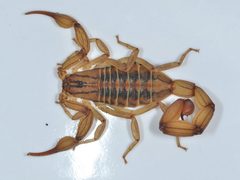
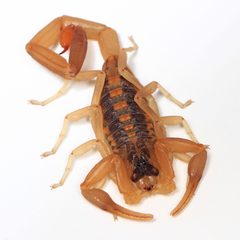
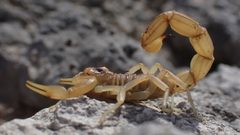
Distinguished from other by the combination of a thickened tail and weak, slender . The spine beneath the stinger is diagnostic for the family (visible in specimens). Buthidae typically have multiple pairs of (2–5), unlike Chaerilidae and Chactidae which have at most one pair. Some superficially resemble Vaejovidae. such as Androctonus, Centruroides, Hottentotta, Leiurus, Parabuthus, and Tityus are notable for their robust tails and medical importance.
Images
Appearance
Most Buthidae are mid-sized to small scorpions, ranging from approximately 2 cm (Microtityus, Microbuthus) to 12 cm (Androctonus, Parabuthus, large Centruroides). The is characterized by thick, robust metasomas (tails), especially in Old World , contrasting with weak, slender, tweezer-like . Most species possess two to five pairs of . Coloration is generally cryptic, uniformly ochre to brown, though some species are black or more vividly colored (e.g., Centruroides, Uroplectes). A diagnostic feature visible in dead specimens is a spine beneath the stinger.
Habitat
Occupies diverse tropical and subtropical environments worldwide. Specific preferences vary by and . Tityus cerroazul in Panama shows preference for forested at considerable elevations. Mesobuthus rakhshanii in Iran occurs in arid and semi-arid regions where precipitation and mean temperature of the coldest quarter are key limiting factors. Many species are , occurring in domiciliary environments.
Distribution
throughout tropical and subtropical regions worldwide. Major centers of diversity include Africa, Asia, the Americas, and the Middle East. Notable distributions: Centruroides vittatus ranges from the south-central United States (Missouri, Arkansas, Louisiana, Texas, Oklahoma, Kansas, Colorado, New Mexico) through northern Mexico; Tityus are widespread in Brazil and Panama; Mesobuthus extends from the Eastern Mediterranean to the Eastern Palaearctic; Androctonus and Leiurus occur in North Africa and the Middle East.
Seasonality
Activity patterns vary by and environment. Mesobuthus eupeus exhibits activity with size-age dependent rhythms: smaller individuals (groups I–II) show unimodal activity, medium individuals (III–IV) bimodal, and largest (V) trimodal patterns.
Diet
. Mesobuthus eupeus feeds primarily on Isopoda, Araneae, Hymenoptera, and Lepidoptera across all size classes. Larger individuals expand their diet to include Coleoptera, Orthoptera, Pulmonata, Lumbricidae, Scolopendromorpha, and Solifugae. Diet breadth increases with body size while feeding intensity decreases. Smaller scorpions show negative electivity indices, becoming more selective with age.
Life Cycle
with litter-bearing . Mesobuthus rakhshanii has observed litter sizes of 22–36 young. Development includes size-age groupings based on metasomal length, with at least five distinct growth stages documented in Mesobuthus eupeus.
Behavior
with aggregated, settlement-forming distribution patterns. has been documented in Tityus metuendus, with larger individuals preying on smaller conspecifics. Many exhibit secretive , sheltering under rocks and debris during daylight hours.
Ecological Role
Important in tropical and subtropical . structure shows pronounced with local cluster formation. Size-dependent dietary shifts influence trophic dynamics.
Human Relevance
Contains nearly all medically important . Approximately 20 species are potentially lethal to humans, including members of Androctonus, Centruroides, Hottentotta, Leiurus, Parabuthus, and Tityus. Venom contains that hyperpolarize nerves and slow sodium channel inactivation, causing prolonged painful nerve firing. The venom of Rhopalurus junceus is used in Cuban traditional medicine and has been investigated for anticancer properties. species such as Tityus trivittatus and Centruroides vittatus occur in human dwellings, increasing envenomation risk.
Similar Taxa
- VaejovidaeSome Buthidae superficially resemble Vaejovidae in general body form, but differ in structure and tail thickness
- ChaerilidaeChaerilidae have at most one pair of and show a yellowish spot between and to the eyes, unlike Buthidae which have 2–5 eye pairs
- ChactidaeChactidae have at most one pair of , whereas Buthidae typically have multiple eye pairs
- HemiscorpiidaeHemiscorpius lepturus is the only medically important not in Buthidae, distinguished by different morphological features and venom composition
More Details
Chromosomal characteristics
Buthidae exhibit distinctive chromosomal structure with telocentric/holocentric possessing one at each end. During in Tityus bahiensis, rod-shaped bivalents orient with bodies flat in the equatorial plane and ends toward opposite poles, moving in parallel without chiasmata until late anaphase.
Venom biochemistry
Buthidae venoms contain and protein toxins typically in the 1–50 kDa range. Tityus kaderkai venom contains 47.6% protein with seven chromatographic peaks, including hyaluronidase activity and toxins affecting both mammals and insects. Some peptide structures (3555, 3772, 3996, 6780, 6820 Da) appear conserved within despite individual variation.
Taxonomic diversity
The includes both very large (Ananteris, Centruroides, Compsobuthus, Tityus with numerous ) and many species-poor or genera. New species continue to be described at a rate of several per year.
Sources and further reading
- BugGuide
- Wikipedia
- GBIF taxonomy match
- iNaturalist taxon
- NCBI Taxonomy
- Catalogue of Life
- A face only a mother could love | Beetles In The Bush
- On the Tityus stigmurus complex (Scorpiones, Buthidae)
- The Chromosomes ofRhopalurus(Scorpiones-Buthidae)
- Size-age differences in the bioecology of Mesobuthus eupeus (C. L. Koch, 1839) (Arachnida, Scorpiones, Buthidae) in Azerbaijan
- Ampliación de la distribución de Tityus cerroazul Lourenço, 1986 (Scorpiones: Buthidae) en Panamá Expansion of the distribution of Tityus cerroazul Lourenço, 1986 (Scorpions: Buthidae) in Panama
- Comparative analysis of peptides and proteins in two congeneric (Leiurus abdullahbayrami; Buthidae ) scorpion venoms by MALDI-TOFMS
- An Integrative Study on Mesobuthus rakhshanii (Scorpiones: Buthidae)
- First record of Tityus trivittatus (Scorpiones: Buthidae) in La Pampa province, Argentina
- Estudio bioquímico del veneno de Tityus kaderkai(Scorpiones: Buthidae) con notas sobre su distribución y hábitat en el Perú Biochemical study of Tityus kaderkai (Scorpiones: Buthidae) venom with notes on its distribution and habitat in Peru
- Cannibalism in Tityus metuendus Pocock, 1897 (Scorpiones: Buthidae) from the Brazilian Amazon
- Phylogeny and Historical Biogeography of the Scorpion Genus Hottentotta Birula, 1908 (Buthidae) in the Iranian Plateau and the Zagros Mountains.