
Centruroides vittatus
(Say, 1821)
Striped Bark Scorpion
Centruroides vittatus is the most common in the United States, occurring throughout the midsection of the country and northern Mexico. This exhibits notable behavioral flexibility, including plant climbing and temperature-modulated antipredator responses. show geographic variation in venom , with eastern populations exhibiting reduced toxicity linked to lower sodium β toxin . The species has been documented harboring the endosymbiont Mycoplasma vittatus, the first Mycoplasma species identified from an arachnid.
Pronunciation
How to pronounce Centruroides vittatus: //ˌsɛntruˈɔɪdiːz vɪˈtætəs//
These audio files are automatically generated. While they are not always 100% accurate, they are a good starting point.
Identification
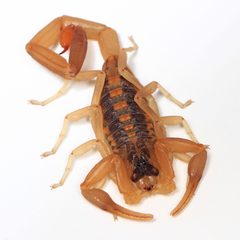
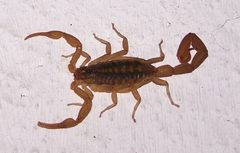
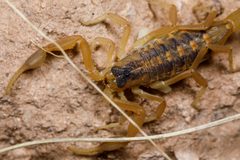
Distinguished from other Centruroides by the paired dark longitudinal stripes on the mesosoma. The slender and long, thin tail separate it from more robust species. Within its range, it may be confused with Centruroides hentzi, but C. vittatus is more widely distributed and generally paler with more pronounced striping. Fluoresces under ultraviolet light, a trait shared with all scorpions but useful for detection.
Images
Habitat
Inhabits diverse environments across its range including limestone glades, blackbrush in south Texas, and vegetated areas. Shows ontogenetic shifts in microhabitat use, with juveniles and occupying different structural . Frequently found under rocks, logs, and other ground debris; also documented climbing vegetation.
Distribution
Native range extends from southern Missouri, western Arkansas, and western Louisiana west through Texas, Oklahoma, and much of Kansas to southeastern Colorado and eastern New Mexico, and south into northern Mexico. The Missouri and Mississippi Rivers form approximate northern and eastern boundaries. Records outside this range in eastern U.S. states and South American countries represent human introductions.
Diet
; foraging and diet composition vary with microhabitat use. Specific prey items not documented in provided sources.
Host Associations
- Mycoplasma vittatus - endosymbiontFirst Mycoplasma identified and sequenced from an arachnid; inhabits the 's body tissues
Life Cycle
Behavior
. Exhibits plant climbing , using vegetation for movement and possibly foraging. Antipredator behaviors include stinging, fleeing, and defensive posturing; these responses are modulated by temperature and desiccation stress. Females display more aggressive defensive behavior than males, which tend to flee. Docile when handled with minimal provocation, typically backing away rather than stinging.
Ecological Role
in terrestrial ; occupies diverse microhabitats from ground level to vegetation. Serves as prey for specialized predators including mice.
Human Relevance
Frequently encountered by humans due to high abundance and tendencies. Stings are common but generally not life-threatening to healthy ; causes pain and localized effects. Venom varies geographically, with eastern less toxic. Fluorescence under UV light makes the useful for educational demonstrations and surveys. Subject of venom research due to genetic diversity in toxin production.
Similar Taxa
- Centruroides hentziOverlapping distribution in parts of the southeastern United States; C. vittatus is more widely distributed, generally paler, and has more pronounced striping
- Other Centruroides speciesShared characteristics including slender build and bark-dwelling habits; C. vittatus distinguished by specific stripe pattern and geographic range
More Details
Venom variation
show significant geographic variation in venom . Eastern populations exhibit reduced toxicity associated with lower sodium β toxin and toxin protein production. Over 70 putative sodium β toxin genes have been identified, with 111 toxin gene and 24 different toxin proteins documented. This genetic diversity may enable venom composition tailored to different targets.
Fluorescence
Like all scorpions, C. vittatus fluoresces under ultraviolet light due to compounds in its hyaline layer. This property is used for detection and has been demonstrated in educational settings.
Etymology
The generic name Centruroides derives from Greek 'centr-' (pointed), 'ur' (tail), and '-oides' (like/form of), referring to the pointed tail. The original name Centrurus was preoccupied. The specific epithet vittatus refers to the striped (banded) appearance.
Sources and further reading
- BugGuide
- GBIF taxonomy match
- iNaturalist taxon
- NCBI Taxonomy
- Catalogue of Life
- Scorpion Scientist Lauren Esposito to Deliver Research Seminar at UC Davis | Bug Squad
- A face only a mother could love | Beetles In The Bush
- Plant Climbing Behavior in the Scorpion Centruroides vittatus
- Microhabitat preferences for the errant scorpion, Centruroides vittatus (Scorpiones, Buthidae)
- Temperature and desiccation effects on the antipredator behavior of Centruroides vittatus (Scorpiones: Buthidae)
- Genome Analyses of a New Mycoplasma Species From the scorpion Centruroides vittatus
- Genome Analyses of a New Mycoplasma Species from the Scorpion Centruroides vittatus
- Ontogenetic shifts in microhabitat use, foraging and temporal activity for the striped bark scorpion Centruroides vittatus (Scorpiones: Buthidae)
- The effect of microhabitat use on the foraging and diet of the striped bark scorpion, Centruroides vittatus (Buthidae: Scorpiones) in blackbrush habitat of south Texas
- Meek Males and Fighting Females: Sexually-Dimorphic Antipredator Behavior and Locomotor Performance Is Explained by Morphology in Bark Scorpions (Centruroides vittatus)
- Reduced Toxicity of Centruroides vittatus (Say, 1821) May Result from Lowered Sodium β Toxin Gene Expression and Toxin Protein Production
- Sex Differences in Defensive Behavior and Venom of The Striped Bark ScorpionCentruroides vittatus(Scorpiones: Buthidae)