
Centruroides
Marx, 1890
bark scorpion, bark scorpions
Species Guides
5- Centruroides gracilis(Slender Brown Scorpion)
- Centruroides guanensis(Keys Bark Scorpion)
- Centruroides hentzi(Hentz striped scorpion)
- Centruroides sculpturatus(Arizona Bark Scorpion)
- Centruroides vittatus(Striped Bark Scorpion)
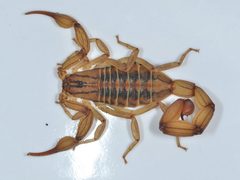
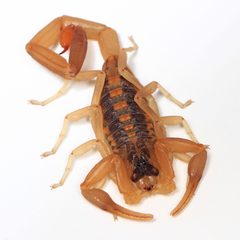
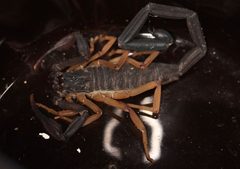
Centruroides is a highly speciose of buthid scorpions comprising at least 100 distributed throughout the southern United States, Mexico, Central America, the Antilles, and northern South America. Commonly known as bark scorpions, members of this genus are notable for their strong fluorescence under ultraviolet light—except immediately after moulting—and several species possess venom potent enough to cause human fatalities. The genus includes species adapted to diverse ranging from tropical rainforests to arid regions, with some showing marked intra-domiciliary tendencies in urban environments.
Pronunciation
How to pronounce Centruroides: /sɛntruˈɔɪdiːz/
These audio files are automatically generated. While they are not always 100% accurate, they are a good starting point.
Identification
Distinguished from other buthid by combination of: strong UV fluorescence (shared with most but not all genera); specific chela and metasomal segment detailed in -level keys. Some species identified by distinctive color patterns. The genus name is frequently misspelled as 'Centuroides' in non-primary literature. For species-level identification, consult regional taxonomic revisions as the genus is highly speciose with complex .
Images
Habitat
Diverse: includes tropical and subtropical forests, limestone glades, arid and semi-arid regions, and anthropogenic environments. Some (e.g., C. edwardsii, C. exilimanus) exhibit strong intra-domiciliary tendencies, regularly occurring inside buildings, cabins, and outhouses. Others occur under loose bark, rocks, and logs in natural settings.
Distribution
Southern United States (west of Missouri/Mississippi River boundaries, with some eastern records attributed to human introduction), Mexico, Central America, the Antilles, and northern South America. Some have extremely narrow ranges (e.g., C. panamensis from foothills of Volcán Barú, Chiriquí Province, Panama). C. vittatus has been introduced to several South American countries and eastern U.S. states outside its natural range.
Seasonality
activity pattern; from burrows at twilight. Activity likely varies by climate and , with year-round activity in tropical regions and seasonal patterns in temperate areas.
Diet
; primarily arthropods (insects, spiders) captured and dismembered using . Documented to include small vertebrates: C. exilimanus observed feeding on Pallas's mastiff bat (Molossus molossus) in Honduras, representing the first reported on bats.
Life Cycle
Behavior
; uses whole-body photoreception to detect light levels and seek dark refugia. Rapid movement when illuminated with UV light, interpreted as escape response to avoid . When threatened, raises metasoma with sting curled over back. Some show docile when disturbed, retreating rather than stinging.
Ecological Role
of arthropods and small vertebrates; venom functions in both prey capture and defense. Clinically significant serve as public health concerns in their ranges. Some species (e.g., C. edwardsii) responsible for substantial percentages of envenomation accidents in their regions.
Human Relevance
Several possess venom potent enough to cause human fatalities, particularly in Mexico and Central America. C. limpidus limpidus venom contains Cll1 and Cll2. C. noxius and C. limpidus venoms show severe cardiovascular in experimental studies. C. vittatus sting causes significant pain but is not generally life-threatening. UV fluorescence aids in detection and removal from dwellings. Some species regularly enter human structures, creating ongoing conflict.
Similar Taxa
- TityusAnother medically important buthid in the Americas; distinguished by morphological features of and metasomal segments, and by geographic range overlap in some areas. Some Tityus have venom more dangerous to humans than most Centruroides.
More Details
UV Fluorescence Mechanism
Fluorescence results from beta-carboline and 4-methyl-7-hydroxycoumarin compounds in the hyaline layer of the . The entire body may function as a photoreceptor ('whole-body ') to detect light levels, with UV exposure triggering rapid movement toward dark refugia.
Venom Diversity
Individual scorpions can carry genes for more than 200 unique venom variants. Venom composition varies by context: different cocktails deployed against versus prey. This represents an evolutionary arms race, particularly with mice (predatory, rodents specialized to prey on scorpions).
Sources and further reading
- BugGuide
- Wikipedia
- GBIF taxonomy match
- iNaturalist taxon
- NCBI Taxonomy
- Catalogue of Life
- Scorpion Scientist Lauren Esposito to Deliver Research Seminar at UC Davis | Bug Squad
- Scorpion glow, scorpion sting: Slenderbrown and other scorpions in Central America, Centruroides spp. — Bug of the Week
- A face only a mother could love | Beetles In The Bush
- Cardiovascular effects of the scorpions Centruroides margaritatus, Centruroides limpidus and Centruroides noxius crude venom
- A new species of Centruroides Marx (Scorpiones: Buthidae) from Panama and new distribution records for Centruroides bicolor (Pocock, 1898) and Centruroides granosus (Thorell, 1876)
- Distribution of Centruroides edwardsii CENTRUROIDES EDWARDSII (GERVAIS, 1843) in the Aantioquia Province, Colombia
- Consumption event of the Pallas’s mastiff bat (Molossus molossus) by the Central America bark scorpion (Centruroides exilimanus) in Honduras
- Immunogenicity of two representative American consensus scorpion neurotoxins from the genera Tityus and Centruroides.