
Vaejovidae
Thorell, 1876
Devil Scorpions
Genus Guides
16Vaejovidae is a of scorpions comprising approximately 25 and over 230 , with the 'Devil Scorpions.' The family is to North America, ranging from western Guatemala through Mexico and into the western United States, with one species extending into the Appalachian Mountains. Members of this family occupy diverse including desert playas, chaparral, pine-spruce forests at high elevations, and alkali sinks. Several species have been described recently from California, including new species discovered through science platforms.
Pronunciation
How to pronounce Vaejovidae: /vaɪˈdʒoʊvɪdeɪ/
These audio files are automatically generated. While they are not always 100% accurate, they are a good starting point.
Identification
Vaejovidae scorpions can be distinguished from other by a combination of morphological characters including specific arrangements of denticles on the fingers. within the family often require detailed examination of pedipalp denticle counts, metasomal segment ratios, and multilocus data for definitive identification. The 'vorhiesi' group of Vaejovis, for example, is characterized by specific fixed and movable finger denticle patterns (typically 6 ID denticles on fixed finger, 7 on movable finger in V. grayae). Many species exhibit subtle morphological differences that necessitate expert taxonomic analysis.
Images
Habitat
Members of Vaejovidae occupy diverse across their North American range. have been documented in desert alkali playas and dry lake beds, chaparral , pine and spruce forests at elevations exceeding 9,500 feet (2,900 m), and temperate foothill regions. The northern scorpion Paruroctonus boreus extends into the southern plains of Canada, representing the northernmost species globally. Several species are habitat restricted to specific alkali sink environments with high pH soils.
Distribution
The is restricted to North America, occurring from western Guatemala throughout Mexico and in the United States primarily west of the 100° meridian. One occurs in the Appalachian Mountains. The northernmost record is from the southern Canadian provinces of Saskatchewan, Alberta, and British Columbia. High diversity occurs in the southwestern United States, particularly Arizona, New Mexico, and California, with ongoing discoveries of new species from these regions.
Life Cycle
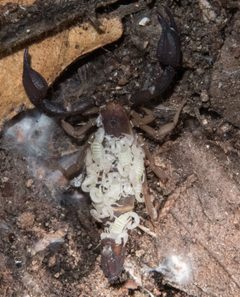
Members of the Vaejovis in the 'vorhiesi' group are , giving birth to live young. Clutch size varies by body size, with larger species producing more offspring per parturition. A study of 100 females across 12 described species documented 2,287 newborns, demonstrating size-dependent reproductive output.
Human Relevance
Vaejovidae includes discovered through science initiatives, notably Paruroctonus soda and P. conclusus described by high school students using iNaturalist observations. Some species have extremely restricted ranges and conservation concerns from development; P. conclusus occupies less than two kilometers of unprotected land vulnerable to solar farm or mining development. The 's restricted North American distribution makes it significant for regional biodiversity assessment and conservation planning.
Similar Taxa
More Details
Taxonomic activity
The has been subject to intensive recent taxonomic revision, particularly in California where -based methods have revealed cryptic diversity. Warren Savary and Rob Bryson have used molecular to clarify relationships among morphologically similar . Several new species have been described from California since 2016, including Pseudouroctonus maidu from the Sierra Nevada foothills.
Conservation status
While the as a whole is not assessed, individual varying threat levels. Paruroctonus soda occurs entirely within Carrizo Plain National Monument and is federally protected, while P. conclusus occupies unprotected vulnerable to development. Climate change poses a general threat to desert-dwelling members of the family.
Sources and further reading
- BugGuide
- Wikipedia
- GBIF taxonomy match
- iNaturalist taxon
- NCBI Taxonomy
- Catalogue of Life
- High school students help describe two new scorpion species
- Destination Sonoran Desert: A time to sting for the Giant Hairy Desert Scorpion, 'Hadrurus arizonensis' — Bug of the Week
- Sierra Nevada | Blog
- California | Blog
- arachnids | Blog - Part 2
- wildlife | Blog - Part 3
- A new species of Vaejovis from chaparral habitat near Yarnell, Arizona (Scorpiones: Vaejovidae)
- Reproduction and birth in the “vorhiesi” group of the genus Vaejovis (Scorpiones: Vaejovidae). Part I. Clutch size
- The relationship between population density of Paruroctonus utahensis (Scorpionida: Vaejovidae) and characteristics of its habitat
- The scorpions of the Estación de Biología Chamela, Jalisco, Mexico with the description of a new species of Mesomexovis (Scorpiones, Vaejovidae) and an identification key.