
Chelifer cancroides
(Linnaeus, 1758)
House Pseudoscorpion
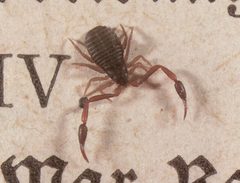
Chelifer cancroides, the house pseudoscorpion, is a small pseudoscorpion measuring 2.5–4.5 mm in body length with extending to 7–9 mm. It is the most widely distributed pseudoscorpion species globally, occurring across North America, Europe, Africa, Australia, and the Caribbean. The species is strongly , frequently found in human dwellings, barns, and beehives, but also occurs in natural including under tree bark, in caves, and in bird nests. It is harmless to humans and preys on small arthropods.
Pronunciation
How to pronounce Chelifer cancroides: //ˈkɛlɪfər kæŋkˈrɔɪdiːz//
These audio files are automatically generated. While they are not always 100% accurate, they are a good starting point.
Identification
Distinguished from other Cheliferidae by: with large setose ; male carapace and tergites I-VII/VIII with distinct lateral keels; cheliceral hand with 4 setae and lacking seta sbs; tarsal claws with lateroventral process (except first leg pair of adult males); denticulate subterminal tarsal setae; male IV strongly arcuate with large lateral process. The Chelifer is currently , with all other described synonymized or transferred to other genera.
Images
Appearance
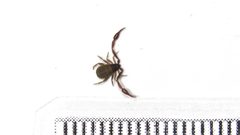
Body teardrop-shaped, 2.5–4.5 mm in length, with rich mahogany coloration. very long, 7–9 mm when extended. with 12 segments, only 10 easily visible. with one pair of . bearing large setose . Males with distinct lateral keels on carapace and tergites I-VII or I-VIII. Cheliceral hand with 4 setae, lacking seta sbs. Tarsal claws of with lateroventral process (except first leg pair of adult males). Subterminal tarsal setae denticulate.
Habitat
Occurs in diverse environments including under tree bark, caves, bird nests, and beehives. Frequently found riding on bats, flies, and hymenopterans. Strongly in human structures: houses, stables, barns, and chicken coops.
Distribution
distribution across North America, Europe, Africa, Australia, Caribbean, Middle America, and Northern Asia (excluding China). Most widely distributed pseudoscorpion globally.
Diet
Feeds on small arthropods including , fruit flies, and mites. Preys on Varroa destructor in beehives. Venomous used to subdue prey.
Host Associations
- Apis mellifera - commensal/Occurs in beehives; preys on Varroa destructor mites parasitizing honey bees
- Varroa destructor - preyActively predated upon in beehive environments
- bats - Has been observed riding on bats
- flies - Has been observed riding on flies
- hymenopterans - Has been observed riding on hymenopterans
Life Cycle
Development from to maturity takes 10–24 months, requiring three . Molting may involve construction of silk nest. 20–40 eggs. Lifespan typically 3–4 years.
Behavior
Males maintain small mating territories, few centimeters in size. Upon female entry, male initiates mating dance and deposits , which female picks up. During forward locomotion, exhibits frequent microstops of 100–200 ms duration. Performs statically stable alternating tetrapod gait during forward and backward , with nearly complete of tetrapod schemes between directions. Achieves highest speeds (up to 17 body lengths per second) during backward locomotion as escape . Forward walking characterized by lower speeds and ~10% phase shifts between loosely coupled leg groups within tetrapod. Second leg pair plays special role, likely for stability related to large . Capable of upside-down walking at low speeds up to 4 body lengths per second, without rigidly fixed leg coordination.
Ecological Role
of small arthropods in diverse microhabitats. Potential agent for Varroa destructor in managed colonies.
Human Relevance
and harmless to humans. Occurs commonly in houses and outbuildings. Of interest in apiculture for potential control of Varroa destructor mites. Venom has demonstrated to methicillin- Staphylococcus aureus, fungi, and other arthropods.
Similar Taxa
- Other CheliferidaeDistinguished by combination of setose , male lateral keels, cheliceral setation, tarsal claw , and male genitalia structure. The Chelifer is , making -level identification straightforward once assignment is confirmed.
More Details
Venom composition
Venom contains various toxic to bacteria (including methicillin- Staphylococcus aureus), fungi, other arthropods (aphids, Varroa mites), and mammalian .
Sensory neuroanatomy
serve as primary sensory appendages. Afferents from pedipalps terminate in glomerular and layered neuropils functioning as first integration centers for chemosensory and mechanosensory input. includes arcuate body and comparatively small mushroom body with some similarities to Solifugae.
Taxonomic history
Originally described by Linnaeus in 1758 as Acarus cancroides, one of first two pseudoscorpion described. Transferred to Phalangium (1767) and Scorpio (1775) before placement in Chelifer (1762). Over 300 species-group names subsequently described in Chelifer; all except C. cancroides moved to other or synonymized. Genus currently , though contains 14 nomina dubia and 11 from original descriptions.
Sources and further reading
- BugGuide
- Wikipedia
- GBIF taxonomy match
- iNaturalist taxon
- NCBI Taxonomy
- Catalogue of Life
- Notes on the Life History of the Pseudoscorpion Chelifer cancroides (Linn.) (Chelonethida).
- Locomotion in the pseudoscorpionChelifer cancroides: forward, backward and upside-down walking in an eight-legged arthropod
- Anatomy of the Nervous System in Chelifer cancroides (Arachnida: Pseudoscorpiones) with a Distinct Sensory Pathway Associated with the Pedipalps
- Predation behaviour of the pseudoscorpion, Chelifer cancroides , against Varroa destructor in the presence and absence of alternative prey and Apis mellifera