
Iocheirata
Harvey, 1992
Suborder Guides
3- Cheliferoidea
- Garypoidea(false scorpions)
- Neobisioidea
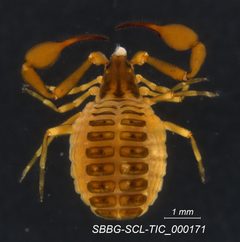
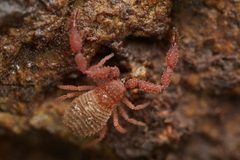
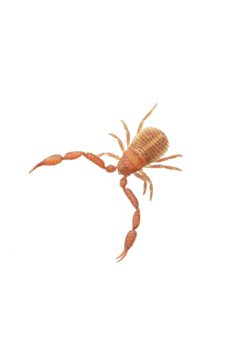
Iocheirata is a suborder of pseudoscorpions (Order Pseudoscorpiones) established by Harvey in 1992. It represents one of two major lineages within the order, distinguished by the presence of venom glands in the pedipalpal chelae. The suborder encompasses the majority of pseudoscorpion diversity, containing numerous distributed worldwide. Iocheirata pseudoscorpions are small arachnids, generally under 5 mm in body length, that inhabit a variety of terrestrial microhabitats.
Pronunciation
How to pronounce Iocheirata: //aɪ.oʊˈkaɪ.rə.tə//
These audio files are automatically generated. While they are not always 100% accurate, they are a good starting point.
Identification
Iocheirata is distinguished from the other pseudoscorpion suborder, Epiocheirata, by the presence of a venom apparatus in the movable finger of the chela. This venom gland opens through a duct near the tip of the finger, a feature absent in Epiocheirata. Members of Iocheirata also exhibit diverse chelal tooth formulas and setation patterns that vary among constituent . The suborder lacks the reduced trichobothrial patterns characteristic of some Epiocheirata lineages.
Images
Distribution
. Iocheirata occurs on all continents except Antarctica, with representatives in tropical, temperate, and arid regions. Distribution patterns vary considerably among constituent , with some groups showing Gondwanan distributions and others being more widespread.
Similar Taxa
- EpiocheirataThe other suborder of Pseudoscorpiones, distinguished by the absence of venom glands in the and generally more reduced trichobothrial patterns on the chelae.
More Details
Systematic history
Harvey (1992) established Iocheirata to accommodate the venom-gland-bearing pseudoscorpions, previously treated as the 'venomous' or 'normal' group in contrast to the venomless Epiocheirata. The suborder has been consistently supported in subsequent phylogenetic analyses based on morphological and molecular data.