
Scytodes longipes
Lucas, 1844
Long-legged Spitting Spider
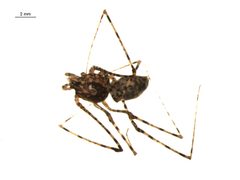
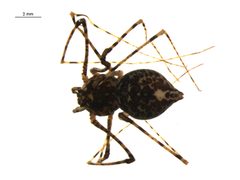
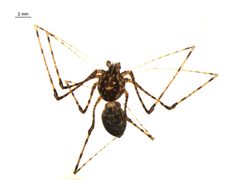
Scytodes longipes is a tropical spitting spider distinguished by its long legs and specialized prey-capture . Unlike short-legged Scytodes that are ground-dwelling hunters, this species constructs tangled, sheet-like webs similar to cellar spiders (Pholcidae). It has been introduced well beyond its native range, establishing on Pacific Islands, in Africa, Southeast Asia, and Australia. The species is notable for its communal tendencies and unique spitting mechanism that immobilizes prey with adhesive venom.
Pronunciation
How to pronounce Scytodes longipes: /sɪˈtoʊdiːz ˈlɒŋɪpiːz/
These audio files are automatically generated. While they are not always 100% accurate, they are a good starting point.
Identification
Distinguished from short-legged Scytodes by leg length and web-building . Long-legged Scytodes species including S. longipes construct tangled, sheet-like webs, whereas short-legged species are strictly wandering hunters that do not spin webs. Differentiated from cellar spiders (Pholcidae) by the convex shape and six- arrangement. Separated from brown recluse spiders (Loxosceles, Sicariidae) by the domed rather than flattened cephalothorax and absence of violin-shaped marking; both families share six eyes in triad pattern and haplogyne genital structure. Specimens found in North America require careful distinction from native S. thoracica, which is smaller (females 4-6 mm) and more ornately marked.
Images
Habitat
Associated with human habitations in introduced range; found on exterior walls, window frames, and structures. In native tropical range, occupies similar anthropogenic . Constructs webs in sheltered locations. Not ground-dwelling; arboreal or structure-dwelling in habit.
Distribution
Native to South America. Introduced to Pacific Islands, Guinea, Democratic Republic of Congo, Indonesia (Irian Jaya/New Guinea), Japan, Australia (Queensland), Galápagos Islands, and Hawaii. Establishment in North America (USA) suspected but not confirmed; specimens in South Carolina tentatively identified as this .
Diet
Specialized of soft-chitinized arthropods: Diptera (flies), Lepidoptera ( and butterflies), Hemiptera (true bugs), Orthopteroidea (grasshoppers, crickets, katydids), and Araneae (other spiders). Shows considerable specialization on spiders as prey. Refuses hard-chitinized insects including Hymenoptera (bees, , ants), Coleoptera (beetles), and Heteroptera (some true bugs).
Life Cycle
Female wraps loosely in thin sheet of silk and carries the package beneath the body; does not construct elaborate egg sac. Average clutch size 20-40 eggs.
Behavior
Stalks prey cautiously with slow, deliberate movements. When prey is within a few centimeters, delivers rapid-fire barrage of sticky venom from fangs that adheres prey to substrate; attack duration approximately 30 milliseconds. The gummy secretion solidifies into elastic threads that contract up to 50%, binding prey tightly; threads form zigzag pattern from rapid jaw oscillation. Shows of conspecifics and may live communally. or activity pattern inferred from attraction to lights.
Ecological Role
controlling of soft-bodied arthropods and other spiders. Considered ecological equivalent to Pholcus phalangioides (cellar spider) in terms of use and web structure, but with distinct prey-capture specialization. May contribute to of pest insects in and around human structures.
Human Relevance
Non-dangerous to humans despite large venom glands; venom adapted for prey capture, not defense. Occasionally found indoors in introduced range. Bites are rare; one unverified report from Western Australia described painful welt with burning sensation, but identification unconfirmed. Commonly mistaken for brown recluse spiders due to similar coloration, long legs, and six- pattern, causing unnecessary concern.
Similar Taxa
- Scytodes thoracicaNative North American spitting spider; smaller body size (4-6 mm females), more markings, shorter legs relative to body
- Pholcus phalangioidesCellar spider with similar long legs and tangled web; differs in eight , elongated cylindrical , and lacks spitting
- Loxosceles reclusaBrown recluse spider; shares six in triad pattern but has flattened with violin marking, medically significant venom, and does not spit
- Short-legged Scytodes speciesCongeneric found on ground in leaf litter or under rocks; strictly wandering hunters without web construction
Misconceptions
Frequently mistaken for brown recluse spiders due to convergent appearance (pale color, long legs, six ), leading to misidentification and unwarranted fear. The domed and absence of violin marking distinguish spitting spiders. Despite large venom glands, they are not dangerous to humans.
More Details
Subspecies
Two recognized: Scytodes longipes longipes Lucas, 1844 and Scytodes longipes simplex Franganillo, 1926
Prey Capture Specialization
Research in Panama demonstrated strong selectivity for soft-chitinized prey, with spiders as particularly favored targets; hard-bodied insects are actively rejected
Sources and further reading
- BugGuide
- Wikipedia
- GBIF taxonomy match
- iNaturalist taxon
- NCBI Taxonomy
- Catalogue of Life
- A Buggy New Year! | Bug Squad
- Bug Eric: Spider Sunday: Spitting Spiders
- Bugs in orange and black: Three assassins - milkweed assassin bug, Zelus longipes; orange assassin bug, Pselliopus barberi; and wheel bug, Arilus cristatus — Bug of the Week
- Bugs in orange and black – Three spooky assassins: milkweed assassin bug, Zelus longipes; orange assassin bug, Pselliopus barberi; and wheel bug, Arilus cristatus — Bug of the Week
- Friday Flower – Dwarf Spiderwort | Beetles In The Bush
- Bug Eric: Sundew Assassin Bugs: Zelus
- Feeding ecology of the tropical spitting spider Scytodes longipes (Araneae, Scytodidae)