
Scytodes thoracica
(Latreille, 1802)
Common Spitting Spider, Spitting Spider
Scytodes thoracica is a small spitting spider renowned for its unique hunting method: projecting venomous, sticky silk threads to immobilize prey. The possesses six arranged in three pairs and distinctive silk glands in the connected to venom glands, enabling production of venomous silk. Native to the Mediterranean region, it has achieved distribution through human-mediated and is frequently encountered in .
Pronunciation
How to pronounce Scytodes thoracica: /skɪˈtoʊdiːz θɔːˈræsɪkə/
These audio files are automatically generated. While they are not always 100% accurate, they are a good starting point.
Identification
Distinguished from most spiders by having only six in three pairs rather than eight. The convex, domed is markedly pronounced to accommodate enlarged venom glands. Distinguished from similar six-eyed Sicariidae (brown recluse and relatives) by the upward-sloping and lack of violin-shaped marking. Long-legged may resemble cellar spiders (Pholcidae) but differ in eye arrangement and body profile. Short-legged exist but are ground-dwelling.
Images
Appearance
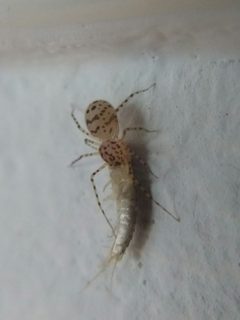
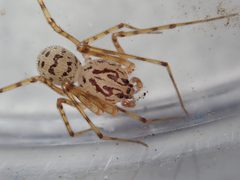
Small spider with long, slender legs that create an impression of larger size. slopes upward toward the rear, while slopes downward, creating a distinctive profile. Coloration typically beige or pale with dark markings on the , though usually not in a violin or fiddle shape. Six arranged in three pairs (triad pattern). Body length 3–6 mm; with legs, individuals may appear 6–8 mm or larger.
Habitat
Naturally occurs in Mediterranean including grassland and savanna biomes. frequent human dwellings, particularly houses, where individuals wander at night. In natural settings, found under stones and in dark places on soil surface. In South Africa, recorded at elevations from 68 to 1444 m above sea level.
Distribution
Native to Mediterranean region. distribution achieved through anthropogenic introduction: found in Europe (rarely north of southern England in UK), North Africa, Turkey, Iran, temperate Asia to China, Korea, and Japan. Introduced to North America, Argentina, South Africa (Gauteng, KwaZulu-Natal, Limpopo), India, Australia, New Zealand, and Atlantic islands (São Miguel, Terceira). Northernmost natural in Eastern Europe occur in the Middle Volga Region (Samara Oblast).
Diet
Active of insects and other spiders. Prey is immobilized by venomous sticky silk rather than direct attack.
Life Cycle
Females carry beneath the body in a loose net of silk rather than constructing an elaborate egg sac. Clutch size averages 20–40 eggs. Nursery web constructed for emerged spiderlings.
Behavior
Slow, deliberate hunter that stalks prey cautiously. From approximately 10 mm distance, measures range with a front leg, then contracts the body and ejects two silk threads in 1/600 second in a zigzag pattern. Multiple discharges used for larger prey. Assumed to use long sensory hairs on legs to locate prey. Primarily . Long-legged construct tangled, sheet-like webs similar to Pholcidae; short-legged populations are wandering hunters that do not spin webs. Individuals may be tolerant of conspecifics, with communal living reported.
Ecological Role
of insects and other spiders. Serves as prey for larger arthropods and small vertebrates.
Human Relevance
Frequently encountered in houses; generally considered harmless to humans despite venomous silk production. Listed as Least Concern by South African National Biodiversity Institute. Protected in Blouberg Nature Reserve, South Africa.
Similar Taxa
- Sicariidae (brown recluse spiders and relatives)Also possess six in three pairs and are haplogyne spiders. Distinguished by violin-shaped cephalothoracic marking, flatter body profile, and medically significant venom to humans.
- Pholcidae (cellar spiders)Long-legged resemble cellar spiders in general habitus and web structure. Distinguished by number (six vs. eight) and shape.
- Short-legged Scytodes species with reduced leg length found in leaf litter and under rocks; strictly wandering hunters without web construction.
More Details
Venom and silk apparatus
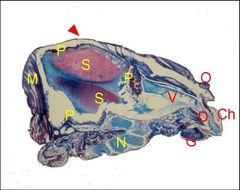
Unique among spiders in possessing silk glands in the connected to venom glands, producing venomous sticky silk. Venom glands divided into two lobes: lobe contains paralytic venom, lobe contains glue-like substance. Ejected silk solidifies into elastic threads that contract up to 50%, enhancing prey binding.
Dispersal mechanism
Wide distribution attributed primarily to anthropogenic factors; is outside native Mediterranean range.
Sources and further reading
- BugGuide
- Wikipedia
- GBIF taxonomy match
- iNaturalist taxon
- NCBI Taxonomy
- Catalogue of Life
- A Buggy New Year! | Bug Squad
- Bug Eric: Spider Sunday: Spitting Spiders
- Bug Eric: Fungus Party-y-y!
- Tyrant ground beetles | Beetles In The Bush
- Cosmopolitan Distribution of the Spitting Spider Scytodes thoracica Latreille, 1802 (Aranei, Scytodidae) and Its New Findings in the Northern Parts of the Range
- Cosmopolitan Distribution of the Spitting Spider Scytodes thoracica Latreille, 1802 (Aranei, Scytodidae) and its New Findings of this Species in the Northern Parts of the Range