
Scytodes globula
Nicolet, 1849
Chilean tiger spider, araña tigre, long-legged spider, spitting spider
Scytodes globula is a predatory spitting spider ( Scytodidae) native to South America. It is notable for its distinctive hunting method: projecting an extremely sticky substance from enlarged venom glands to immobilize prey. The has gained recognition as a documented of the medically significant Chilean recluse spider (Loxosceles laeta), though experimental evidence indicates success varies with prey . It is primarily and commonly associated with human dwellings.
Pronunciation
How to pronounce Scytodes globula: /ˈsaɪtoʊˌdiːz ˈɡloʊbjʊlə/
These audio files are automatically generated. While they are not always 100% accurate, they are a good starting point.
Identification
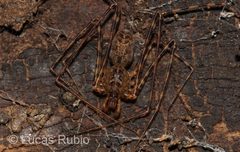
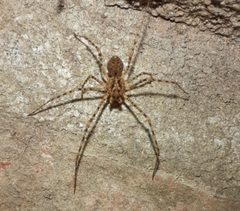
The domed, convex is diagnostic for Scytodidae and distinguishes S. globula from superficially similar spiders such as cellar spiders (Pholcidae) and brown spiders (Loxosceles). The six in three dyads separate it from most other spider . Long legs relative to small body size and slow, deliberate movements are additional field characteristics. Unlike Loxosceles, it lacks a violin-shaped marking on the cephalothorax.
Images
Appearance
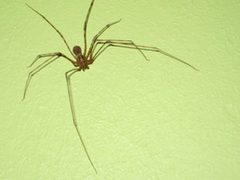
measure 30–70 mm in total span, with legs disproportionately long—typically 3–4 times the length of the body. The body itself is relatively small. The is distinctly convex and domed, accommodating enlarged venom glands. Coloration is generally uniform beige to pale brown. The spider possesses only six (rather than the typical eight), arranged in three pairs.
Habitat
Occurs both indoors and outdoors. Inside human dwellings, it occupies dark, hidden locations such as behind picture frames, in closets, and in corners. Outdoors, it has been observed under Eucalyptus trees. Shows preference for warm environments with moderate to high humidity.
Distribution
Native to South America. Documented in Chile, Argentina, Uruguay, Bolivia, and Brazil. Most common and well-studied in Chile, where it frequently co-occurs with Loxosceles laeta in domestic environments.
Seasonality
hunter; activity restricted to night hours. Seasonal patterns not well documented, but year-round presence in domestic environments suggests continuous activity.
Diet
of insects and other arthropods. Documented prey includes flies, mosquitoes, bees, horse-flies, and other insects. Exhibits araneophagy (spider-eating), with verified on Loxosceles laeta and Metaltella simoni. Prey capture relies on projection of sticky venom/glue substance rather than web-building.
Host Associations
- Loxosceles laeta - preyDocumented -prey interaction; S. globula has been observed killing L. laeta in controlled experiments, though success rate varies
- Metaltella simoni - preyAraneophagic documented in experimental trials; S. globula invades webs and preys on spider
Life Cycle
Females produce clutches of 20–40 eggs. Eggs are wrapped loosely in a thin sheet of silk and carried beneath the body. Web-building is minimal and restricted to retreat construction; no elaborate prey-capture web is produced.
Behavior
Hunts exclusively at night with slow, stealthy movements. Approaches prey to within a few centimeters, then contracts the to project a rapid burst of sticky venom (attack duration approximately 30 milliseconds). The substance solidifies into elastic threads that contract up to 50%, binding prey to the substrate. Uses both offensive spitting to capture prey and defensive spitting to deter counter-attacks from other spiders. Shows for conspecifics and may live communally in some cases.
Ecological Role
Intraguild that mediates predator-predator interactions. Functions as a agent of medically significant spiders, particularly Loxosceles laeta, though its effectiveness depends on behavioral factors of prey.
Human Relevance
Considered harmless to humans; multiple Chilean university studies have declared it "innocuous to human beings." No clinical records of bites exist. Valued in domestic settings for its potential to control of dangerous recluse spiders. Sometimes mistaken for brown spiders (Loxosceles) due to similar preference and arrangement, leading to unnecessary concern.
Similar Taxa
- Scytodes thoracicaAlso a spitting spider with similar hunting method and body plan; distinguished by markings and smaller size (females 4–6 mm body length)
- Loxosceles laetaShares six in three dyads and similar preference; distinguished by flatter , violin-shaped marking, and absence of spitting
- Pholcus phalangioidesSimilar long-legged appearance and domestic ; distinguished by eight , different web architecture, and absence of spitting
More Details
Predation on Loxosceles laeta
The reputation of S. globula as the 'only natural ' of L. laeta derives from its frequent co-occurrence in human dwellings and documented events. However, a University of Chile study (25 experimental trials) showed predation in only 12 of 15 encounters where interaction occurred, and the authors noted that more research is needed to conclusively establish its effectiveness as a agent.
Venom apparatus
The venom glands are divided into two lobes: the lobe contains conventional venom for prey paralysis and digestion, while the lobe produces the sticky 'glue' substance used in hunting. This dual-function system is unique among spiders and requires the enlarged, domed .
Sources and further reading
- BugGuide
- Wikipedia
- GBIF taxonomy match
- iNaturalist taxon
- NCBI Taxonomy
- Catalogue of Life
- A Buggy New Year! | Bug Squad
- Grasshoppers of Colorado
- Bug Eric: Spider Sunday: Spitting Spiders
- 🌿 Botanizing w/ the Webster Groves Nature Study Society (WGNSS) Botany Group at Rockwoods Reservation – 3 Nov 2025 | Beetles In The Bush
- Pollen Bath | Beetles In The Bush
- New Genus of Treehopper Named After Selena, the Queen of Tejano Music
- Risky behaviors by the host could favor araneophagy of the spitting spider Scytodes globula on the hacklemesh weaver Metaltella simoni
- Behavioral analysis of the interaction between the spitting spider Scytodes globula (Araneae: Scytodidae) and the harvestman Discocyrtus invalidus (Opiliones: Gonyleptidae)
- Niche modelling of the C hilean recluse spider Loxosceles laeta and araneophagic spitting spider Scytodes globula and risk for loxoscelism in C hile