
Thanatus vulgaris
Simon, 1870
Cricket Thief Spider
Thanatus vulgaris is a running crab spider in the Philodromidae with a remarkably wide global distribution spanning native Palearctic ranges and introduced across multiple continents. The occupies diverse terrestrial from natural grasslands and shrublands to agricultural systems. It is known for ground-dwelling and has been observed engaging in ballooning . Two are recognized: T. v. vulgaris and T. v. creticus.

Pronunciation
How to pronounce Thanatus vulgaris: /θəˈneɪtəs vʊlˈɡɛrɪs/
These audio files are automatically generated. While they are not always 100% accurate, they are a good starting point.
Identification
Distinguished from the similar slender crab spider Tibellus (also Philodromidae) by more robust body build and different stripe pattern. Tibellus has elongated body form and vertical stripes for grass-stem camouflage, while Thanatus is stockier with different abdominal markings. Distinguished from ground crab spiders (Xysticus, Thomisidae) by -level characters including arrangement and leg spine patterns. Distinguished from wolf spiders (Lycosidae) and jumping spiders (Salticidae) by flattened body profile and laterigrade leg orientation typical of crab spiders.
Images
Appearance
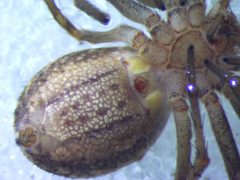
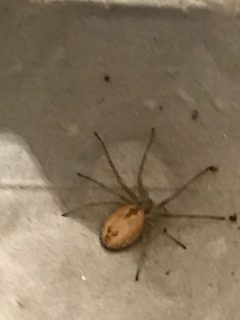
Running crab spider with robust body form compared to the more slender Tibellus. pattern includes stripes on the and a dark cardiac mark on the top. Body size similar to Tibellus (females approximately 6-11 mm, males slightly smaller). Legs adapted for running rather than web-building.
Habitat
Free-living ground and plant dweller in open terrestrial environments. Recorded from Fynbos, Grassland, Nama Karoo, Savanna, and Thicket biomes in South Africa. Occupies agro- including cotton, lucerne, maize, potato, and strawberry fields. Found from sea level to 1795 m elevation. Overwinters as or in leaf litter, grass tussock bases, or other ground debris.
Distribution
Native to Palearctic: Europe, North Africa, Turkey, Israel, Caucasus, Russia (European to Far East), Central Asia, China, Korea, Japan, Iran, Kazakhstan, Middle East. Introduced to North America, South Africa, Australia. In South Africa, documented from eight provinces and more than ten protected areas.
Seasonality
active in early spring (March observed in Colorado) with adults and immatures present during winter months. Eurychronous with extended development period allowing overwintering at multiple stages. Ballooning observed in autumn (November) for .
Life Cycle
Eurychronous development with extended maturation period permitting as or immatures. sac production timing not specifically documented for this . Spiderlings likely emerge from egg sacs in favorable weather conditions. Overwintering strategy involves physiological cold-hardiness including glycerol in to reduce freezing point.
Behavior
Ground-dwelling hunter, distinct from vegetation- relatives. Basks on warm surfaces including concrete paths. Engages in ballooning : climbs vertical objects (fence posts, mailboxes, utility boxes) and stands on tiptoe to catch wind for aerial dispersal. Tumbles readily when disturbed by wind. Does not construct capture webs; hunts actively or waits in ambush.
Ecological Role
in ground and low vegetation . Occupies disturbed and agricultural where it contributes to arthropod . Serves as prey for larger arthropods and vertebrates. Part of winter-active spider fauna in temperate regions, maintaining predator presence during cold seasons.
Human Relevance
Introduced in multiple regions with unknown ecological impacts. Present in agricultural systems but specific pest control benefits or crop damage not documented. Listed as Least Concern in South Africa due to wide range and protected area coverage. Subject of citizen science documentation through iNaturalist.
Similar Taxa
- Tibellus spp.Slender crab spiders in same (Philodromidae) with similar striped pattern but more elongated body, vertical stripes, and vegetation-dwelling habit versus robust ground-dwelling form of Thanatus
- Xysticus spp.Ground crab spiders (Thomisidae) share ground-dwelling habit and dark markings but differ in characters including arrangement and leg structure
- Oxyopes salticusStriped Lynx Spider shares striped appearance but has very long leg spines, scrunched ambush posture, and longer '' ( profile)
- Pisaurina miraNursery web spider juveniles share and resting posture but are more robust, hairier, with different arrangement, and grow much larger as
More Details
Subspecies
Two recognized: Thanatus vulgaris vulgaris Simon, 1870 and Thanatus vulgaris creticus Kulczynski, 1903
Cold hardiness
As temperate-region spider in exposed conditions, possesses physiological adaptations including glycerol in reducing freezing point by approximately 1°C, with additional proteins providing protection to -20°C
Conservation status
Listed as Least Concern by South African National Biodiversity Institute; protected in Blouberg Nature Reserve and Amanzi Nature Reserve among others
Sources and further reading
- BugGuide
- Wikipedia
- GBIF taxonomy match
- iNaturalist taxon
- NCBI Taxonomy
- Catalogue of Life
- Grasshoppers of Colorado
- Grasshoppers of Colorado
- Bug Eric: Spider Sunday: Slender Crab Spiders (and their look-a-likes)
- Bug Eric: ArachNovember?
- Bug Eric: Spider Sunday: Spring Spiders
- Bug Eric: Wasp Wednesday: Western Yellowjacket