
Tibellus oblongus
(Walckenaer, 1802)
oblong running spider, slender crab spider
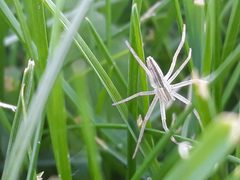
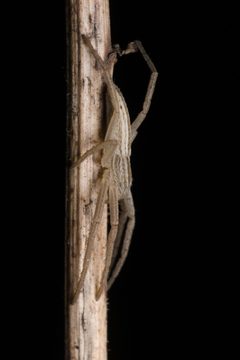
Tibellus oblongus is a Holarctic spider in the Philodromidae. It is an active hunter that does not construct webs, instead pursuing and ambushing small insect prey. The exhibits distinctive elongated body with longitudinal striping that provides camouflage in grassy vegetation. females measure 6–11 mm in body length, with males slightly smaller at 5–8 mm. Females construct flattened sacs and guard them until spiderlings emerge.

Pronunciation
How to pronounce Tibellus oblongus: /tɪˈbɛl.lus əbˈlɔŋ.ɡus/
These audio files are automatically generated. While they are not always 100% accurate, they are a good starting point.
Identification
Distinguished from similar slender, striped spiders by combination of: extremely elongated, flattened body form; longitudinal striping pattern; on stems, grassblades, and leaves rather than ground. Differs from nursery web spiders (Pisaurina) by more gracile build, less hairy appearance, and different arrangement. Separated from Thanatus (also Philodromidae) by more slender build and different stripe pattern; Thanatus is more robust and ground-dwelling. Distinguished from Oxyopes salticus (striped lynx spider) by lack of prominent leg spines, more flattened profile, and less 'scrunched' resting posture.
Images
Appearance
Elongated, slender body with longitudinal pale and dark stripes running the length of the and . Body length 5–11 mm (males 5–8 mm, females 6–11 mm). Legs long and slender, held laterally in crab-like posture typical of Philodromidae. somewhat flattened. Overall coloration and striping adapted for camouflage against grasses and stems.
Habitat
Grassy including meadows, fields, and areas with tall grasses and herbaceous vegetation. Found on stems, stalks, grassblades, and leaves rather than on the ground surface.
Distribution
Holarctic distribution: North America, Europe, North Africa, Turkey, Israel, Caucasus, Russia (European part to Far East), Kazakhstan, Iran, Central Asia, Mongolia, China, Korea, and Japan.
Diet
Small insects, captured through active without web use.
Life Cycle
Females construct flattened sacs attached to vegetation, which they guard continuously until spiderlings emerge and disperse.
Behavior
Active hunter that does not spin webs; lies in ambush on grasses or foliage, relying on camouflage. Pursues prey actively when detected. Females exhibit maternal guarding of sacs, remaining motionless even when disturbed.
Ecological Role
of small insects in grassy ; prey for larger spiders including wolf spiders (Lycosidae).
Human Relevance
Subject of venom research; venom contains novel insectotoxins (Tbo-IT2) with potential applications in understanding structure and insecticidal compounds. Not medically significant to humans.
Similar Taxa
- Pisaurina miraSimilar and resting posture, but more robust, hairier, with different arrangement and larger size (12.5–16.5 mm females).
- Thanatus spp.Same (Philodromidae) with similar size and striping, but more robust build, different stripe pattern, and ground-dwelling habit versus vegetation-dwelling in Tibellus.
- Oxyopes salticusSimilar striped appearance and ambush posture on vegetation, but has very long leg spines, more scrunched posture, longer '' ( profile), and different (Oxyopidae).
More Details
Venom composition
Venom contains at least 217 novel polypeptide toxins, including Tbo-IT2, a 42-residue insectotoxin with an unusual 5-disulfide inhibitor cystine knot fold. This toxin shows insecticidal activity against housefly larvae (Musca domestica, LD100 200 μg/g) but no activity on tested neuronal receptors or ion channels.
Sources and further reading
- BugGuide
- Wikipedia
- GBIF taxonomy match
- iNaturalist taxon
- NCBI Taxonomy
- Catalogue of Life
- Bug Eric: Spider Sunday: Slender Crab Spiders (and their look-a-likes)
- Bug Eric: A Nursery Web Spider, Pisaurina dubia
- New Insectotoxin from Tibellus Oblongus Spider Venom Presents Novel Adaptation of ICK Fold
- Venom-gland transcriptomics and venom proteomics of the Tibellus oblongus spider.