
Thanatus formicinus
(Clerck, 1757)
Running Crab Spider, Ant-mimic Crab Spider
Thanatus formicinus is a running crab spider in the Philodromidae with a Holarctic distribution spanning North America, Europe, and Asia. It is a ground-dwelling hunter active during spring and early summer, often observed basking on warm surfaces like concrete paths. The exhibits -mimicry in both appearance and , a distinctive trait among crab spiders.
Pronunciation
How to pronounce Thanatus formicinus: //ˈθænətəs fɔːrˈmɪsɪnəs//
These audio files are automatically generated. While they are not always 100% accurate, they are a good starting point.
Identification
Distinguished from similar slender crab spiders (Tibellus) by more robust body build and different stripe pattern; Tibellus has more elongated, slender form and vertical striping for grass-stem camouflage. Differs from ground crab spiders (Xysticus) by more active running and less compact body. Separated from wolf spiders (Schizocosa, Pardosa) with similar striping by lateral leg posture and arrangement.
Images
Appearance
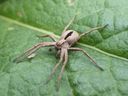
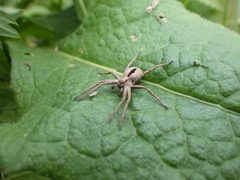
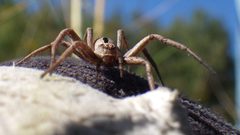
Medium-sized running crab spider with a somewhat flattened, elongated body. and bear longitudinal stripes, with a dark 'cardiac' mark on the surface of the abdomen. Legs are long and laterally extended, typical of crab spiders, with the first two pairs longer than the rear pairs. Coloration provides effective camouflage among grasses and debris.
Habitat
Ground-dwelling amid grasses, weeds, and low vegetation; frequently found on warm surfaces such as concrete paths, sidewalks, and asphalt where it basks to elevate body temperature. Occurs in open, disturbed including trails, vacant lots, and suburban areas.
Distribution
Holarctic: North America, Europe, North Africa, Turkey, Caucasus, Russia (European Russia to Far East including Kamchatka), Iraq, Iran, Kazakhstan, Central Asia, China, and Japan.
Seasonality
Active primarily in spring and early summer; overwinter and emerge with warming temperatures. Observed from March through June in temperate regions, with peak activity in April and May.
Behavior
hunter that actively runs down prey rather than waiting in ambush. Frequently observed basking on sun-warmed surfaces early in the season when ambient temperatures remain cool. overwinter in sheltered locations such as leaf litter or grass tussocks. May engage in ballooning in fall, climbing vertical objects to catch wind currents. Exhibits -mimicry in movement and posture.
Ecological Role
of small insects and other arthropods; serves as prey for spider wasps including Priocnemis minorata.
Human Relevance
Occasionally encountered by pedestrians on trails and sidewalks; harmless to humans. Subject of citizen science observation and photographic documentation.
Similar Taxa
- Tibellus spp.Both in Philodromidae with striped patterns, but Tibellus is more slender with vertical stripes, hunts on vegetation stems and leaves rather than ground
- Xysticus spp.Ground-dwelling crab spiders, but Xysticus is more compact, typically ambush-hunts from flowers or ground cover, and has different body proportions
- Schizocosa spp.Wolf spiders with similar striped pattern and ground , but have different arrangement (two large eyes) and do not hold legs in lateral crab-like posture