
Hypochilus pococki
Platnick, 1987
Pocock's lampshade-web spider
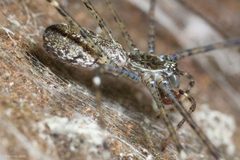
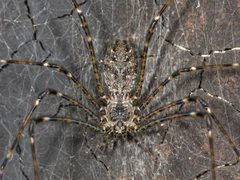
Hypochilus pococki is a relictual lampshade spider to the southern Appalachian Mountains. It belongs to a paleoendemic distributed disjunctly across three montane regions in North America. The exhibits extreme genetic divergence over small geographic distances, with five identified mitochondrial haplogroups, yet shows striking morphological stasis in male reproductive structures. As a microhabitat , it has extremely low ability, leading to pronounced genetic structuring.
Pronunciation
How to pronounce Hypochilus pococki: /haɪpoʊˈkaɪləs pəˈkɒkaɪ/
These audio files are automatically generated. While they are not always 100% accurate, they are a good starting point.
Identification
Distinguished from other Appalachian Hypochilus by male , though this shows notable stasis across genetically divergent . Distinguished from H. thorelli and H. coylei (which are sister ) by genetic and geographic criteria. The lampshade-shaped web architecture is characteristic of the Hypochilidae. Specific diagnostic morphological features for separating H. pococki from other Appalachian species are not provided in available sources.
Images
Habitat
Shaded, mesic rock outcrop in montane regions. Strict microhabitat with limited for environmental variation.
Distribution
Southern Appalachian Mountains, United States. are highly genetically structured with five mitochondrial haplogroups distributed over small geographic distances, indicating extremely localized population structure.
Behavior
Microhabitat with strict preferences. Extremely low vagility ( ability) leading to pronounced genetic structuring among . Web architecture consists of the characteristic lampshade-shaped webs typical of the .
Similar Taxa
- Hypochilus thorelliSister in Appalachia; distinguished by phylogenetic placement and geographic distribution, though morphologically similar
- Hypochilus coyleiSister to H. thorelli; forms a distinct lineage from H. pococki within the Appalachian clade
- Hypochilus petrunkevitchiCalifornia clade ; distribution in southern Sierra Nevada versus Appalachian distribution of H. pococki
Sources and further reading
- BugGuide
- Wikipedia
- GBIF taxonomy match
- iNaturalist taxon
- NCBI Taxonomy
- Catalogue of Life
- Meet Awesome Annie, the Scorpion, at UC Davis Biodiversity Museum Day | Bug Squad
- Phylogenomics of paleoendemic lampshade spiders (Araneae, Hypochilidae, Hypochilus), with the description of a new species from montane California