
Hypochilus thorelli
Marx, 1888
Thorell's Lampshade-web Spider, lampshade spider
Hypochilus thorelli is a relictual spider notable for possessing four book lungs—a trait shared with mesothele and mygalomorph spiders but unique among araneomorphs. The species constructs distinctive lampshade-shaped webs on the undersides of overhangs in humid Appalachian forests. First described by George Marx in 1888, it serves as the type species for both its and . Its combination of primitive respiratory anatomy with derived silk-producing structures makes it significant for spider .
Pronunciation
How to pronounce Hypochilus thorelli: /haɪpəˈkaɪləs θɔːˈrɛli/
These audio files are automatically generated. While they are not always 100% accurate, they are a good starting point.
Identification
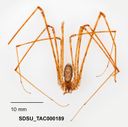
Distinguished from all other eastern North American spiders by the combination of: (1) four book lungs visible through (vs. two in all other araneomorphs), (2) presence of cribellum and calamistrum, (3) lampshade-shaped web architecture, and (4) restriction to moist, shaded rock overhangs in Appalachian stream gorges. The unique arrangement (2-3-3-2 pattern) and exceptionally long first legs further support identification. No other Hypochilus occurs in this geographic range.
Images
Habitat
Restricted to stream gorges in humid deciduous forests at elevations of 600–1100 m. Requires high humidity, shade, and suitable overhanging or vertical rock surfaces for web construction. Microhabitat specificity is extreme; absent from seemingly suitable nearby lacking appropriate overhang geometry.
Distribution
to the southern Appalachian Mountains: North Carolina, Tennessee, with marginal records in adjacent Kentucky, Alabama, Georgia, and South Carolina. Core range coincides with high-elevation gorge systems of the Blue Ridge and Cumberland Plateau.
Diet
Prey composition includes roughly equal proportions of flying insects (e.g., crane flies) and crawling arthropods (e.g., harvestmen, ants). Prey captured in cribellate silk are killed by direct biting without prior wrapping.
Behavior
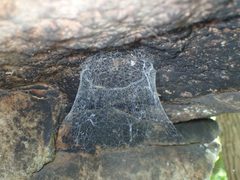
Constructs characteristic lampshade-shaped webs: a circular silk mat forms the top, with cylindrical sides widening downward and open at the bottom. Web anchored taut by basal threads. Spider rests at web apex with legs outstretched to contact cylinder edges. Prey handling involves immediate biting without silk wrapping.
Ecological Role
in shaded, moist microhabitats of Appalachian forest . Specialized web architecture targets both aerial and ground-dwelling prey in a unique spatial . As a phylogenetic relict, represents an evolutionary intermediate in spider respiratory and silk systems.
Human Relevance
Subject of phylogenetic research due to its mosaic of primitive and derived traits. No documented medical, agricultural, or nuisance significance. Vulnerable to alteration affecting humidity and rock overhang availability.
Similar Taxa
- Other Hypochilidae (Hypochilus pococki, H. kundurai)Western North American and Mexican with similar and web architecture; distinguished by distribution
- Cribellate araneomorphs (e.g., Filistatidae, Dictynidae)Share cribellum/calamistrum but possess only two book lungs and different web types
- Mygalomorph spidersShare four book lungs but lack cribellum, have different arrangements, and construct burrows or sheet webs rather than aerial lampshade webs
More Details
Evolutionary significance
H. thorelli exhibits a unique character combination: four book lungs (plesiomorphic, shared with Mesothelae and Mygalomorphae) plus cribellum/calamistrum (apomorphic, shared with some Araneomorphae). This mosaic led Marx to erect the Hypochilidae, now recognized as the sister group to all other araneomorph spiders.
Conservation considerations
Extreme microhabitat specificity and restricted geographic range may confer vulnerability to climate change, stream alteration, and forest disturbance affecting humidity regimes.