
Clubiona abboti
L. Koch, 1866
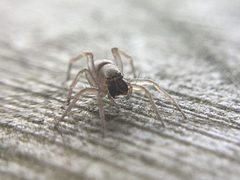
Clubiona abboti is a of sac spider in the Clubionidae, found in the United States and Canada. It is a hunter that does not construct webs to capture prey. The species was described by L. Koch in 1866 and includes two recognized : C. a. abboti and C. a. abbotoides.

Pronunciation
How to pronounce Clubiona abboti: /kluˈbaɪoʊnə ˈæbətaɪ/
These audio files are automatically generated. While they are not always 100% accurate, they are a good starting point.
Identification
Distinguished from the similar Cheiracanthium (longlegged sac spiders) by the presence of a distinct groove in the center of the and a tuft of curved setae on the front edge of the . Cheiracanthium lacks both of these characters.
Images
Habitat
Found in forested and natural outdoor settings. Less commonly encountered indoors compared to some other sac spider .
Distribution
North America: United States and Canada. Canadian records include Alberta, Manitoba, and Ontario.
Behavior
hunter that does not construct silken snares. Builds silken retreats ('sleeping bags') for resting during daylight hours, typically positioned at wall-ceiling junctions or in similar sheltered locations. Retreats are not reused; spiders construct new retreats after each night of hunting.
Ecological Role
of small insects. Serves as prey for spider wasps including Priocnemis minorata.
Similar Taxa
- CheiracanthiumCheiracanthium (longlegged sac spiders) are frequently confused with Clubiona due to similar body form and . Clubiona can be distinguished by the groove and abdominal setae tuft that Cheiracanthium lacks.