
Glomeroides primus
(Silvestri, 1929)
California Pill Millipede
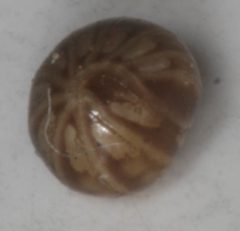
Glomeroides primus is a pill in the Protoglomeridae, native to western North America. It is one of the few pill millipede species found in the Nearctic region, where it occupies a restricted range centered on California. The species was originally described by Silvestri in 1929 under the basionym Apiomeris prima. Like other members of Glomerida, it has the ability to conglobate (roll into a complete ball) as a defensive . The Glomeroides represents an ancient lineage within the Oniscomorpha, the clade containing all pill millipedes.
Pronunciation
How to pronounce Glomeroides primus: /ɡloʊˌmɛroʊˈaɪdiːz ˈpraɪməs/
These audio files are automatically generated. While they are not always 100% accurate, they are a good starting point.
Identification
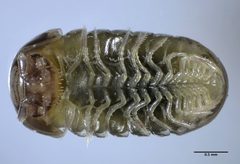
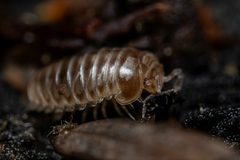
Glomeroides primus can be distinguished from the European Glomeris marginata and other Palearctic glomeridans by its Nearctic distribution. Within its range, it may be confused with the introduced Glomeris marginata, which has established in North America. Glomeroides primus is generally smaller than G. marginata, with typically reaching 8-12 mm in length versus 15-20 mm for G. marginata. The tergites of G. primus lack the distinct longitudinal keels present in many Glomeris . The species has 17-19 body segments (counting the collum) in adults, typical for the . When rolled, the conglobated ball is relatively compact with the anal shield fitting flush against the collum.
Images
Habitat
Found in Mediterranean-type climates of coastal and foothill regions, occupying oak woodland, chaparral, and mixed evergreen forest . Occurs in moist microhabitats under decaying logs, rocks, and leaf litter. Shows preference for areas with calcareous soils, which provide necessary calcium for development. Elevation range extends from near sea level to approximately 1,500 meters.
Distribution
to western North America with core range in California, USA. Documented from coastal counties from Sonoma southward through the San Francisco Bay Area to Monterey and San Luis Obispo counties, with scattered records from the Sierra Nevada foothills. The has also been recorded from extreme southwestern Oregon. Distribution appears limited by both moisture requirements and suitable soil chemistry.
Seasonality
Active primarily during the wet season from late autumn through spring. Surface activity ceases during summer drought conditions, when individuals burrow deeper into soil or occupy moist refugia. Reproductive activity peaks in spring following winter rains. Juveniles are most commonly observed in late spring and early summer.
Life Cycle
Development includes anamorphic post-embryonic growth, with individuals adding segments and legs through successive until reaching the stage with the characteristic pill body plan. The final number of segments (17-19) is achieved after approximately 7-9 instars. Sexual maturity is reached after 2-3 years. Lifespan in the wild is estimated at 3-5 years, though precise data are lacking. Females deposit in soil cavities, with clutch sizes of 20-50 eggs. Parental care has not been documented.
Behavior
Exhibits conglobation (voluntary rolling into a complete ball) as the primary defense against . This is triggered by tactile disturbance and involves coordinated contraction of muscles to draw the body into a sphere with the hard tergites forming the outer surface. When conglobated, the is protected by the interlocking margins of the enlarged second tergite and the anal shield. The is primarily , with peak surface activity during humid nights. During dry periods, individuals remain in soil or under cover objects. Movement is slow and deliberate, with the conglobated ball able to roll short distances if disturbed on slopes.
Ecological Role
Functions as a in forest and woodland , contributing to decomposition of leaf litter and woody debris. Through feeding activity, fragments organic matter and accelerates nutrient cycling. Serves as prey for various vertebrate and including birds, small mammals, , and ground beetles. The conglobation defense represents an evolutionary convergence with the unrelated pill bugs (Crustacea: Isopoda), providing a case study in defensive .
Human Relevance
Occasionally encountered by hikers and naturalists in California oak woodlands. Not considered a pest . Has been used in educational contexts to demonstrate with isopod pill bugs. The restricted range makes the species potentially vulnerable to loss from urbanization and climate change in the California Floristic Province.
Similar Taxa
- Glomeris marginataThe European pill has been introduced to North America and may occur sympatrically with G. primus in some areas. G. marginata is larger (15-20 mm), has distinct longitudinal keels on tergites, and shows subtle differences in conglobation mechanics.
- Glomeris connexaAnother introduced European with scattered North American records. Differs in tergite sculpturing and body proportions.
- OnomerisA related of Nearctic pill millipedes found in eastern North America. in this genus have different segment counts and tergite proportions.
More Details
Taxonomic History
The was originally described by Filippo Silvestri in 1929 as Apiomeris prima. The Glomeroides was erected to accommodate this and related Nearctic species, distinguishing them from the primarily Palearctic Glomeris. The placement has varied between Protoglomeridae and Glomeridae in different classifications; current treatments favor Protoglomeridae based on morphological and molecular evidence.
Conservation Status
Not formally assessed by IUCN. The restricted range in a region experiencing significant modification suggests potential conservation concern, though the appears locally common in suitable habitat patches. Climate change projections for Mediterranean California indicate potential range contraction due to increased drought frequency and severity.