
Protoglomeridae
Brölemann, 1913
Genus Guides
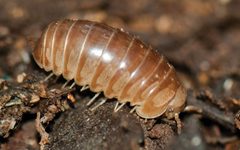
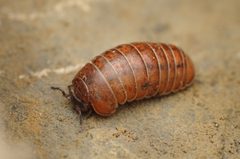
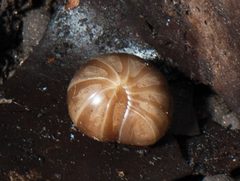
1Protoglomeridae is a of millipedes in the order Glomerida, characterized by their ability to roll into a complete ball (conglobation). First described by Brölemann in 1913, this family represents an early-diverging lineage within the Oniscomorpha, the pill clade. Members are distinguished from the more diverse Glomeridae by subtle morphological features of the and . The family is relatively -poor and primarily distributed in the Mediterranean region and parts of Asia.
Pronunciation
How to pronounce Protoglomeridae: //ˌproʊtoʊˌɡlɒməˈrɪdiː//
These audio files are automatically generated. While they are not always 100% accurate, they are a good starting point.
Identification
Distinguished from Glomeridae by the structure of the , particularly the arrangement of ocelli and the shape of the gnathochilarium. The (terminal body segment) lacks the characteristic projection found in many Glomeridae. Antennal segments are relatively short compared to body size. The collum (first tergite behind the head) is broad and contributes to the conglobation mechanism.
Images
Habitat
Found in moist, shaded microhabitats including leaf litter, soil crevices, and under stones and decaying wood. Prefers calcareous substrates in Mediterranean climates. Most abundant in undisturbed forest floor environments with high humidity and stable temperatures.
Distribution
Mediterranean basin, including southern Europe, North Africa, and the Middle East; extends eastward into parts of Central Asia and the Caucasus region.
Seasonality
Activity peaks during spring and autumn when soil moisture is adequate; less surface-active during summer drought and winter cold periods.
Behavior
Conglobation (complete rolling into a ball) is the primary defense mechanism. This is triggered by mechanical disturbance and involves tight coiling of the body with the and meeting at the center.
Ecological Role
Contributes to litter decomposition and soil nutrient cycling through feeding on decaying plant material. Serves as prey for small vertebrates and in forest floor .
Similar Taxa
- GlomeridaeLarger and more diverse of pill millipedes; distinguished by structure, , and typically larger body size
- Sphaerotheriida (giant pill millipedes)Superficially similar conglobation but belong to a separate order; distinguished by much larger size, tropical distribution, and different leg arrangement
More Details
Taxonomic history
Protoglomeridae was established by Brölemann to accommodate previously placed in Glomeridae that showed primitive characteristics. The has undergone repeated revision, with some authors questioning its validity as a distinct lineage. Recent molecular studies support its monophyly and basal position within Oniscomorpha.
Conservation status
No comprehensive assessment exists; many have restricted ranges and are vulnerable to loss from deforestation and urbanization in the Mediterranean region.