
Hercinothrips femoralis
(Reuter, 1891)
Banded Greenhouse Thrips
Hercinothrips femoralis is a pantropical thrips and significant agricultural pest known as the banded greenhouse thrips. It infests a wide range of crops including bananas, cotton, pineapple, sugar beet, sugar cane, and ornamentals, causing characteristic silver streaking and discoloration of leaf tissue through its piercing-sucking feeding. The species exhibits remarkable phenotypic plasticity with a "phenotype explosion" phenomenon—multiple color morphs and forms that facilitate successful of new regions. Under laboratory conditions at 25°C, it completes development from to in approximately 21 days with high (averaging 133 offspring per female), enabling rapid growth in greenhouses.
Pronunciation
How to pronounce Hercinothrips femoralis: //hɛrˌsɪnoʊˌθrɪps ˌfɛmɔˈrælɪs//
These audio files are automatically generated. While they are not always 100% accurate, they are a good starting point.
Identification
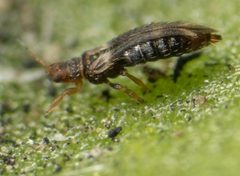
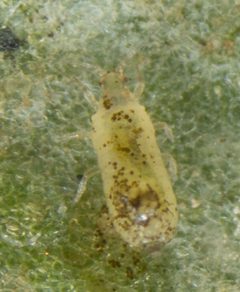
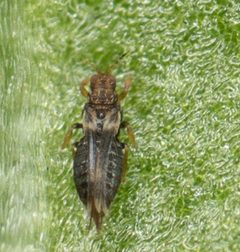
Distinguished from other thrips by the combination of dark brown coloration, pantropical distribution, and greenhouse association. The banded greenhouse thrips can be separated from western flower thrips (Frankliniella occidentalis) and onion thrips (Thrips tabaci) by its darker coloration and preference. signs include silvery streaks on leaves, discolored patches of morbid tissue, and conspicuous black fecal deposits. Examination with a 20x hand lens reveals adults and larvae feeding on leaf tissue, often with larvae bearing fecal droplets on their end.
Images
Appearance
are dark brown in color with distinctive fringed wings bearing long hairs (the source of the order name Thysanoptera, meaning "feather wing"). Larvae are translucent, yellow to whitish, and wingless. Both stages are minute; adults typically 1-2 mm in length. A key identifying feature is the dark brown to black fecal deposits left on leaf surfaces.
Habitat
Primarily greenhouse environments in temperate regions; occurs outdoors in pantropical climates. Thrives in warm, dry conditions typical of protected . Laboratory studies indicate optimal conditions around 25°C with 65% relative humidity.
Distribution
Pantropical origin with worldwide distribution in greenhouses. Documented in Africa (Canary Islands, Nigeria, Sierra Leone, Tanzania), Asia (Japan, Korea, Turkey), Australasia (Australia, Hawaii, New Zealand), Europe (Romania, Spain, former Yugoslavia), North America (USA, including Massachusetts), South America (Argentina, Brazil), and West Indies.
Diet
Phytophagous; feeds on plant contents obtained through . Documented feeding damage on bean, pepper, cucumber, and banana fruits, as well as cotton, pineapple, sugar beet, sugar cane, and ornamental plants including lilies (Crinum powellii album).
Host Associations
- Crinum powellii album - feeds onWhite swamp lily; causes yellowing, browning, and silver streaking of foliage
- Musa spp. - feeds onBanana
- Capsicum spp. - feeds onPepper
- Cucumis sativus - feeds onCucumber
- Phaseolus spp. - feeds onBean; used as laboratory rearing
- Gossypium spp. - feeds onCotton
- Ananas comosus - feeds onPineapple
- Beta vulgaris - feeds onSugar beet
- Saccharum officinarum - feeds onSugar cane
Life Cycle
Complete development from to averages 20.82 days at 25°C: egg stage 9.0 days, first instar larva 2.85 days, second instar larva 4.0 days, 1.41 days, pupa 3.56 days. Adult longevity averages 74.88 days. Females produce a mean of 132.62 offspring. Multiple occur annually in greenhouse environments, with continuous possible year-round under favorable conditions.
Behavior
Exhibits "phenotype explosion"—remarkable intraspecific phenotypic plasticity producing multiple color morphs and forms during initial phases of , followed by phenotypic specialization in subsequent . This plasticity is proposed as a key factor enabling successful introduction and establishment in novel environments. and larvae aggregate on leaf undersides and along . Larvae cannot fly; adults disperse by . Females embed in leaf tissue, making them to dislodgement by water sprays.
Ecological Role
Significant agricultural pest causing economic damage to fruits, vegetables, ornamentals, and industrial crops. Feeding damage reduces photosynthetic capacity and aesthetic value of ornamental plants. Serves as prey for predatory mites, minute pirate bugs (Orius spp.), and in programs.
Human Relevance
Major greenhouse pest requiring . Chemical control with spinosad (100% mortality in laboratory ) and abamectin (94% mortality) is effective. using predatory mites, minute pirate bugs, or (Steinernema and Heterorhabditis spp.) is employed in commercial greenhouses. Heavy may require plant removal and replacement.
Similar Taxa
- Frankliniella occidentalisWestern flower thrips; lighter yellow to brown coloration, more , plant viruses which H. femoralis does not
- Thrips tabaciOnion thrips; smaller, yellowish, primarily attacks Allium crops and tobacco
- Heliothrips haemorrhoidalisGreenhouse thrips; similar but black coloration differs from dark brown H. femoralis
More Details
Phenotypic plasticity
The demonstrates extraordinary morphological variability during of new environments, with "phenotype explosion" in body length and other traits in early , followed by specialization in later generations under stable conditions.
Taxonomic note
Originally described as Heliothrips femoralis Reuter, 1891; transferred to Hercinothrips. The genus name has been misspelled as Hercinothrips in some literature.
Organic production
Spinosad, derived from Saccharopolyspora spinosa, is approved for use in certified organic vegetable production against this pest.
Sources and further reading
- BugGuide
- GBIF taxonomy match
- iNaturalist taxon
- NCBI Taxonomy
- Catalogue of Life
- Archive — Bug of the Week
- From the mailbag – white lilies feeling the blues: Could it be the banded greenhouse thrips, Hercinothrips femoralis? — Bug of the Week
- Cimbicidae | Beetles In The Bush
- I Brake for Dung Beetles! | Beetles In The Bush
- behavior | Beetles In The Bush | Page 6
- Hercinothrips femoralis . [Distribution map].
- Life table parameters and susceptibility levels of Hercinothrips femoralis (Reuter, 1891) (Thysanoptera: Thripidae) to spinosad and abamectin
- Phenotype “Explosion” in Hercinothrips femoralis (O. M. Reuter 1891) (Thysanoptera: Thripidae): A Particular Phenomenon for Successful Introduction of Economic Species