
Heliothrips haemorrhoidalis
(Bouché, 1833)
greenhouse thrips, glasshouse thrip, black tea thrips
Heliothrips haemorrhoidalis, commonly known as the greenhouse , is a pest in the Thripidae. It is parthenogenetic with rare males, and reproduces rapidly in favorable conditions. The species is a significant agricultural pest of greenhouse crops, ornamentals, and fruit trees worldwide, particularly in tropical and subtropical regions. It has been introduced globally and is subject to efforts using such as Thripobius semiluteus and Thripobius javae.
Pronunciation
How to pronounce Heliothrips haemorrhoidalis: //ˌhiːlioʊˈθrɪps ˌhɛmɔːrɔɪˈdeɪlɪs//
These audio files are automatically generated. While they are not always 100% accurate, they are a good starting point.
Identification
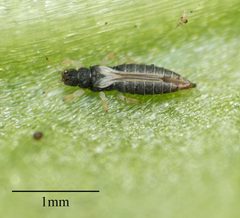
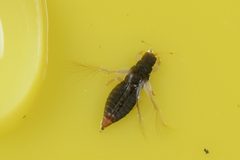
Distinguished from other by the combination of black with yellow-brown and orange tip, asymmetrical mouthcones with single , and 8-segmented with needle-like terminal segment. The greenhouse thrips can be separated from the banded greenhouse thrips (Hercinothrips femoralis) by the latter's distinct dark transverse bands across the abdomen. lack the bold patterning of many other pest thrips . The presence of fecal droplets on larval abdomens is a behavioral indicator. Confirmation requires microscopic examination of mouthpart structure and antennal segmentation.
Images
Appearance
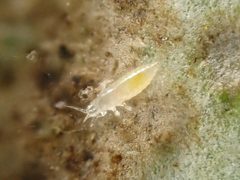
are 1.2–1.8 mm in length with black and yellow to dark brown bearing an orange tip. The is hypognathous (pointed backward) with 8-segmented pale yellow , the terminal segment needle-like. contain 65–70 and three ocelli are present. Mouthcones are asymmetrical, containing paired maxillary stylets and a single well-developed left . The 10-segmented abdomen is covered by averaging 7.5 μm thick. Forewings are narrow with few short setae on . Legs are white with single-segmented . Larvae are white with red , darkening through instars; some carry fecal droplets on the abdomen tip.
Habitat
Primarily associated with protected environments including greenhouses and glasshouses. Occurs on a wide range of plants including ornamentals (azaleas, chrysanthemums, fuchsia, roses, orchids), ferns, palms, vines, and fruit crops (avocado, persimmon, kiwi, strawberry). In outdoor settings, found in tropical and subtropical regions on diverse vegetation. Shelter trees in agricultural settings (e.g., Cryptomeria japonica in kiwifruit orchards) can harbor .
Distribution
in tropical, subtropical, and temperate regions worldwide. Native range presumed tropical; introduced to Europe, North America, Central and South America, Africa, Asia, Australasia, and Pacific Islands. Documented in greenhouses in northern temperate regions where it cannot survive outdoors year-round. Specific records from: Europe (widespread), North America (USA, Canada, Mexico), Central America (Honduras), West Indies, South America (Argentina, Bolivia, Brazil, Chile, Ecuador, Peru, Surinam, Uruguay, Venezuela), Africa (widespread), Asia (China, India, Indonesia, Japan, Israel, Turkey, etc.), and Australasia (Australia, New Zealand, Fiji, Hawaii, Papua New Guinea).
Seasonality
Activity and abundance follow strong seasonal patterns in outdoor settings. In kiwifruit orchards (New Zealand), increase from January, peak in April–May, then decline in late autumn/winter, remaining low until the following January–February. Multiple occur annually: up to seven generations in temperate conditions, more than twelve in tropical conditions. Development rate is temperature-dependent with minimal influence from humidity. are active year-round in protected environments.
Diet
Phytophagous. Feeds by piercing epidermal and parenchymal tissue of leaves and fruits with stylet mouthparts, extracting cellular contents. Shows preference for mature foliage over young terminal leaves. Nitrogen content of foliage influences feeding preference. Documented include: strawberry (Fragaria × ananassa), avocado (Persea americana), kiwifruit (Actinidia chinensis), persimmon (Diospyros spp.), azalea (Rhododendron simsii), chrysanthemum, fuchsia, rose, orchid, ferns, palms, and numerous other ornamental and crop plants.
Host Associations
- strawberry - pest'Camino Real' and other cultivars; complete development in ~28 days at 25°C
- avocado - major pestSignificant pest in southern California; subject to programs
- kiwifruit - pestStrong seasonal on 'Hayward' and 'Zesy002' cultivars
- Rhododendron simsii - Cyclic ; avoid young terminal leaves due to trichome and grayanotoxin I defenses
- persimmon - pestFruit cosmetic damage reported
- ornamental plants - pestAzaleas, chrysanthemums, fuchsia, roses, orchids, ferns, palms
Life Cycle
Development includes , two larval instars, non-feeding prepupal stage, and pupal stage. Complete cycle averages 28.4 days at 25°C: egg hatching 14–15 days at 26–28°C or 16–22 days at 21–25°C; first larval instar ~4 days (97% viability); second larval instar ~5 days (99% viability); ~1 day (99% viability); pupa ~3 days (100% viability). Females begin oviposition 4–6 days after , producing up to 47 eggs under favorable conditions. Eggs laid singly beneath leaf or fruit surfaces, or carried exposed and coated with accessory gland secretions and . Parthenogenetic ; males rare. Average lifespan ~1 month.
Behavior
Larvae of some individuals carry fecal droplets on the abdominal tip, hypothesized to function as repellent. Feeding occurs primarily on mature foliage, avoiding young terminal leaves on some . and larvae aggregate on undersides of leaves. Non-feeding during prepupal and pupal stages. Winged adults disperse by . Females exhibit oviposition site selection based on plant tissue characteristics.
Ecological Role
Agricultural pest causing direct feeding damage and indirect damage through cosmetic injury to fruit and honeydew-like promoting . Serves as for including Thripobius semiluteus, Thripobius javae, and Megaphragma spp., contributing to structure in managed . Prey for predatory (Franklinothrips orizabensis) and other .
Human Relevance
Major economic pest of greenhouse crops, ornamentals, and fruit production globally. Feeding causes silvery or lead-colored leaf discoloration and cosmetic fruit damage reducing market value; fruit quality itself is not affected. Controlled through using (Thripobius semiluteus in California avocados, T. javae in New Zealand), predatory mites, minute pirate bugs, and . Susceptible to phosphine (620 ppm for 2 hours) and spinosad , though show strong tendency to develop insecticide resistance. Subject to regulations for kiwifruit export.
Similar Taxa
- Hercinothrips femoralisAlso called 'banded greenhouse thrips'; distinguished by dark transverse bands across versus H. haemorrhoidalis's more uniform coloration with orange tip only
- other Heliothrips speciesRequire microscopic examination of mouthpart asymmetry and antennal segmentation for definitive separation
Sources and further reading
- BugGuide
- Wikipedia
- GBIF taxonomy match
- iNaturalist taxon
- NCBI Taxonomy
- Catalogue of Life
- From the mailbag – white lilies feeling the blues: Could it be the banded greenhouse thrips, Hercinothrips femoralis? — Bug of the Week
- The invasion that wasn’t | Beetles In The Bush
- The “black bringer of light” | Beetles In The Bush
- Gardening for Solitary Bees - Buglife Blog - Buglife
- Heliothrips haemorrhoidalis . [Distribution map].
- Biology and life table parameters of the Heliothrips haemorrhoidalis on strawberries
- Leaf morphology of hosts and nonhosts of the thrips Heliothrips haemorrhoidalis (Bouché)
- Ecological Studies of the Greenhouse Thrips, Heliothrips haemorrhoidalis, in Palestine
- Phenology of greenhouse thrips (Heliothrips haemorrhoidalis) on kiwifruit vines, shelter trees and alternative host plants
- Predation behaviors of Franklinothrips orizabensis (Thysanoptera: Aeolothripidae) towards Scirtothrips perseae and Heliothrips haemorrhoidalis (Thysanoptera: Thripidae)
- Leaf trichomes and foliar chemistry mediate defence against glasshouse thrips; Heliothrips haemorrhoidalis (Bouché) in Rhododendron simsii
- Population Abundance, Phenology, Spatial Distribution and a Binominal Sampling Plan forHeliothrips haemorrhoidalis(Thysanoptera: Thripidae) in Avocado
- Biological parameters ofThripobius semiluteusBouček (Hym., Eulophidae), a larval endoparasitoid ofHeliothrips haemorrhoidalis(Bouché) (Thysan., Thripidae)