
Hercinothrips
Bagnall, 1932
Species Guides
1- Hercinothrips femoralis(Banded Greenhouse Thrips)
Hercinothrips is a of thrips in the Thripidae, Panchaetothripinae, containing several economically significant pest . The most widely documented species, H. femoralis (banded greenhouse thrips), is a pantropical invader that has established in greenhouses worldwide and feeds on a broad range of vegetables, fruits, and ornamental plants. Members of this genus are characterized by their small size, fringed wings, and that cause characteristic silvery streaking and discoloration on foliage.
Pronunciation
How to pronounce Hercinothrips: /hɛrˌsɪnoʊˈθrɪps/
These audio files are automatically generated. While they are not always 100% accurate, they are a good starting point.
Identification
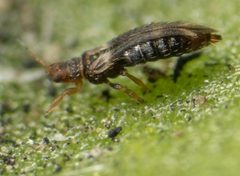
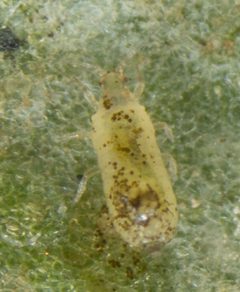
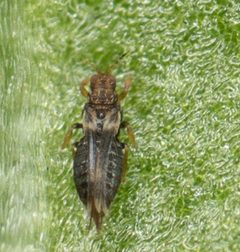
Hercinothrips are small thrips (typically 1-2 mm) with slender bodies and two pairs of narrow wings fringed with long setae, the source of the order name Thysanoptera ('feather wing'). of H. femoralis are dark brown to black, while larvae are translucent yellow to whitish. A key identifying feature of thrips is the presence of silvery feeding scars on leaves, often accompanied by black fecal droplets. Species-level identification within the requires microscopic examination of morphological characters such as segmentation, wing venation, and body setation.
Images
Habitat
Primarily associated with greenhouse environments and tropical to subtropical regions. H. femoralis thrives in warm, dry conditions typical of controlled agricultural and horticultural settings. Outdoor occur in pantropical zones where plants are available.
Distribution
Pantropical and in greenhouses. Documented occurrences include Africa (Canary Islands, Nigeria, Sierra Leone, Tanzania, South Africa), Asia (Japan, Korea, Turkey, India), Australasia (Australia, New Zealand, Hawaii), Europe (Romania, Spain, France, Italy, Portugal), North America (USA), South America (Argentina, Brazil, Peru), and the West Indies (Bermuda).
Seasonality
In greenhouse environments, active year-round with multiple overlapping . Development from to requires approximately 21 days at 25°C. In temperate outdoor zones, activity limited to warm seasons; may overwinter in protected locations or on .
Diet
Phytophagous. H. femoralis feeds on a wide variety of plant material including vegetables (beans, peppers, cucumbers), fruits (bananas), and ornamental plants (lilies, Crinum ). Feeding involves piercing epidermal and parenchyma with asymmetrical mouthparts and extracting cell contents.
Host Associations
- Crinum powellii - white swamp lily, ornamental
- Phaseolus vulgaris - green bean
- Capsicum annuum - pepper
- Cucumis sativus - cucumber
- Musa spp. - banana
- Aloe spp. - H. dimidiatus specific
- Passiflora spp. - H. bicinctus
Life Cycle
Holometabolous-like development with distinct stages: , two larval instars, , pupa, and . Eggs are embedded in leaf tissue. Larvae are wingless and feed actively. Prepupal and pupal stages are relatively quiescent. Total development time from egg to adult approximately 20.8 days at 25°C (egg: 9.0 days; first instar: 2.9 days; second instar: 4.0 days; prepupa: 1.4 days; pupa: 3.6 days). Adult longevity averages 75 days. Females produce an average of 133 offspring.
Behavior
Larvae are gregarious and often found in dense on leaf surfaces. are capable of and may disperse to new plants. Both life stages feed on plant tissue, with larvae causing the most visible damage. Larvae frequently carry black fecal droplets on their end. Adults engage in .
Ecological Role
Herbivore and agricultural pest. In natural , likely functions as a foliage-feeding insect on diverse plant . In invaded greenhouse environments, can reach densities causing significant economic damage to ornamental and food crop production.
Human Relevance
Major greenhouse pest with significant economic impact on ornamental horticulture and vegetable production. Management strategies include chemical control (spinosad and abamectin are highly effective), using predatory mites (Amblyseius swirskii), minute pirate bugs (Orius spp.), and , and cultural practices such as plant removal and water washing. H. femoralis is a model organism for studying phenotypic plasticity, demonstrating rapid morphological changes ('phenotype explosion') during establishment in novel environments.
Similar Taxa
- Frankliniella occidentalisWestern flower thrips, another economically important greenhouse thrips with similar damage and preferences; distinguished by different coloration and antennal structure
- Thrips tabaciOnion thrips, similar size and feeding damage; distinguished by preferences and morphological details of wings and
- Heliothrips haemorrhoidalisGreenhouse thrips, congeneric with some former Hercinothrips ; historically confused taxonomically but now placed in separate
More Details
Phenotypic Plasticity
H. femoralis exhibits remarkable phenotypic plasticity during establishment in new environments. Laboratory studies demonstrate 'phenotype explosion'—rapid changes in body length, wing length, and other morphological traits across when introduced to novel temperature and humidity conditions. This plasticity likely facilitates successful invasion of diverse climatic zones.
Taxonomic History
The has undergone taxonomic revision, with some previously placed in Hercinothrips now transferred to other genera (e.g., Heliothrips). Current classification places Hercinothrips in the Panchaetothripinae based on morphological and molecular characters.
Control Challenges
embedded in leaf tissue are protected from contact and water sprays, making complete difficult. combining agents with selective chemistry is recommended for sustainable management.
Sources and further reading
- BugGuide
- GBIF taxonomy match
- iNaturalist taxon
- NCBI Taxonomy
- Catalogue of Life
- From the mailbag – white lilies feeling the blues: Could it be the banded greenhouse thrips, Hercinothrips femoralis? — Bug of the Week
- Archive — Bug of the Week
- Hercinothrips bicinctus . [Distribution map].
- Hercinothrips dimidiatus Hood. [Distribution map].
- Hercinothrips femoralis . [Distribution map].
- Life table parameters and susceptibility levels of Hercinothrips femoralis (Reuter, 1891) (Thysanoptera: Thripidae) to spinosad and abamectin
- Phenotype “Explosion” in Hercinothrips femoralis (O. M. Reuter 1891) (Thysanoptera: Thripidae): A Particular Phenomenon for Successful Introduction of Economic Species