
Trichodectes canis
(de Geer, 1778)
canine chewing louse, dog chewing louse
Trichodectes canis is a chewing (suborder ) that parasitizes domestic dogs and wild canids worldwide. It is a permanent , completing its entire on the . The is a known intermediate host for the dog tapeworm Dipylidium caninum, which can be transmitted to canids (and rarely humans) through ingestion of infected lice. are generally uncommon in well-cared-for dogs in developed countries but can occur in neglected or immunocompromised animals. A 2023 study reported T. canis from domestic cats in Tehran, Iran, representing a new host record.
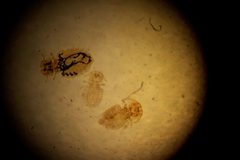
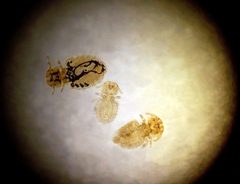
Pronunciation
How to pronounce Trichodectes canis: /ˌtrɪkoʊˈdɛktiːz ˈkeɪnɪs/
These audio files are automatically generated. While they are not always 100% accurate, they are a good starting point.
Identification
Distinguished from other mammal by: three-segmented with single tarsal claw per leg ( Trichodectidae); specific association with canid ; small size under 2 mm; dorsoventrally flattened body. Females identifiable by paired bowed appendages at abdominal terminus. Distinguished from sucking lice () by chewing mouthparts with visible and broad . Distinguished from other Trichodectes by host specificity and subtle morphological characters requiring examination.
Images
Appearance
Small, dorsoventrally flattened with broad, short . Body length 1.60–1.68 mm in males, 1.75–1.82 mm in females. three-segmented with hair-like sensory appendages. each bear a single claw. Mouthparts consist of paired lacking maxillary palps, adapted for chewing. reduced to degenerate state. Females possess distinctive paired bowed abdominal appendages visible dorsally at the end, used for attachment and gripping fur. Body ectothermic with bilateral symmetry. has been reported.
Habitat
Strictly parasitic; all life stages occur on the . Found in fur of canid hosts, with preference for back, neck, and regions. Tolerates temperate, terrestrial, and tropical climates. More prevalent in colder regions where competing (fleas, ticks) are less abundant. Urban, suburban, and wildland environments where host canids occur. No free-living stage.
Distribution
distribution associated with domestic dog and wild canid ranges. Documented in Europe, Africa, Asia-Temperate, Asia-Tropical, and Australasia. Specific records include: Czech Republic (1950s, original description from domestic dogs), Canada (gray wolves, 1934), Texas and Kansas (coyotes, 1959), Australia (introduced with domestic dogs), Iran (domestic cats, 2023). Uncommon in North America and developed countries with proper veterinary care.
Seasonality
Year-round activity; no seasonal dormancy. occurs continuously throughout the year. buildup more likely in colder environments where competing are suppressed.
Diet
Feeds on skin flakes (scurf) and skin secretions from canid . Uses modified to scrape host skin surface. Does not suck blood.
Host Associations
- Canis lupus familiaris - primary domestic dog
- Canis lupus - gray wolf
- Canis aureus - golden jackal
- Canis latrans - coyote
- Lycalopex culpaeus - culpeo (formerly Dusicyon culpaeus)
- Cerdocyon thous - crab-eating fox
- Vulpes bengalensis - Bengal fox
- Viverra civetta - African civet
- Nyctereutes procyonoides - raccoon dog
- Felis catus - domestic cat; new record from Tehran, Iran (2023)
Life Cycle
Hemimetabolous (). Female glues individual (nits) to hairs using specialized abdominal appendages; up to 100 eggs laid. Incubation 5–8 days. Nymphs hatch by pushing open . Three nymphal instars, each resembling with progressive size increase. Third nymph to adult. Entire cycle completed in 3–5 weeks, entirely on host. No free-living stages. Female longevity exceeds male, though exact lifespan unknown.
Behavior
Permanent with limited departure. Males reportedly more mobile than females and may leave host temporarily. Moves slowly on host, often appearing motionless. Exhibits no host preference among canids, but selects individual hosts that are older, younger, or in poor health. Strong morphological adaptations for permanent : modified legs, , and female abdominal appendages for fur gripping. No parental care after deposition.
Ecological Role
Intermediate for Dipylidium caninum (dog tapeworm), facilitating transmission to definitive hosts through ingestion. Heavy cause host stress via skin irritation and wound creation, potentially increasing susceptibility to infectious . Host response to itching causes hair loss. influenced by host health status and environmental temperature.
Human Relevance
Veterinary concern as of domestic dogs. for Dipylidium caninum, a tapeworm infecting dogs and rarely humans (usually asymptomatic). indicate poor animal husbandry or compromised health. Treatment effective with imidacloprid, selamectin, or topical permethrin. Not considered zoonotic for direct infestation; human are different . No environmental simplifies control.
Similar Taxa
- Heterodoxus spinigerAnother chewing of canids; distinguished by different antennal segmentation and geographic distribution (more common in warmer climates)
- Linognathus setosus of dogs; distinguished by narrow , blood-feeding mouthparts, and different (Linognathidae)
- Felicola subrostratusChewing of cats; distinguished by preference and subtle morphological differences
More Details
Vector capacity
T. canis is the primary intermediate for Dipylidium caninum. Dogs acquire tapeworm by ingesting containing cysticercoid larvae during . Human infection is rare and typically asymptomatic, requiring accidental ingestion of infected louse.
Taxonomic note
Formerly classified in suborder (chewing lice), now placed in order Psocodea following molecular phylogenetic studies. Basionym Pediculus canis de Geer, 1778.
Population ecology
rare in healthy, well-cared-for dogs in developed countries. Higher associated with neglect, immunocompromise, or extreme environmental conditions that suppress and competitors.
Sources and further reading
- BugGuide
- Wikipedia
- GBIF taxonomy match
- iNaturalist taxon
- NCBI Taxonomy
- How did coyotes conquer North America? | Blog
- Golden jackals might be settling near Prague | Blog
- Study on Ectoparasites of Free-Ranging Domestic Cats (Felidae; Felis catus) and Introducing Trichodectes canis as a New Record Louse in Tehran Urban Parks, Iran