
Felicola subrostratus
(Burmeister, 1838)
cat biting louse
Felicola subrostratus is a chewing (order Psocodea) and the only louse known to infest domestic cats. It is an obligate with strict specificity for felids. cause characterized by pruritus, dermatitis, and alopecia, though some cats remain asymptomatic. Long-haired cats typically experience more severe clinical signs. Despite a broad geographic distribution spanning multiple continents, field reports indicate it is uncommon in pet cats and occurs more frequently in stray, shelter, or cattery .
Pronunciation
How to pronounce Felicola subrostratus: //fɛˈlɪkoʊlə sʌbroʊˈstreɪtəs//
These audio files are automatically generated. While they are not always 100% accurate, they are a good starting point.
Identification
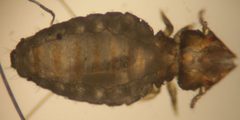
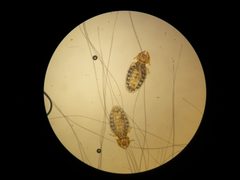
Definitive identification requires microscopic examination of collected hair . Very high specificity for felids facilitates field recognition—no other is known to infest domestic cats. Differentiation from other (fleas, mites) is based on morphological features visible under magnification: dorsoventrally flattened body, short , and chewing mouthparts distinct from of blood-feeding .
Images
Appearance
As a member of Trichodectidae, F. subrostratus has a dorsoventrally flattened body adapted for moving through fur. Chewing lice possess broad, short with mouthparts for consuming host epidermal debris. The is microscopic and requires examination of collected hair for positive identification.
Habitat
Strictly associated with the pelage of living felids; requires direct contact for survival. Most commonly reported in multi-cat environments including catteries, shelters, and stray cat .
Distribution
Documented from Europe, Africa, Asia (temperate and tropical regions), Australasia, and South America. Specific locality records include Igarassu (Pernambuco), Campina Grande (Paraíba), and Quatis (Rio de Janeiro) in Brazil.
Diet
Feeds on epidermal debris, skin secretions, and hair fragments from the 's coat; does not consume blood.
Host Associations
- Felis catus - obligate domestic cat; sole affecting this
- Felidae - obligate strict specificity at level
Life Cycle
with , nymph, and stages. Eggs (nits) are attached to hair shafts. Field studies indicate that no reinfestation from hatching eggs was observed within 30 days post-treatment, suggesting egg-to-adult development occurs within this timeframe or that eggs were eliminated by treatment.
Behavior
Permanently resides on ; transmission requires direct contact between cats. Causes intense pruritus leading to self-trauma, trichorrhexia (hair shaft fracturing), and secondary behavioral changes including irritability. Long-haired cats are most severely affected, likely due to favorable microhabitat conditions in dense pelage.
Ecological Role
of felids with no known role beyond - interaction. Secondary bacterial may develop at sites of self-inflicted trauma from pruritus.
Human Relevance
Veterinary significance as cause of feline . Zoonotic potential is absent—strict specificity precludes human . Effective treatments include topical fipronil, esafoxolaner-based , and combination products containing fipronil/moxidectin/praziquantel, with clinical resolution typically achieved within 7–30 days.
Similar Taxa
- Notoedres catiBoth cause pruritic skin conditions in cats; N. cati is a burrowing mite requiring different treatment approach and microscopic differentiation.
- Ctenocephalides felisCommon of cats causing pruritus; distinguished by jumping , blood-feeding habit, and visible size difference.
- Otodectes cynotisEar mite of cats causing otitis externa; location in ear canal and morphological features differentiate it from F. subrostratus.
More Details
Atypical clinical presentation
One documented case associated persistent diarrhea and coat deterioration without visible skin , emphasizing the need for parasitological investigation in debilitated cats even when dermatological signs are absent.
Treatment efficacy
Clinical field studies demonstrate 100% efficacy of modern ectoparasiticides against natural by day 30, with no observed reinfestation from hatching during the surveillance period.
Sources and further reading
- BugGuide
- GBIF taxonomy match
- iNaturalist taxon
- NCBI Taxonomy
- Catalogue of Life
- Infestação em Felis catus por Felicola subrostratus: Relato de Caso Infestation in Felis catus by Felicola subrostratus: Case report Infestación en Felis catus por Felicola subrostratus: Reporte de caso
- Infestação por Felicola subrostratus em felinos de gatil em Igarassu, Pernambuco, Brasil: relato de caso Infestation by Felicola subrostratus in cat cats in Igarassu, Pernambuco, Brazil: case report Infestación por Felicola subrostratus en felinos de gatil en Igarassu, Pernambuco, Brasil: reporte de caso
- <i>Felicola subrostratus</i> em felino doméstico na cidade de Campina Grande, Paraíba <i>Felicola subrostratus</i> in domestic cats in the city of Campina Grande, Paraíba
- Efficacy of a topical formulation containing esafoxolaner, eprinomectin and praziquantel (NexGard Combo®) against natural infestations with the cat louse, Felicola subrostratus under field conditions
- Efficacy of a single-dose topical formulation combining Fipronil, Moxidectin and Praziquantel against natural infestations of Notoedres cati, Otodectes cynotis and Felicola subrostratus in cats.