
Trichodectes
Nitzsch, 1818
Species Guides
1- Trichodectes canis(canine chewing louse)
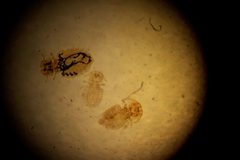
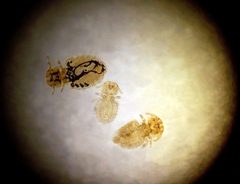
Trichodectes is a of chewing lice in the Trichodectidae, described by Nitzsch in 1818. are of small to medium-sized mammals, primarily including mustelids, canids, and felids. The genus has a distribution across multiple continents. Individual species show varying degrees of specificity, with some documented on multiple host families.
Pronunciation
How to pronounce Trichodectes: //ˌtɹɪkoʊˈdɛktiːz//
These audio files are automatically generated. While they are not always 100% accurate, they are a good starting point.
Identification
Distinguished from other by broad body shape and association with mammalian . Within Trichodectidae, -level identification requires examination of genitalia and chaetotaxy. Trichodectes canis, the dog chewing louse, is the most frequently encountered species in veterinary contexts. Differentiation from the related genus Felicola (formerly included in Trichodectes) is based on host association and morphological characters.
Images
Appearance
Small, dorsoventrally flattened insects with broad bodies. Length ranges from 1 mm to 2 mm. As chewing lice (suborder Ischnocera), they possess mouthparts adapted for chewing skin debris and hair. Body form is characteristic of mammalian , with short and legs modified for clinging to host hair.
Habitat
Strictly parasitic; found exclusively on the bodies of living mammalian . Occurs in host fur across all body regions. Environmental persistence is limited; survival off-host is brief. Urban and wild of host mammals support populations.
Distribution
. Documented from Europe, Africa, temperate and tropical Asia, and Australasia. Distribution follows that of mammals, with particular in regions supporting of mustelids, canids, and related .
Diet
Chewing lice that feed on skin debris, hair fragments, and secretions. mouthparts are used to macerate epidermal material and hair.
Host Associations
- Canis lupus familiaris (domestic dog) - primary Trichodectes canis is the dog chewing
- Felis catus (domestic cat) - accidental T. canis documented as new record in Tehran; not typical
- Meles meles (European badger) - primary T. melis specific to badgers
- Mustela spp. and related mustelids - primary Multiple including T. mustelae, T. galictidis
- Mephitis mephitis (striped skunk) - primary Documented for several
Life Cycle
with three stages: (nit), nymph, and . Eggs are cemented to hair shafts. Nymphs resemble smaller adults and undergo three . Entire occurs on the host. Duration of developmental stages varies with temperature and host condition.
Behavior
Permanent that complete their entire on a single individual. Transmission occurs through direct host-to-host contact. by hosts may reduce but rarely eliminates . Populations tend to concentrate on body regions where host self-grooming is less effective.
Ecological Role
that may influence health through direct irritation and as a for . Heavy can cause dermatitis and hair loss in host mammals. Some are suspected vectors of tapeworms (Dipylidium caninum) between hosts, though vector competence varies by species.
Human Relevance
Veterinary significance through of domestic dogs (T. canis) and occasional detection on cats. Dog infestations cause pruritus, dermatitis, and reduced condition. Control is achieved through topical and improved hygiene. Zoonotic potential is minimal; human infestation is rare and transient. Some serve as intermediate hosts for cestode of veterinary importance.
Similar Taxa
- FelicolaFormerly classified within Trichodectes; now separated based on associations with felids and morphological characters. Felicola subrostratus is the cat chewing , distinct from Trichodectes .
- Damalinia (formerly Bovicola)Another of Trichodectidae parasitizing ungulates and other mammals; distinguished by range and subtle morphological differences in structure.
More Details
Host specificity variation
within Trichodectes show a gradient of specificity. Some, like T. canis, are primarily restricted to canids but have been documented on felids in isolated records. Others, like T. melis and T. galictidis, appear more strictly associated with single host species or .
Taxonomic history
The has undergone significant taxonomic revision. Many formerly placed in Trichodectes have been transferred to other genera, particularly Felicola for felid-associated species. Current classification reflects refined understanding of phylogenetic relationships within Trichodectidae.
Sources and further reading
- BugGuide
- Wikipedia
- GBIF taxonomy match
- iNaturalist taxon
- NCBI Taxonomy
- Catalogue of Life
- Study on Ectoparasites of Free-Ranging Domestic Cats (Felidae; Felis catus) and Introducing Trichodectes canis as a New Record Louse in Tehran Urban Parks, Iran
- Reviving knowledge: A 70-year gap in the host-parasite relationship between Trichodectes galictidis (Ischnocera: Trichodectidae) and Galictis cuja (Molina, 1782) (Carnivora: Mustelidae)