
Menacanthus
Neumann, 1912
bird lice, chewing lice
Species Guides
1- Menacanthus stramineus(Chicken Body Louse)
Menacanthus is a of chewing (: Menoponidae) that parasitizes birds. The is highly uncertain, with recent studies synonymizing dozens of previously recognized and invalidating other names. Species in this genus feed on blood and feathers by piercing feather quills and gnawing . They are significant pests of poultry, causing feather loss, reduced production, and transmission. The genus has a global distribution across all major landmasses.
Pronunciation
How to pronounce Menacanthus: /mɛnəˈkænθəs/
These audio files are automatically generated. While they are not always 100% accurate, they are a good starting point.
Identification
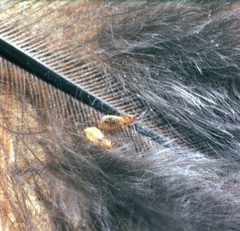
Menacanthus are distinguished from other avian lice by their combination of: dorsoventral flattening; 5-segmented (segments 4-5 clubbed in males); two tarsal claws; and specific setal patterns on abdominal tergites and sternites. They differ from ischnoceran lice (e.g., Philopteridae) by having visible antennae and rather than suctorial mouthparts. -level identification requires examination of genitalia, setal counts on specific abdominal segments, and ocular seta length. Males and females differ in antennae structure and abdominal terminalia.
Images
Habitat
Ectoparasitic on birds; permanent that complete entire on . Microhabitat selection is temperature-driven: concentrated in warmer body regions ( neck, back, vent) at 35–40°C, avoiding cooler extremities (comb, wattles, shanks, feet). Seasonal between surfaces in winter and dorsal surfaces in summer observed in temperate regions. Found in feather tracts, particularly on breast, back, vent, and under wings.
Distribution
Global distribution across all zoogeographic regions: Europe, Africa, Asia-Temperate, Asia-Tropical, Australasia, and the Americas. Distribution follows that of birds, with greatest in areas with high avian diversity.
Seasonality
Activity and continuous in stable environments; influenced by body temperature and ambient conditions. Seasonal shifts in microhabitat location on host body correlate with temperature changes: to warmer areas in winter, areas in summer.
Diet
Feeds on blood and feathers; pierces feather quills to access blood and gnaws . Primary feeding on feathers with supplemental blood feeding from pin feathers and quill bases.
Host Associations
- Gallus gallus (domestic chicken) - primary Menacanthus stramineus is the chicken body louse, most common on backyard and commercial chickens
- Zonotrichia capensis hypoleuca (White-bellied Sparrow) - of Menacanthus bonariensis in Argentina
- Rhipidura fuliginosa fuliginosa (South Island fantail) - of Menacanthus rhipidurae in New Zealand
- Acrocephalus scirpaceus (Reed Warbler) - of Menacanthus curuccae
- Various Picoides woodpeckers - of Menacanthus pici
Life Cycle
with three nymphal instars. incubated 4–5 days. Each nymphal stage lasts approximately 3 days. lifespan approximately 12 days. Females produce up to 4 eggs per day, averaging 1.6 eggs daily; egg production peaks 5–6 days after reaching adulthood. All life stages occur on the ; no free-living stages.
Behavior
Temperature-driven microhabitat selection: active movement between body regions to maintain optimal temperature range of 35–40°C. Reduced feeding and locomotory activity below 30°C; heat avoidance above 45°C. Aggregative in thermally favorable zones. Increased preening behavior observed in infested . Dustbathing by hosts reduces through mechanical removal and desiccation.
Ecological Role
affecting through blood loss, feather damage, and energy expenditure from . May serve as for avian . influenced by host social structure and .
Human Relevance
Significant pest of poultry production. reduce production, hen weight, and feed conversion . Cause feather loss and skin ; moderate infestations produce welfare impacts even at low densities. Control through including dustbathing substrates (, kaolin clay, sulfur), environmental management, and targeted . Do not infest humans. Backyard chicken keeping increases exposure risk compared to commercial caged systems.
Similar Taxa
- Menopon gallinaeAlso a menoponid of poultry; differs in and preferred microhabitat (Menopon typically on and neck, Menacanthus on body)
- Goniocotes gallinae (fluff louse)Common of different (Philopteridae); differs in mouthpart type and preference
- Ornithonyssus sylviarum (northern fowl mite)Common poultry but an acarine, not insect; smaller, eight-legged, blood-feeding only, no permanent attachment
More Details
Taxonomic uncertainty
The Menacanthus has undergone extensive taxonomic revision. Most historical treatments recognized over 100 , but recent studies have synonymized dozens of species and found other names invalid. Some synonymizations may be erroneous, and undescribed species likely remain. This uncertainty complicates identification and epidemiological studies.
Integrated pest management
Research at UC Riverside demonstrated that dustbathing in , kaolin clay, or sulfur can reduce Menacanthus by 80–100% after one week of use. Sulfur dustboxes showed residual effects lasting up to 9 weeks. Effectiveness depends on proportion of birds using dustbathing facilities; non-users do not benefit from kaolin or diatomaceous earth treatments.
Sources and further reading
- BugGuide
- Wikipedia
- GBIF taxonomy match
- iNaturalist taxon
- NCBI Taxonomy
- Catalogue of Life
- Menacanthus stramineus Archives - Entomology Today
- Backyard Chickens May Have Mites, Lice and Fleas
- Backyard Chickens Harbor Greater Diversity of Mites and Lice than Farm-raised Chickens
- Biology of the chicken body louse, Menacanthus stramineus
- Biology of the Chicken Body Louse, Menacanthus stramineus1
- Distribution of Menacanthus stramineus in Relation to Chickens' Surface Temperatures
- Menopon picicola: a new junior synonym of Menacanthus pici (Insecta: Phthiraptera: Menoponidae)
- Morpho-taxonomy of new host and locality record of Menacanthus abdominalis (Piaget 1880) (Phthiraptera: Amblycera) from Hyderabad, Sindh, Pakistan
- New Distribution Record and Economic Importance of Menacanthus cornutus (SchÖmmer) on Georgia Broilers1
- Menacanthus bonariensis new species (Phthiraptera: Menoponidae), parasitic on the White-bellied Sparrow, Zonotrichia capensishypoleuca (Todd, 1915) (Aves: Passeriformes: Fringillidae) in Buenos Aires Province, Argentina
- The Effect of Host Beak Condition on the Size of Menacanthus Stramineus Populations of Domestic Chickens
- Case Report of Mixed Infestation of Menacanthus stramineus and Menopon gallinae in Commercial Pullets in Ibadan, Nigeria
- The identity of Menacanthus eisenachensis Balát (Insecta, Phthiraptera, Amblycera, Menoponidae) from the Reed Warbler (Passeriformes, Sylviidae)
- Beak condition and cage density determine abundance and spatial distribution of northern fowl mites, Ornithonyssus sylviarum, and chicken body lice, Menacanthus stramineus, on caged laying hens
- Low levels of chicken body louse (Menacanthus stramineus) infestations affect chicken welfare in a cage-free housing system
- Housing and dustbathing effects on northern fowl mites ( Ornithonyssus sylviarum ) and chicken body lice ( Menacanthus stramineus ) on hens
- Menacanthus rhipidurae, a new species of chewing louse (Insecta: Phthiraptera: Menoponidae) from South Island fantails, Rhipidura fuliginosa fuliginosa (Aves: Passeriformes: Dicruridae)
- Responses of Ornithonyssus sylviarum (Acari: Macronyssidae) and Menacanthus stramineus (Phthiraptera: Menoponidae) to Gradients of Temperature, Light, and Humidity, With Comments on Microhabitat Selection on Chickens