
Menoponidae
Mjoberg, 1910
chicken body lice, chicken body louse family
Genus Guides
2- Colpocephalum
- Menacanthus(bird lice)
is a of chewing lice (suborder ) comprising of birds. They are frequently called the chicken body louse family due to the economic importance of like Menacanthus stramineus on poultry, though the family parasitizes diverse avian including migratory birds and passerines. Members possess short concealed in grooves behind the , and many retain partial dependence on blood-feeding through specialized mouthparts such as the hypopharynx. This capability allows broader host distribution and reduced microhabitat specialization compared to other chewing lice.
Pronunciation
How to pronounce Menoponidae: //mɛˌnoʊpəˈnaɪdiː//
These audio files are automatically generated. While they are not always 100% accurate, they are a good starting point.
Identification
Distinguished from other by the combination of concealed short and partial blood-feeding habit. Differentiation from Ischnocera (Philopteridae) requires examination of antennae structure and mouthpart . -level identification within generally requires microscopic analysis of genitalia and chaetotaxy due to reduced ecological specialization and consequent morphological similarity.
Images
Appearance
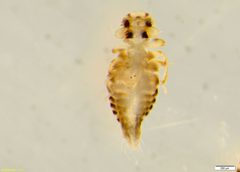
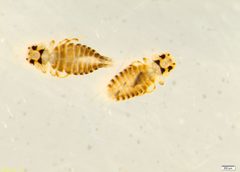
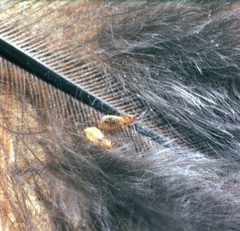
Small, dorsoventrally flattened insects with short hidden in grooves to the , giving an appearance of absent antennae to casual observation. Body form adapted for clinging to feather shafts and . Specific morphological features vary by and , with microscopic examination typically required for reliable identification.
Habitat
Strictly associated with avian ; occurs on feathers and skin of birds. Within host, distribution varies by —some occupy specific feather regions (tail base, , shaft) while others show broader host-site utilization due to blood-feeding capability.
Distribution
distribution following avian ranges. Documented from Europe, Africa, Asia-Temperate, Asia-Tropical, and Australasia. Individual distributions correlate with host specificity and geographic range of avian hosts.
Diet
Mixed feeding strategy: primarily feeds on feathers and epidermal debris, with partial dependence on blood obtained by scratching and nibbling at feather bases using modified mouthparts (hypopharynx). This component distinguishes from feather- and enables broader -site utilization.
Host Associations
- Gallus gallus domesticus - primary Domestic chicken; Menacanthus stramineus and Menopon gallinae are major
- Meleagris gallopavo - Domestic turkey; to Menacanthus stramineus
- Numida meleagris - Guinea fowl; to Menopon gallinae
- Columba livia domestica - Domestic pigeon; to Bonomiella columbae, Hohorstiella lata, Neocolpocephalus turbinatum
- Pycnonotus spp. - Bulbuls; diverse Myrsidea documented
- Tyrannidae - Tyrant flycatchers; multiple Myrsidea
- Thraupidae - Tanagers; Myrsidea in Panama
- Cotingidae - Cotingas; first Myrsidea records recently described
- Pelecaniformes - orderPelicans and allies; to Colpocephalum
- Trichoglossus novae-hollandiae - Rainbow lorikeet; specimens recorded
- Picoides spp. - Woodpeckers; historical record for Menacanthus pici complex
- Falconiformes - orderCaracaras; Colpocephalum ateri from Daptrius ater
- Malagasy warblers - groupBernieria, Oxylabes, Xanthomixis; Myrsidea
Life Cycle
with , three nymphal instars, and stages. For Menacanthus stramineus: eggs hatch in 4–5 days; nymph-to-adult development requires approximately 14 days. Adult females deposit approximately 1.5 eggs daily for 12.5 days. Rapid reproductive potential enables large- , particularly in high- poultry operations.
Behavior
When disturbed, some (e.g., Menopon gallinae) quickly run from feather shafts onto the body surface to avoid threats. Species with specific feather-site preferences will attempt to feed on alternative feather types if displaced, but fail to reproduce and die—indicating strong behavioral and physiological specialization despite broader site in some .
Ecological Role
affecting avian through direct damage (feather degradation, skin irritation) and blood loss. High intensity produces clinical signs indicating substantial impact. Often the first detected on birds, particularly nidifugous young born with feathers. influenced by host and contact rates.
Human Relevance
Veterinary and agricultural significance due to pathogenic effects on poultry. Menacanthus stramineus is the most common on poultry worldwide, causing reduced productivity and welfare concerns. Menopon gallinae (shaft louse) similarly affects chickens and guinea fowl. Control required in commercial operations. Menopon gallinae sequenced (155 MB) for comparative studies of -switching evolution in parasitic lice.
Similar Taxa
- PhilopteridaeAlso avian chewing lice, but Ischnocera rather than ; distinguished by structure (not concealed in grooves) and lack of blood-feeding habit, typically showing greater microhabitat specialization on .
- LaemobothriidaeOther with avian ; differentiated by morphological features of and structure.
More Details
Taxonomic diversity
The includes numerous of economic and systematic importance: Menacanthus, Menopon, Myrsidea, Colpocephalum, Bonomiella, Hohorstiella, Neocolpocephalum, Actornithophilus, Apterygon, Austromenopon, Kurodaia, Longimenopon, Meromenopon, Nosopon, Piagetiella, Psittacobrosus. New descriptions continue frequently, particularly in passerine-associated genus Myrsidea.
Research significance
serve as model organisms for studying - , parasite diversification, and the evolutionary transition to . The 's distribution patterns are used to infer phylogenetic relationships among avian hosts.
Sources and further reading
- BugGuide
- Wikipedia
- GBIF taxonomy match
- iNaturalist taxon
- NCBI Taxonomy
- Catalogue of Life
- The Mallophagan Family Menoponidae
- The Mallophagan Family Menoponidae
- Two new species of the genus Myrsidea Waterston (Phthiraptera: Menoponidae) from cotingas (Passeriformes: Cotingidae)
- Five new species of Myrsidea Waterston (Phthiraptera: Menoponidae) from tanagers (Passeriformes: Thraupidae) in Panama
- The genus Myrsidea Waterston (Phthiraptera: Menoponidae) from bulbuls (Passeriformes: Pycnonotidae), with descriptions of 16 new species
- Species in the genus Bonomiella Conci, 1942 (Phthiraptera: Menoponidae) from Argentina and Chile
- THE COLPOCEPHALUM (MALLOPHAGA: MENOPONIDAE) OF THE PELECANIFORMES
- Bird Lice (Mallophaga, Philopteridae, Menoponidae) of Domestic Pigeons on Specialized Pigeon Breeding Farms in Poltava
- Niethammerella Eichler, a senior synonym of Kaysius Price & Clayton (Phthiraptera: Amblycera: Menoponidae)
- Menopon picicola: a new junior synonym of Menacanthus pici (Insecta: Phthiraptera: Menoponidae)
- Four new species of Myrsidea Waterston chewing lice (Phthiraptera: Menoponidae) from the Malagasy warblers (Passeriformes)
- The genus Myrsidea Waterston (Phthiraptera: Menoponidae) from tyrant-flycatchers (Passeriformes: Tyrannidae), with descriptions of 13 new species
- A New Colpocephalum (Mallophaga: Menoponidae) from Daptrius ater
- Cladistic Analysis of Species Infesting (Amblycera: Menoponidae) Fowls of District Hyderabad, Sindh, Pakistan