
Ornithonyssus sylviarum
(Canestrini & Fanzago, 1877)
Northern Fowl Mite
, commonly known as the , is a blood-feeding of birds that has become a major economic pest of poultry worldwide. The entire occurs on the , allowing to expand rapidly under favorable conditions. Heavy cause anemia, reduced production, and can lead to death in severe cases. The mite has been reported on over 72 host across 26 bird and has shown ability to infest mammalian hosts including humans, though it does not permanently establish on non-avian hosts.
Pronunciation
How to pronounce Ornithonyssus sylviarum: /ˌɔrnɪˈθɒnɪsəs sɪlˈvaɪərəm/
These audio files are automatically generated. While they are not always 100% accurate, they are a good starting point.
Identification
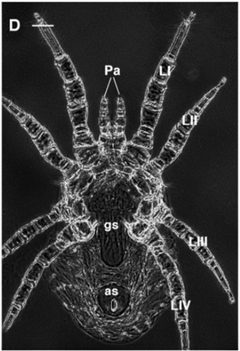
Distinguished from the chicken mite () by its permanent on- residence—O. sylviarum completes its entire on the bird and is found on the host at all times, whereas D. gallinae hides in cracks and crevices during the day and feeds only at night. Check for mites first on the vent, then tail, back, and legs of layers. Feathers appear soiled from mite debris in heavy . Microscopic examination reveals the typical macronyssid mite with long adapted for piercing skin.
Images
Appearance
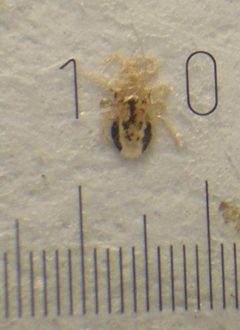
are approximately 1/26 inch (about 1 mm) long and appear dark red to black when engorged with blood. The body is oval and dorsoventrally flattened, typical of parasitic mites. Feathers become soiled from visible accumulations of mite , cast skins, dried blood, and excrement in heavy . The eight-legged adult form is barely visible to the unaided and resembles the red mite in general appearance.
Habitat
Primarily found in poultry houses and the nests of wild birds. In commercial settings, mites inhabit cage structures, nest boxes, and roosting areas where birds congregate. The mite requires close contact and does not survive long off-host except in protected microhabitats such as cracks in wood or equipment where birds roost. Cooler temperatures favor increases.
Distribution
Widespread globally in poultry production systems, with confirmed records from North America, South America (Brazil), Australia, China, Europe, Africa, and the Middle East. Particularly problematic in temperate regions. Documented on 72 of North American birds across 26 , indicating broad avian host range across multiple continents.
Seasonality
increase during cooler weather. Activity continues year-round in climate-controlled poultry facilities. In outdoor or semi-outdoor settings, population peaks typically occur in autumn and winter months when cooler temperatures slow immune responses and create favorable conditions for mite .
Diet
Strictly haematophagous; all active life stages (larva, nymphs, and ) feed on blood. Requires blood meals for development and .
Host Associations
- Gallus gallus domesticus - primary Domestic chickens, especially -laying hens; causes major economic damage
- Meleagris gallopavo - Domestic turkeys
- Various wild birds - 72 documented across 26 in North America alone
- Homo sapiens - incidental Can bite humans handling infested birds but does not establish permanent
- Canis lupus familiaris - incidental Documented on dogs in domestic environments
- Felis catus - incidental Documented on cats in domestic environments
- Rodentia - incidental Documented on various rodents; may serve as bridge
Life Cycle
The entire is completed on the bird, distinguishing it from many other poultry mites. Stages include , larva, , deutonymph, and . All active stages are blood-feeders. Under ideal conditions, development from egg to adult can be completed within 7 days, enabling rapid expansion. Females lay eggs in feathers, particularly around the vent region. No off-host developmental stages occur.
Behavior
Permanent that remains on the continuously rather than retreating to hiding places between meals. Aggregates in favored feeding sites, particularly the vent region, with distribution on the host body influenced by temperature gradients. Can survive limited periods off-host in cracks, equipment, or rodent burrows, facilitating spread between flocks. Disperses via wild birds, contaminated equipment, and human activity. can reach damaging densities rapidly due to short time and continuous host contact.
Ecological Role
with no known beneficial functions. Acts as a significant pest in agricultural systems and may serve as a potential for transmission between avian , though specific vector competence requires further documentation. are governed by host and environmental temperature.
Human Relevance
Major economic pest of the poultry industry since the early 1900s, causing estimated 10-15% reduction in production and reduced weight gain in meat birds. Severe cause anemia and death. Poultry may be bitten when handling infested birds, causing irritation and dermatitis. Control relies on chemical acaricides, though resistance to permethrin and other compounds has been documented. Integrated management including sulfur dust bags, dust baths, and improved beak condition (reduced trimming) shows promise for cage-free systems.
Similar Taxa
- Dermanyssus gallinaeSimilar size and appearance; distinguished by off- hiding and feeding—D. gallinae hides in cracks during day and feeds only at night, while O. sylviarum remains on host continuously
- Ornithonyssus bursaRelated with similar ; primarily distinguished by geographic distribution and preferences
More Details
Control challenges in cage-free systems
Traditional high-pressure insecticidal sprays designed for battery cages are ineffective in cage-free housing with solid floors and nest boxes that provide hiding places. Research shows that dust bathing with mixtures and minimizing beak trimming allows chickens to self-manage mite through natural . Sulfur dust bags hung near feed or water sources enable self-treatment and have proven more effective than permethrin strips in trials, with documented permethrin resistance in commercial mite populations.
Temperature-dependent distribution
Research demonstrates that temperature governs on- distribution, with mites aggregating in microhabitats that optimize their thermal requirements. This influences where on the bird mites are most easily detected and has implications for targeted monitoring protocols.
Sources and further reading
- BugGuide
- Wikipedia
- GBIF taxonomy match
- iNaturalist taxon
- NCBI Taxonomy
- Catalogue of Life
- Poultry Pest Management - AgriLife Extension Entomology
- Dust Baths and Longer Beaks Can Make Cage-free Chickens into Mite-free Chickens
- Battling Chicken Mites with Bags of Brimstone
- Backyard Chickens Harbor Greater Diversity of Mites and Lice than Farm-raised Chickens
- Backyard Chickens May Have Mites, Lice and Fleas
- The Avian Mite, Ornithonyssus sylviarum, on Mammalian Hosts with References to Transmission to Poultry
- A review of the biology, ecology, and control of the northern fowl mite, Ornithonyssus sylviarum (Acari: Macronyssidae)
- Temperature Governs On-Host Distribution of the Northern Fowl Mite, Ornithonyssus sylviarum (Acari: Macronyssidae)
- Host Digestion to Determine Populations of the Northern Fowl Mite, Ornithonyssus sylviarum (Acari: Macronyssidae), on Mature Chickens
- Efficacy of fluralaner solution administered to egg layer chickens through drinking water for control of northern fowl mite (Ornithonyssus sylviarum).