
Macronyssidae
Oudemans, 1936
Genus Guides
1- Ornithonyssus(bird mites)
Macronyssidae is a of parasitic mites in the order Mesostigmata, established by Oudemans in 1936. Members are obligate of vertebrates, primarily infesting reptiles, birds, and mammals. The family includes economically significant pests such as the () and the tropical rat mite (Ornithonyssus bacoti), as well as the snake mite (Ophionyssus natricis). Macronyssids are and have been documented as of including and Bartonella .
Pronunciation
How to pronounce Macronyssidae: /ˌmækrəˈnɪsɪdiː/
These audio files are automatically generated. While they are not always 100% accurate, they are a good starting point.
Identification
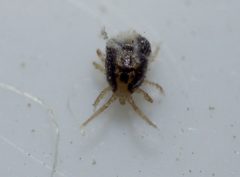
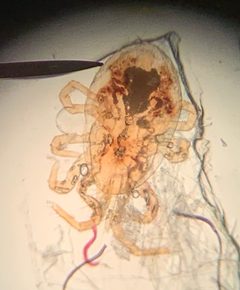
Macronyssidae can be distinguished from related in Dermanyssoidea by a combination of morphological features including the structure of the gnathosoma and leg chaetotaxy. Members possess a characteristic shield that is typically entire or weakly divided, with setation patterns useful for generic-level identification. The family is most readily separated from by details of the tarsal claws and . Identification to level requires examination of cleared and mounted specimens under compound microscopy.
Images
Habitat
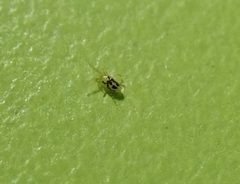
Macronyssid mites occupy the microhabitats provided by their vertebrate , including nests, burrows, cages, and enclosures. associated with birds inhabit poultry houses, nest boxes, and roosting sites. Rodent-associated species occupy the nests and runways of their hosts. The snake mite Ophionyssus natricis has been observed to deposit in the environment rather than on the host, utilizing cracks and crevices in enclosures.
Distribution
The has a worldwide distribution, with records from North America, South America, Europe, Africa, and Asia. In Brazil, 13 and 26 have been documented from 99 species. The genus Glauconyssus is associated with African bats. GBIF distribution records include Denmark, Norway, Sweden, and Vermont, USA. Ornithonyssus bacoti has been recorded across seven ecoregions in the La Plata Basin of Argentina.
Diet
All macronyssids are obligate hematophages, feeding on the blood of their vertebrate . The feeds on poultry. Ornithonyssus bacoti feeds on cricetid rodents. Ophionyssus natricis feeds on snakes, including pythons and boas.
Host Associations
- birds - primary Includes poultry; is a major pest
- reptiles - primary Snakes, including pythons and boas; Ophionyssus natricis
- mammals - primary Rodents, bats, and other small mammals; Ornithonyssus bacoti on cricetid rodents
Life Cycle
The includes , larva, , deutonymph, and stages. In Ophionyssus natricis, females deposit eggs in the environment rather than on the ; eggs hatch in 1.5–2 days. Larval and nymphal development proceeds rapidly under favorable conditions. The non-feeding deutonymphal stage is retained in some .
Behavior
exhibits strong positive , orienting toward body temperature. Ophionyssus natricis shows negative and is attracted to thermal cues rather than chemical or visual host-associated stimuli; this does not respond to snake skin or . Host-seeking is primarily driven by temperature gradients. Chickens infested with O. sylviarum engage in dust bathing to dislodge , and birds with intact beaks groom more effectively, reducing mite loads.
Ecological Role
Macronyssids function as and have been implicated as of bacterial . Ornithonyssus bacoti has been found harboring spp. and Bartonella sp., with potential for horizontal pathogen transmission among ectoparasites. cause stress, reduced production in poultry (10–15% decrease), and impaired weight gain in meat birds. The exhibits -dependent patterns in wild rodent .
Human Relevance
Several macronyssid are significant pests of domestic animals and humans. is a major of poultry, causing economic losses in cage-free and free-range systems. Ornithonyssus bacoti, the tropical rat mite, is a zoonotic that bites humans and has been associated with transmission. Ophionyssus natricis is a common pest of captive snakes in herpetoculture. Control methods include acaricides, in dust baths, and environmental management.
Similar Taxa
- DermanyssidaeBoth are in superfamily Dermanyssoidea and contain mites parasitic on vertebrates; distinguished by tarsal claw and structure, and details of gnathosomal
- LaelapidaeRelated in Mesostigmata with some parasitic members; laelapids typically have more diverse feeding habits including and mycophagy, and differ in shield and leg chaetotaxy
Sources and further reading
- BugGuide
- Wikipedia
- GBIF taxonomy match
- iNaturalist taxon
- NCBI Taxonomy
- Catalogue of Life
- Macronyssidae Archives - Entomology Today
- Dust Baths and Longer Beaks Can Make Cage-free Chickens into Mite-free Chickens
- Glauconyssus: A New Genus Associated with African Bats (Acari: Macronyssidae)
- A Checklist of Macronyssid Species (Mesostigmata: Macronyssidae) From Brazil
- Observations on the Life History and Sensory Behavior of the Snake Mite, Ophionyssus natricis (Gervais) (Acarina: Macronyssidae)
- Ecoregional distribution and parasitism of the mite Ornithonyssus bacoti Hirst (Mesostigmata: Macronyssidae) in cricetid rodents across localities from the La Plata Basin, Argentina
- A review of the biology, ecology, and control of the northern fowl mite, Ornithonyssus sylviarum (Acari: Macronyssidae)