
Skwala
Ricker, 1943
springflies
Species Guides
2- Skwala americana(American springfly)
- Skwala curvata(Curved Springfly)
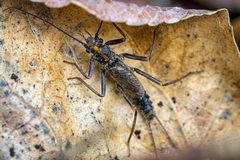
Skwala is a of springflies (Plecoptera: Perlodidae) established by Ricker in 1943, containing approximately five described distributed across North America and Asia. Species in this genus are amphibiotic, with aquatic nymphal stages in freshwater streams and terrestrial . At least one species, Skwala pusilla, has been documented as predatory. The genus has been subject to cytogenetic study, with Skwala compacta representing the first photographic documentation of .


Pronunciation
How to pronounce Skwala: /ˈskwɑːlə/
These audio files are automatically generated. While they are not always 100% accurate, they are a good starting point.
Identification
Members of Skwala can be distinguished from other Perlodidae by their placement within the tribe Arcynopterygini. -level identification requires examination of morphological characters not detailed in available sources. The genus is characterized by the cytogenetic features documented in S. compacta: karyotype of 2n=26 with XY male/XX female sex determination, subacrocentric , and distinctive heterochromatic .
Images
Habitat
Freshwater lotic environments including rivers and montane streams. Documented collection sites include third-order Colorado montane streams and the Izdrevaya River in Novosibirsk, Siberia. Nymphs are aquatic; are terrestrial.
Distribution
North America (Colorado, Arizona, Alberta, British Columbia) and Asia (Siberia/Russia, northern Japan, Altay, Amur region). Specific documented locations include Colorado montane streams, the Izdrevaya River in Novosibirsk (55.0018°N, 83.2156°E), and northern Japan.
Seasonality
Nymphs active year-round with seasonal growth patterns: small nymphs appear in May in Colorado , with rapid growth through summer and autumn, continued slow growth through winter until April. Maximum nymphal densities observed in July. timing not specified in available sources.
Diet
Predatory (documented for S. pusilla in northern Japan). Specific prey items not described in available sources.
Life Cycle
with distinct cohort (documented in S. parallela). Amphibiotic: aquatic nymphal stages followed by terrestrial . Nymphs collected across spring and autumn seasons at various developmental stages. Gonadal development observed in larvae.
Behavior
in S. compacta exhibit negative heteropyknosis during meiotic prophase, an unusual feature compared to other . X and Y remain in close proximity during prophase, suggesting conserved conjugation .
Ecological Role
Aquatic nymphs function as in freshwater stream . production of 395.3 mg/m² (3.95 kg/ha dry weight) documented for S. parallela in Colorado, with P/B ratio of 4.4. Component of benthic macroinvertebrate in montane and riverine systems.
Similar Taxa
- Other Perlodidae generaSkwala shares -level characteristics with other Perlodidae but is distinguished by tribal placement in Arcynopterygini and documented cytogenetic features including the distinctive with entirely heterochromatic short arms rich in ribosomal .
- KamimuriaBoth contain predatory stoneflies in northern Japanese streams, but Kamimuria belongs to Perlidae rather than Perlodidae, differing in family-level morphological and genetic characteristics.
More Details
Cytogenetic significance
Skwala compacta represents the first photographic documentation of in stoneflies (Plecoptera), with karyotype characterized by 12 pairs plus XY/XX , pericentromeric C-bands in all autosomes, and telomeric TTAGG repeats at chromosome termini.
Species diversity
Five described : Skwala americana (American springfly), S. asiatica, S. compacta, S. curvata (curved springfly), and S. natorii. Additional species may be described as the receives further taxonomic attention.
Sources and further reading
- BugGuide
- Wikipedia
- GBIF taxonomy match
- iNaturalist taxon
- NCBI Taxonomy
- Catalogue of Life
- Life cycle and production of Skwala parallela (Frison) (Plecoptera: Perlodidae) in a Colorado montane stream
- Life history, growth patterns and feeding habits of two predatory stoneflies,Skwala pusilla(Perlodidae) andKamimuria tibialis(Perlidae) in northern Japan
- New insights into the chromosomes of stoneflies: I. Karyotype, C-banding and localization of ribosomal and telomeric DNA markers in Skwala compacta (McLachlan, 1872) (Polyneoptera, Plecoptera, Perlodidae) from Siberia