
Zapada
Ricker, 1952
forestflies, spring stoneflies, little brown stoneflies
Species Guides
5- Zapada cinctipes(Common Forestfly)
- Zapada columbiana(Columbian forestfly)
- Zapada cordillera(Cordilleran Forestfly)
- Zapada frigida(Frigid Forestfly)
- Zapada oregonensis(Oregon forestfly)
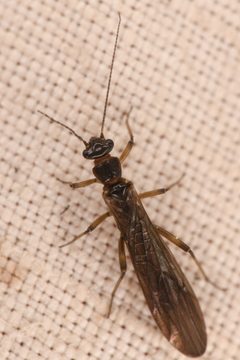
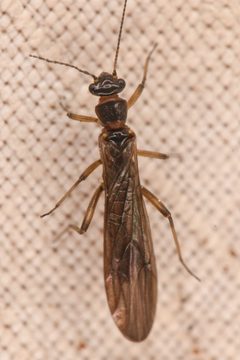
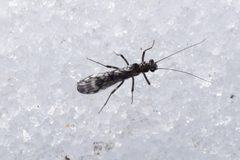
Zapada is a of small spring stoneflies in the Nemouridae, commonly known as forestflies or little brown stoneflies. The genus contains at least 10 described distributed across western North America, from Alaska and the Rocky Mountains to California. are 5–8 mm in body length and emerge in early spring, often February through April depending on elevation and species. Nymphs are aquatic that process leaf litter and other organic matter in cold, well-oxygenated streams.
Pronunciation
How to pronounce Zapada: /zəˈpɑːdə/
These audio files are automatically generated. While they are not always 100% accurate, they are a good starting point.
Identification
are distinguished from other Nemouridae by the retention of two sets of branched cervical ("neck") gills—diagnostic for the . These external gills are visible on each side of the and persist from the nymphal stage. Nymphs possess two branched gills on each side of the body. Adults are small (5–8 mm body length), brown, and inconspicuous. Mature nymphs are similarly small and found clinging to submerged rocks in flowing water.
Images
Habitat
Cold, well-oxygenated lotic waters including mountain streams, creeks, and rivers. Nymphs inhabit riffle with cobble substrate, often in moss covering boulders and cobbles. are found on bridges, logs, or other structures crossing streams. show altitudinal zonation, with different species occupying distinct elevation bands in the same watershed.
Distribution
Western North America including Alaska, Alberta, British Columbia, California, and the Rocky Mountain states. Documented from the Wasatch Mountains of Utah, Rocky Mountains of Alberta, and the Pacific Northwest. The shows a broad distribution across montane and subalpine regions.
Seasonality
emerge in early spring, with timing varying by elevation and . Peak generally occurs from mid-February to mid-April at lower elevations; higher elevation species emerge later, from mid-April to early June. Nymphal growth is confined to the ice-free period of June to November in subalpine streams.
Diet
Nymphs are detritivorous that feed on allochthonous leaf litter, fine particulate organic matter, and moss. Gut contents include moss (predominant in specimens from moss ), detritus from conifer needles (major winter food source), and conditioned leaves. Nymphs grow faster on moss than on conditioned leaves, and can utilize conifer needles only when highly conditioned and fragmented.
Life Cycle
range from (one year) to semivoltine (2–3 years) depending on and elevation. Z. cinctipes is univoltine with one per year. Z. columbiana has a predominantly 3-year life cycle in subalpine streams, though some individuals complete development in 2 years. undergo summer , hatching in autumn. Nymphal development spans the ice-free period; growth ceases during winter. do not disperse far from streams.
Behavior
Nymphs cling to submerged rocks and seek spaces in cobble substrate. are active, running rapidly on streamside structures and flying when startled. Adults of Z. cinctipes exhibit behavioral by entering water at subzero night temperatures, a strategy distinct from physiological cold mechanisms used by other insects. Emerging adults and ovipositing females show no upstream in movement.
Ecological Role
- in headwater stream . Processes coarse particulate organic matter, particularly leaf litter and moss. An abundant and important component of macroinvertebrate in cold-water mountain streams. Serves as food for fish and other . Spring stoneflies are moderately tolerant of pollution and disturbance compared to other stoneflies, making them useful but less sensitive indicators of water quality than more sensitive Plecoptera .
Human Relevance
Used as indicators of water quality in stream biomonitoring, though less sensitive to pollution than other . Important food source for trout and other game fish, making them relevant to angling and fly-fishing. timing is tracked by anglers for "hatches" that trigger fish feeding activity.
Similar Taxa
- NemouraAlso in Nemouridae; lacks the two sets of branched cervical gills diagnostic for Zapada and nymphs.
- AmphinemuraAnother Nemouridae ; distinguished by gill and other subtle morphological features.
Sources and further reading
- BugGuide
- Wikipedia
- GBIF taxonomy match
- iNaturalist taxon
- NCBI Taxonomy
- Catalogue of Life
- Bug Eric: Forestflies (Spring Stoneflies)
- DEHRISTIJANIZACIJA: TEMELJ SUMRAKA ZAPADA
- Underwater behavioural thermoregulation in the adult stonefly, Zapada cinctipes
- Comparative Ecology of Three Zapada Species of Mill Creek, Wasatch Mountains, Utah (Plecoptera: Nemouridae)
- Two New Trichomycete Species fromZapadaSpp. (Stonefly) Nymphs with an Unusual Distribution
- The life history of Zapada columbiana (Plecoptera: Nemouridae) in a Rocky Mountain stream