
Zapada cinctipes
(Banks, 1897)
Common Forestfly
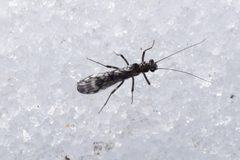
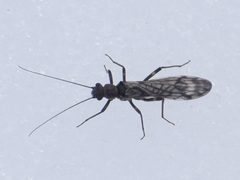
Zapada cinctipes, the common forestfly, is a small in the Nemouridae. measure 5–8 mm in body length and emerge primarily from mid-March to mid-April, with some appearing as early as late February. The is , completing one per year. Nymphs are aquatic that feed on decaying leaf material in flowing waters.
Pronunciation
How to pronounce Zapada cinctipes: /zəˈpɑːdə ˈsɪŋktɪˌpiːz/
These audio files are automatically generated. While they are not always 100% accurate, they are a good starting point.
Identification
are distinguished by retained cervical gills from the larval stage—two sets of branched gills on each side of the body, a diagnostic trait for the Zapada. Adults are small (5–8 mm body length), brown, and active runners that fly when startled.
Images
Habitat
Nymphs inhabit flowing waters where they cling to submerged rocks and heavy objects. are often found on bridges or logs spanning streams and creeks.
Distribution
North America: recorded from Alaska, Alberta, British Columbia, California, and Colorado.
Seasonality
begins as early as late February, with peak activity from mid-March to mid-April.
Diet
Nymphs feed on vegetable matter, primarily decaying leaves that fall into the water; they function as in aquatic . diet is not documented.
Life Cycle
: one per year. Nymphs develop in aquatic environments before emerging as .
Behavior
exhibit underwater behavioral , entering water to survive subzero night temperatures rather than relying on physiological cold . Adults are active runners on streamside surfaces and fly readily when disturbed.
Ecological Role
Nymphs serve as , processing coarse particulate organic matter (decaying leaves) in stream . The is moderately tolerant of pollution and human disturbance compared to other stoneflies, making it a useful but less sensitive indicator of water quality.
Human Relevance
Important to anglers as part of "hatches." Used as an indicator of stream health, though less sensitive to pollution than many other .
Similar Taxa
- Zapada (other species)Other Zapada share the diagnostic branched cervical gills; Z. cinctipes is distinguished by its (one year) versus 2–3 years in some .
- Other NemouridaeLack the paired branched cervical gills retained in Zapada; adults of other lack this structure.