
Neoconocephalus ensiger
(Harris, 1841)
Sword-bearing Conehead, Swordbearer
Neoconocephalus ensiger is a in the conehead tribe Copiphorini, recognized by the male's elongated, sword-like ovipositor-like structure at the tip. Males produce loud, distinctive songs through stridulation of modified forewings. The species occurs in grassland and prairie across eastern and central North America. It is primarily and has been observed molting to adulthood at night near ultraviolet light sources.


Pronunciation
How to pronounce Neoconocephalus ensiger: //ˌni.oʊˌkɒnoʊˈsɛfələs ˈɛnsɪdʒər//
These audio files are automatically generated. While they are not always 100% accurate, they are a good starting point.
Identification
Distinguished from other Neoconocephalus by the male's elongated, sword-shaped subgenital plate. The song is diagnostic: males produce a loud, continuous buzzing trill. Can be separated from the slightly similar Neoconocephalus nebrascensis (Nebraska conehead) by differences in song pattern and geographic range. The 'left-handed' wing overlap (left forewing over right) is typical for katydids and opposite to most crickets.
Images
Appearance
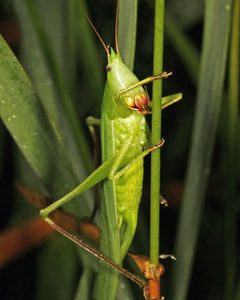
Medium to large with characteristic cone-shaped . Males possess an elongated, sword-like terminal abdominal appendage (the 'sword' giving the its ), which is actually an enlarged subgenital plate rather than a true ovipositor. Body typically green or brown, providing camouflage in grassy vegetation. Forewings of males modified for sound production with file-and-scraper stridulatory apparatus; left forewing overlaps right ('left-handed').
Habitat
Tallgrass prairie, restored prairie remnants, and grassland with dense herbaceous vegetation. Associated with open areas containing grasses and forbs, often near woodland edges. In Missouri, documented from restored tallgrass prairie with mixed upland forest and grassland.
Distribution
Eastern and central North America. Documented from Colorado, Delaware, Illinois, Indiana, Iowa, Kansas, Massachusetts, Missouri, Nebraska, Oklahoma, and Texas. Range extends from the Great Plains eastward.
Seasonality
active from mid-summer through early fall (July–September). Final-instar nymphs observed in late August. Peak singing activity during warm, humid nights.
Life Cycle
Hemimetabolous development with , nymph, and stages. Final-instar nymphs undergo nighttime molting to adulthood. Specific details of egg-laying substrate and stage not documented in available sources.
Behavior
Males sing primarily at night to attract females, producing loud, continuous trills through forewing stridulation. Nocturnally active, readily attracted to ultraviolet light sources. Observed scavenging not documented; primarily herbivorous. Males establish singing perches in vegetation to broadcast calls.
Ecological Role
Human Relevance
Subject of bioacoustic research due to distinctive male song. Occasionally encountered by entomologists and naturalists during insect surveys. Not considered an agricultural pest.
Similar Taxa
- Neoconocephalus nebrascensisNebraska conehead overlaps in range and ; distinguished by differences in male song pattern and structure of the subgenital plate
- Neoconocephalus robustusRobust conehead similar in size and preference; song and male genitalia structure differ
- Conocephalus spp.Meadow katydids in related lack the elongated sword-like male appendage and have different song characteristics
More Details
Stridulatory Mechanism
Male forewings possess a 'file' of fine teeth on one wing edge and a bladelike 'scraper' on the opposite wing. The scraper is drawn rapidly across the file to generate sound. Katydids are 'left-handed' (left forewing overlaps right), opposite to most crickets.
Etymology
Specific epithet 'ensiger' derives from Latin 'ensis' (sword) + 'ger' (bearing), referring to the male's sword-like abdominal appendage.