
Udeopsylla robusta
(Haldeman, 1850)
Robust Camel Cricket
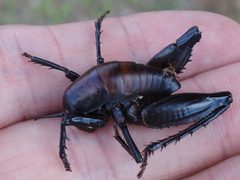
Udeopsylla robusta, commonly known as the Robust Camel Cricket, is a of camel cricket in the Rhaphidophoridae. First described by Haldeman in 1850 under the name Phalangopsis robustus, this species is native to North America and has been recorded from the United States and Mexico. The species is characterized by its robust body form typical of camel crickets, with a humpbacked appearance and long . It is primarily and has been observed in various including oak-juniper woodlands and montane environments.
Pronunciation
How to pronounce Udeopsylla robusta: /ˌjuːdiːˈɒpsɪlə roʊˈbʌstə/
These audio files are automatically generated. While they are not always 100% accurate, they are a good starting point.
Identification
Udeopsylla robusta can be distinguished from other camel crickets by its robust body structure, as indicated by its specific epithet. Members of the Udeopsylla are characterized by their humpbacked profile, long filamentous , and enlarged hind adapted for jumping. The lacks wings and has reduced , typical of cave and crevice-dwelling rhaphidophorids. Accurate identification to species level typically requires examination of genitalia and comparison with .
Images
Habitat
Recorded from oak-juniper woodlands in montane environments, including riparian areas with mixed vegetation. Has been observed near spring-fed creeks in woodland settings. The appears to favor rocky or crevice-rich microhabitats typical of camel crickets, though specific microhabitat preferences remain poorly documented.
Distribution
United States (Illinois, Kansas, Minnesota, New Mexico, Oklahoma, Texas, Arizona) and Mexico (Northeast). Records span the Great Plains, southwestern deserts, and montane regions of the western United States.
Seasonality
have been observed in late May and early June. Activity appears to be , with individuals encountered at night near ultraviolet light setups and by active searching after dark.
Behavior
in activity pattern. When disturbed, individuals have been observed to assume defensive postures, regurgitate, and defecate. The has been documented aggregating near artificial light sources at night, suggesting positive or attraction to insect prey attracted to lights.
Ecological Role
Human Relevance
Occasionally encountered by entomologists during collecting activities. Not known to be a pest . The species has been featured in entomological trip reports documenting field collecting techniques and natural history observations.
Similar Taxa
- Ceuthophilus spp.Similar body form and preferences; Ceuthophilus is a large of camel crickets in the same Ceuthophilini. Udeopsylla is distinguished by specific genitalic characters and subtle differences in body proportions.
- Daihnia brevipesAnother camel cricket occurring in similar Great Plains and western ; D. brevipes (Great Plains camel cricket) differs in distribution and specific habitat associations.