
Ceuthophilus nodulosus
Brunner von Wattenwyl, 1888
camel cricket, cave cricket
Ceuthophilus nodulosus is a of in the Rhaphidophoridae. It is a wingless, humpbacked insect with exceptionally long adapted for navigating dark environments. The species is found in North America, with records from Missouri, New Mexico, and Texas. Like other members of its , it inhabits cool, damp, dark microhabitats and is primarily .
Pronunciation
How to pronounce Ceuthophilus nodulosus: //kjuːˈθɒfɪləs nɒdʒʊˈloʊsəs//
These audio files are automatically generated. While they are not always 100% accurate, they are a good starting point.
Identification
Distinguished from true crickets (Gryllidae) by the absence of wings and the inability to produce sound. The humpbacked profile and extremely long separate it from other orthopteran groups. Within Ceuthophilus, specific identification to C. nodulosus requires examination of morphological details not consistently described in available sources; the epithet 'nodulosus' suggests tuberculate or nodular body features. Distinguished from the Asian camel cricket (Diestrammena asynamora) by native status and subtle morphological differences in body proportions and ovipositor structure.
Images
Appearance
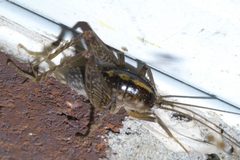
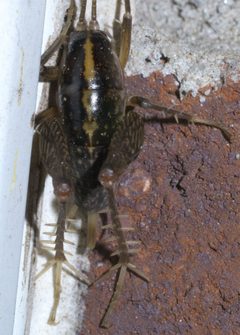
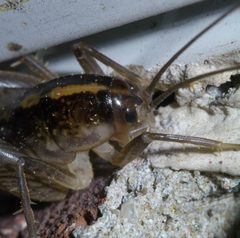
are wingless with a characteristic humpbacked (camel-like) . Body length varies by in the , typically ranging 9–35 mm. are exceptionally long, often exceeding body length, and bear sensory structures for detecting food and in darkness. Hind legs are elongated and powerful, enabling jumps of several times the body height. Females possess a prominent, blade-like ovipositor extending from the rear of the . Coloration is generally dull, often brown or tan, providing camouflage in dim .
Habitat
Cool, damp, dark microhabitats including caves, cellars, basements, mine shafts, old wells, rodent burrows, and deep woodland litter. Highly moisture-dependent; presence often indicates humid conditions. In residential settings, colonizes crawl spaces, garages, and tool sheds with elevated humidity.
Distribution
Recorded from Missouri, New Mexico, and Texas. Distribution within North America is incompletely documented; likely more widespread in suitable karst and subterranean of the south-central and southwestern United States.
Seasonality
Active year-round in stable subterranean environments. Home invasions and surface activity peak in late summer and early autumn. ; surface activity occurs primarily at night.
Diet
scavenger. Consumes decaying organic matter including leaf litter, roots, and fruits. Has been observed to feed on fungi, mold, and mildew. Captures and consumes injured or weakened insects and . Occasionally damages paper products and stored fabrics.
Life Cycle
Development includes , nymph, and stages. Females use the blade-like ovipositor to insert eggs into soil or substrate. Nymphs resemble smaller adults and undergo . Specific developmental timing for this is not documented.
Behavior
and thigmotactic, often traveling with body contact against walls or surfaces. Highly mobile; capable of jumping several feet when disturbed. Exhibits (voluntary leg detachment) when captured by , with potential for partial . Not social in the eusocial sense, but aggregates in groups under boards, stones, and debris. Attracted to molasses and dry oatmeal baits.
Ecological Role
Scavenger and decomposer in cave and subterranean . Contributes to nutrient cycling through consumption of decaying organic matter and fungal material. Serves as prey for cave-dwelling including spiders, salamanders, and small mammals. Some Ceuthophilus are obligate cave inhabitants; ecological role of C. nodulosus specifically is not documented.
Human Relevance
Occasional nuisance pest in basements, crawl spaces, and garages. Does not bite humans or transmit . Rarely causes property damage; may nibble fabrics and paper products. Fecal deposits can stain surfaces in enclosed spaces. Presence often indicates excess moisture or potential mold issues. Used as fish by some anglers.
Similar Taxa
- Diestrammena asynamoraAsian greenhouse camel cricket, in eastern North America; bested native Ceuthophilus in residential surveys. Distinguished by introduced status and subtle differences in body form.
- Ceuthophilus utahensisAnother native with overlapping range in southwestern states; distinguished by specific morphological features and preferences.
- Gryllus spp.True field crickets possess wings (in most ) and stridulatory organs for sound production; Ceuthophilus is wingless and silent.
Misconceptions
The female ovipositor is frequently mistaken for a stinger; it is harmless and functions solely in -laying. Despite the ',' camel crickets are not true crickets and do not chirp. Their spidery appearance and jumping cause unnecessary alarm, but they pose no danger to humans.
More Details
Taxonomic Note
The specific epithet 'nodulosus' (Brunner von Wattenwyl, 1888) suggests distinctive tuberculate or nodular body sculpturing, though detailed morphological descriptions are sparse in readily available literature.
Research Gap
Most ecological and behavioral information attributed to this is inferred from -level studies of Ceuthophilus; species-specific natural history remains poorly documented.
Sources and further reading
- BugGuide
- Wikipedia
- GBIF taxonomy match
- iNaturalist taxon
- Grasshoppers of Colorado
- Grasshoppers of Colorado
- Grasshoppers of Colorado
- Five-legged cricket in the bathtub: Ceuthophilus spp. (American camel crickets) and Diestrammena spp. (Asian camel crickets) — Bug of the Week
- Move over American camel crickets, Asian camel crickets are in town: Ceuthophilus sp. (American camel crickets) and Diestrammena sp. (Asian camel crickets) — Bug of the Week
- Bug Eric: Camel Crickets