
Diestrammena asynamora
(Adelung, 1902)
Greenhouse camel cricket, Asian camel cricket, Greenhouse stone cricket
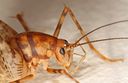
Diestrammena asynamora, commonly known as the greenhouse camel cricket or Asian camel cricket, is a wingless orthopteran native to China and other parts of Asia. First detected in the United States in a Minnesota greenhouse in 1898, it has become the camel cricket in human dwellings across eastern North America, now comprising over 90% of camel crickets found in homes in regions like Maryland, Virginia, and Washington D.C. This species thrives in dark, damp, cool environments including basements, crawl spaces, caves, and tool sheds.


Pronunciation
How to pronounce Diestrammena asynamora: /daɪˌɛstræˈmiːnə æsɪnəˈmɔrə/
These audio files are automatically generated. While they are not always 100% accurate, they are a good starting point.
Identification
Distinguished from native North American camel crickets (primarily Ceuthophilus spp.) by subtle morphological features requiring expert examination, though D. asynamora is now far more commonly encountered in human dwellings east of the Rocky Mountains. The greenhouse camel cricket can be separated from the related Asian D. japanica by detailed examination of body proportions and genitalia. In homes, the presence of any camel cricket in the eastern United States is statistically likely to be D. asynamora based on survey data. The long , humpbacked profile, and wingless condition distinguish camel crickets from true crickets (Gryllidae) and field crickets, which have shorter antennae and functional wings in .
Images
Appearance
are wingless with a characteristic humpbacked, arched that gives camel crickets their . The body is typically 9-35 millimeters in length with exceptionally long, thread-like often exceeding body length. Powerful, elongated hind legs provide remarkable jumping ability. Females possess a prominent, blade-like ovipositor extending from the rear of the , often mistaken for a stinger. Coloration is generally dull brown to tan, providing camouflage in dark . The overall appearance is spider-like, leading to frequent misidentification.
Habitat
Strongly associated with dark, damp, cool microhabitats with high humidity and low light. Natural include caves, deep woodlands, and shaded rocky crevices. In human-modified environments, occupies basements, crawl spaces, garages, tool sheds, damp woodpiles, spaces beneath upturned wheelbarrows, and shaded areas behind rubbish bins. Also found in commercial greenhouses, the habitat of its original North American detection. Has been documented invading natural limestone caves in western Maryland, suggesting expansion beyond anthropogenic habitats.
Distribution
Native to China and other parts of Asia. Introduced to North America, with first detection in Minnesota in 1898. Now established and in urban and suburban environments throughout eastern North America, particularly east of the Rocky Mountains and especially abundant in the Mid-Atlantic region (Maryland, Virginia, District of Columbia). Distribution appears centered on human dwellings and associated structures, with declining with distance from buildings in surveyed yards.
Seasonality
home invasion begins in force during late summer and early autumn. Activity continues through winter in suitable indoor microhabitats. Little crickets enter structures early in the season and often go unnoticed until they grow larger through scavenging. Year-round presence possible in climate-controlled basements and crawl spaces.
Diet
scavenger. Consumes decaying organic matter including leaves, roots, and fruits. Devours rotting remains of other insects, including conspecifics. Has been observed capturing and eating other insects and , particularly injured or weakened individuals. Indoors, may graze on mold, mildew, and fungi. Occasionally damages stored fabrics and paper products; can cause damage to vulnerable young plants in greenhouses.
Life Cycle
Development includes , nymph, and stages. Females use the blade-like ovipositor to insert eggs into soil. Nymphs resemble smaller versions of adults and develop through multiple instars. —voluntary shedding of legs when captured by —has been documented; missing legs may regenerate. Specific details of developmental timing and number per year are not well documented.
Behavior
, venturing from daytime shelters at night. Highly thigmotactic, often traveling with a shoulder near walls and congregating in corner junctions. Remarkable jumping ability using elongated hind legs; can clear obstacles more than ten times body height in a single leap. Not social in the eusocial sense, but aggregates in large numbers under suitable shelter. When disturbed, individuals scatter rapidly. of legs occurs when threatened by , with the severed limb potentially distracting the attacker while the escapes.
Ecological Role
Scavenger that consumes dead organic matter and decaying material, potentially providing nutrient cycling service in basements, garages, and caves. of weakened or injured insects. Serves as prey for various predators including spiders, , and potentially small mammals. In caves, contributes to processing organic inputs. Competitive interactions with native camel cricket (Ceuthophilus spp.) in both anthropogenic and natural ; may be displacing native species in some areas.
Human Relevance
Frequent household nuisance, particularly in basements and bathrooms, engendering strong negative reactions due to spider-like appearance and jumping . Occasionally damages stored fabrics and paper products. Fecal deposits stain wood, tools, and surfaces in sheds and other structures. Not dangerous to humans; cannot bite or sting, though large individuals could potentially nip with . Valued by some as fish . Management through moisture reduction, sealing entry points, and removal of harborage near foundations.
Similar Taxa
- Ceuthophilus spp.Native North American camel crickets; now largely displaced by D. asynamora in human dwellings but remain common in rural and natural settings. Similar humpbacked, wingless but statistically far less likely to be encountered in eastern U.S. homes.
- Diestrammena japanicaSecond Asian camel cricket recently detected in U.S. homes, particularly in the Northeast; distinguished by subtle morphological features, but D. asynamora remains far more commonly reported.
- Gryllus pennsylvanicusFall field cricket; true with functional wings in , shorter , and different body proportions. Also enters homes but is taxonomically and morphologically distinct.
More Details
Invasion History
First detected in North America in 1898 in a Minnesota greenhouse, hence the 'greenhouse camel cricket.' Remained relatively obscure for a century before a 2014 citizen science study revealed its dramatic success in colonizing human dwellings across eastern North America.
Research Significance
Subject of the 'Camel Cricket ' citizen science project by North Carolina State University's Your Wild Life lab, which documented that over 90% of camel crickets in homes in the Mid-Atlantic region were D. asynamora rather than native .
Cave Invasion
Recent observations confirm this has expanded beyond buildings into natural cave systems in western Maryland, raising questions about impacts on native cave-dwelling .
Sources and further reading
- BugGuide
- NCBI Taxonomy
- Catalogue of Life
- Asian Camel Crickets are Displacing Natives in U.S. Homes
- Bug Eric: Camel Crickets
- Does a recent home invader also invade caves in the DMV? Greenhouse camel cricket, Tachycines asynamorus — Bug of the Week
- Move over American camel crickets, Asian camel crickets are in town: Ceuthophilus sp. (American camel crickets) and Diestrammena sp. (Asian camel crickets) — Bug of the Week
- Five-legged cricket in the bathtub: Ceuthophilus spp. (American camel crickets) and Diestrammena spp. (Asian camel crickets) — Bug of the Week
- Archive — Bug of the Week