
Diestrammena japanica
Blatchley, 1920
Japanese camel cricket
Diestrammena japanica is a of camel cricket native to Japan. It has been identified as an in the eastern United States, where it has been observed in homes, particularly in the Northeast. In its native range in China, it serves as a keystone scavenger species in karst cave , inhabiting all light zones from cave entrances to deep dark regions. Research indicates its varies with light intensity, with individuals in light regions being significantly larger than those in dark cave zones.
Pronunciation
How to pronounce Diestrammena japanica: //ˌdaɪeɪˈstræmɛnə dʒəˈpænɪkə//
These audio files are automatically generated. While they are not always 100% accurate, they are a good starting point.
Identification
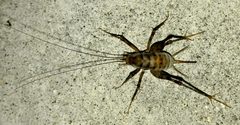
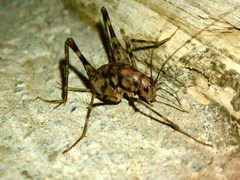
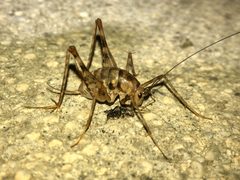
Diestrammena japanica can be distinguished from the closely related and more common Diestrammena asynamora (greenhouse camel cricket) by subtle morphological differences; definitive identification requires examination of physical specimens rather than photographs alone. Both share the characteristic hump-backed appearance, wingless condition, exceptionally long , and enlarged hind legs typical of camel crickets. In the eastern United States, D. japanica has been reported primarily from the Northeast, while D. asynamora dominates in the mid-Atlantic region and areas east of the Mississippi River.
Images
Habitat
In its native range: karst caves in southwestern China, inhabiting light regions near entrances (<10 m from entrance, direct sunlight), weak light regions (twilight zone, 10–30 m from entrance), and dark regions (deep zones, >50 m from entrance, entirely dark). Cave environments characterized by darkness, moistness, constant temperature, poor air circulation, high CO2 concentration, and low . In the range: basements, garages, crawl spaces, tool sheds, and other human structures with high humidity and low light levels; also found in damp wood piles and leaf litter near building foundations.
Distribution
Native to Japan; established in karst caves in southwestern China (Libo County, Guizhou Province). in the eastern United States, with confirmed observations in the Northeast; precise distribution in North America remains under investigation. First detected in the United States in the 19th century according to some sources, though formal reports of D. japanica specifically in the U.S. were lacking until citizen science surveys in the 2010s.
Seasonality
home invasion in the range begins in force in late summer and early autumn. Activity continues through winter in heated structures.
Diet
Scavenger; in native cave , diet varies by light region—moss and fern material in light regions, animal carcasses and fungi in weak light and dark regions. In human structures, has been observed to consume decaying organic matter, mold, mildew, fungi, and stored fabrics.
Behavior
Exhibits thigmotaxis, traveling with a shoulder near walls. Capable of —discarding a leg when threatened by a , with the severed limb potentially distracting the predator while the insect escapes. Possesses powerful jumping ability; individuals have been observed leaping more than ten times their body height. Not social in the sense of eusocial insects, but aggregates in groups under boards, stones, bricks, logs, and leaf litter. Nocturnally active, venturing from daytime shelters at night.
Ecological Role
Keystone scavenger in karst cave in its native range, providing energy to the cave . Gut bacteria likely contribute to nutrition by supplying and may play a role in body size to varying light conditions. In the range in North America, potential ecological impacts remain unknown; may compete with native camel cricket species (Ceuthophilus spp.) in human-modified environments.
Human Relevance
Recognized as an in the eastern United States. Occasionally considered a nuisance pest in basements, garages, and crawl spaces due to its presence and jumping . May nibble stored fabrics and paper products; fecal deposits can stain wood and tools in sheds. Has been used as fish . Not dangerous to humans; does not bite or sting. The female's blade-like ovipositor is often mistaken for a stinger but is used only for -laying in soil.
Similar Taxa
- Diestrammena asynamoraAlso an Asian camel cricket in North America; D. asynamora is far more common in homes east of the Rocky Mountains and dominates in the mid-Atlantic region, while D. japanica appears restricted to the Northeast. D. asynamora was established in North America before 1900 and was originally known as the greenhouse camel cricket. The two require physical specimens for definitive differentiation.
- Ceuthophilus spp.Native North American camel crickets; approximately 90 in this represent the most common native camel crickets in the United States. Asian Diestrammena species have displaced native Ceuthophilus in residential environments, with surveys showing over 90% of camel crickets in some eastern U.S. homes being Asian species rather than natives.
More Details
Morphological plasticity
Body size in D. japanica varies significantly with light intensity in cave . Individuals from light regions near cave entrances are substantially larger than those from weak light and dark regions. This morphological variation may be mediated by gut bacterial contributions to nutrition and metabolism.
Gut microbiome
Gut bacterial composed of 245 operational taxonomic units from nine , with Firmicutes as the phylum. Bacterial composition and diversity do not differ significantly among light regions, but bacterial groups may serve different metabolic functions under varying light conditions. Individuals exhibit lower metabolic rates in dark cave compared to light regions.
Detection history in North America
While camel crickets in the Diestrammena were first detected in the United States in 1898 (D. asynamora in Minnesota), D. japanica was not formally reported from the U.S. until citizen science surveys in the 2010s identified it from photographs submitted by residents in the Northeast. Researchers have noted the need for physical specimens to confirm its identification and establish its full distribution.
Sources and further reading
- BugGuide
- Wikipedia
- GBIF taxonomy match
- iNaturalist taxon
- NCBI Taxonomy
- Catalogue of Life
- Does a recent home invader also invade caves in the DMV? Greenhouse camel cricket, Tachycines asynamorus — Bug of the Week
- Asian Camel Crickets are Displacing Natives in U.S. Homes
- Move over American camel crickets, Asian camel crickets are in town: Ceuthophilus sp. (American camel crickets) and Diestrammena sp. (Asian camel crickets) — Bug of the Week
- Five-legged cricket in the bathtub: Ceuthophilus spp. (American camel crickets) and Diestrammena spp. (Asian camel crickets) — Bug of the Week
- Getting by on five - can losing a leg save a life? Leaffooted bugs, Leptoglossus and Diactor, field and camel crickets, Gryllus and Diestrammena — Bug of the Week
- Bug Eric: Camel Crickets
- Gut bacteria reflect the adaptation of Diestrammena japanica (Orthoptera: Rhaphidophoridae) to the cave