
Diestrammena
Brunner von Wattenwyl, 1888
Asian camel cricket, cave cricket, greenhouse camel cricket
Species Guides
2- Diestrammena asynamora(Greenhouse camel cricket)
- Diestrammena japanica(Japanese camel cricket)
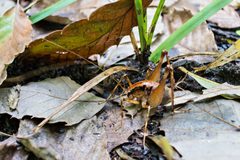
Diestrammena is a of camel crickets ( Rhaphidophoridae) native to Asia, including Japan, China, and Southeast Asia. Several have become in North America, particularly in residential basements, garages, and caves. These wingless crickets are characterized by their humpbacked appearance, extraordinarily long , and powerful jumping legs. Research has shown that Asian camel crickets now dominate indoor environments in many parts of the eastern United States, having largely displaced native camel cricket species.


Pronunciation
How to pronounce Diestrammena: //daɪˌɛstrəˈmiːnə//
These audio files are automatically generated. While they are not always 100% accurate, they are a good starting point.
Identification
Distinguished from the similar Diestramima by subtle morphological differences in the Aemodogryllinae. Distinguished from native North American camel crickets (primarily Ceuthophilus) by genetic and subtle morphological differences; identification to level requires examination of genitalia and other fine structural features. All Diestrammena species are wingless with long, thread-like often exceeding body length, humpbacked , and enlarged hind adapted for jumping.
Images
Habitat
Native inhabit caves, deep woodlands, and moist rocky across Asia. populations in North America occupy basements, crawl spaces, garages, tool sheds, damp wood piles, and natural caves. Highly moisture-dependent; favors dark, humid environments with temperatures between 10-20°C. In caves, occupies all zones from entrance (light region) to deep interior (dark region), showing morphological plasticity based on light availability.
Distribution
Native to Asia: Japan, China (including Inner Mongolia, North-central and Southeast regions), Cambodia, and Indo-China region including Sulawesi. in North America: established throughout eastern United States east of the Rocky Mountains, with highest densities in Maryland, Virginia, Washington D.C., and surrounding mid-Atlantic states. First detected in North America in Minnesota in 1898.
Seasonality
home invasion in North America begins late summer and early autumn (August-October), continuing through winter in heated structures. Activity year-round in cave environments. Peak visibility in residential settings occurs autumn through early spring when crickets seek shelter.
Diet
Scavenger; consumes decaying organic matter including leaves, roots, fruits, fungi, and rotting insect remains. Diet varies by : in cave light zones consumes more moss and fern material; in dark zones feeds more heavily on animal carcasses and fungi. Occasionally damages stored fabrics, paper products, and vulnerable greenhouse plants.
Life Cycle
deposited in soil or substrate using blade-like ovipositor. Development includes egg, nymph, and stages; nymphs resemble smaller adults. Specific developmental rates and seasonal timing vary by and latitude.
Behavior
; ventures from daytime shelters at night to forage. Exhibits thigmotaxis, traveling with body contact against walls and corners. Capable of (self-amputation of legs) when captured by , with subsequent in some cases. Remarkable jumping ability: can leap more than ten times body height. Non-aggressive; poses no danger to humans.
Ecological Role
Keystone scavenger in native Asian cave , providing energy transfer through decomposition of organic matter. in North America compete with and have largely displaced native camel cricket (Ceuthophilus) in anthropogenic . Gut assists in nutrition and to cave environments, potentially contributing to body size regulation.
Human Relevance
Occasional nuisance pest in homes, staining surfaces with fecal deposits and causing minor fabric damage. Serves as excellent fish . Subject of significant ecological research regarding dynamics and cave . Some (particularly D. japanica) used as model organisms for studying gut microbiome contributions to adaptation in extreme environments.
Similar Taxa
- DiestramimaSimilar name in same Aemodogryllinae; distinguished by subtle morphological features, not to be confused with Diestrammena despite nomenclatural similarity
- CeuthophilusNative North American camel cricket ; Diestrammena have largely displaced Ceuthophilus in residential indoor environments in the eastern United States
- TachycinesClosely related Asian camel cricket ; T. asynamorus (formerly placed in Diestrammena) is a major in North America with similar and appearance
Sources and further reading
- BugGuide
- Wikipedia
- GBIF taxonomy match
- iNaturalist taxon
- NCBI Taxonomy
- Catalogue of Life
- Move over American camel crickets, Asian camel crickets are in town: Ceuthophilus sp. (American camel crickets) and Diestrammena sp. (Asian camel crickets) — Bug of the Week
- Five-legged cricket in the bathtub: Ceuthophilus spp. (American camel crickets) and Diestrammena spp. (Asian camel crickets) — Bug of the Week
- Getting by on five - can losing a leg save a life? Leaffooted bugs, Leptoglossus and Diactor, field and camel crickets, Gryllus and Diestrammena — Bug of the Week
- Does a recent home invader also invade caves in the DMV? Greenhouse camel cricket, Tachycines asynamorus — Bug of the Week
- Bug Eric: Camel Crickets
- Archive — Bug of the Week
- Gut bacteria reflect the adaptation of Diestrammena japanica (Orthoptera: Rhaphidophoridae) to the cave