
Ellipes
Scudder, 1902
pygmy mole crickets
Species Guides
6- Ellipes californicus
- Ellipes deyrupi(Deyrup's Pygmy Mole Cricket)
- Ellipes eisneri(Eisner's Pygmy Mole Cricket)
- Ellipes gurneyi
- Ellipes minuta(Smaller Sand Cricket)
- Ellipes monticolus(canyon pygmy mole cricket)
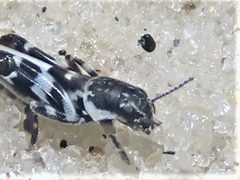
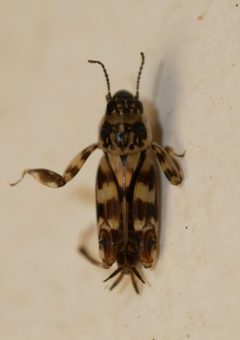
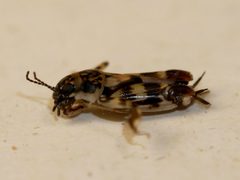
Ellipes is a of pygmy mole crickets (Orthoptera: Tridactylidae) containing small, insects. Most tridactylids inhabit moist margins of ponds and streams, but some Ellipes have independently evolved to occupy xeric scrub and sandhill . The genus includes at least six described species distributed across North and South America, with several Florida endemics exhibiting restricted ranges and limited study due to their minute size and cryptic habits.
Pronunciation
How to pronounce Ellipes: //ˈɛlɪpiːz//
These audio files are automatically generated. While they are not always 100% accurate, they are a good starting point.
Identification
Ellipes are distinguished from other tridactylid by genitalic characters, particularly male genitalia structure. The genus contains some of the smallest mole crickets, with often measuring only a few millimeters. Species-level identification requires examination of genitalia and is not reliably accomplished from external alone.
Images
Habitat
varies by lineage: most Ellipes inhabit moist environments near ponds and streams, while derived scrub-dwelling (E. eisneri, E. deyrupi) occupy xeric scrub and sandhill habitats in Florida's sandy uplands. E. monticolus occurs in canyon environments of the Chiricahua Mountains, Arizona.
Distribution
North and South America: United States (California, Baja California Norte, Florida, southern and southwestern U.S., eastern and central North America), Argentina (Northeast, Northwest), Belize, Brazil (West-central). Several have highly restricted ranges: E. eisneri (Northern Brooksville Ridge, Florida), E. deyrupi (northern Lake Wales Ridge, Florida), E. monticolus (Chiricahua Mountains, Arizona).
Behavior
Scrub-dwelling Florida (E. eisneri, E. deyrupi) exhibit convergent habits with Neotridactylus archboldi, including to xeric conditions. E. deyrupi is sympatric with N. archboldi at all known locations but has not been found co-occurring with E. eisneri despite their close relationship. Members of the are , spending much of their lives in soil or sand.
Human Relevance
Conservation concern for Florida scrub due to restricted geographic ranges and specificity. E. monticolus remained virtually unknown from 1977 until 2020, illustrating the difficulty of detecting and studying these insects. No known agricultural or economic significance.
Similar Taxa
- NeotridactylusSympatric with scrub-dwelling Ellipes in Florida; convergent ecological adaptations to xeric scrub ; E. deyrupi co-occurs with N. archboldi at all known locations
- TridactylusShared Tridactylidae; both contain pygmy mole crickets with habits, though Tridactylus typically occupy more mesic
More Details
Taxonomic note
The Wikipedia entry contains a typographical error, listing the as "Ellipses" rather than "Ellipes". The correct spelling is Ellipes Scudder, 1902.
Research challenges
remain poorly known due to minute size (often <5mm), cryptic habits, and difficulty of collection. E. monticolus was known only from genitalia drawings for 43 years until first live photographs were obtained in 2020.
Sources and further reading
- BugGuide
- Wikipedia
- GBIF taxonomy match
- iNaturalist taxon
- NCBI Taxonomy
- Catalogue of Life
- First natural history observations of the canyon pygmy mole cricket, Ellipes monticolus (Orthoptera: Tridactylidae)
- A new species of pygmy mole cricket (Orthoptera: Tridactylidae) from the Lake Wales ridge of Florida and new records of Ellipes eisneri from the northern Brooksville ridge