
Ellipes monticolus
Günther, 1977
canyon pygmy mole cricket
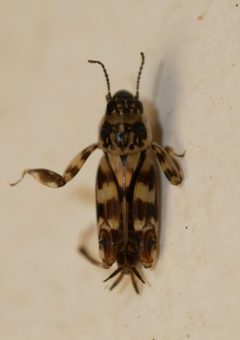
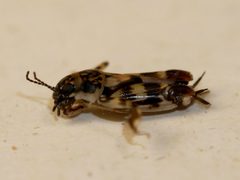
Ellipes monticolus is a poorly known pygmy to canyon environments in the southwestern United States. First described in 1977 from genitalia drawings alone, the remained without natural history documentation until 2020, when the first live photographs and field observations were published from the Chiricahua Mountains of Arizona. The species inhabits the Sky Islands region, a biodiversity hotspot characterized by isolated mountain ranges. As a member of Tridactylidae, it likely exhibits adaptations for burrowing in moist substrates near water.
Pronunciation
How to pronounce Ellipes monticolus: /ˈɛlɪpiːz mɒnˈtɪkələs/
These audio files are automatically generated. While they are not always 100% accurate, they are a good starting point.
Identification
Ellipes monticolus can be distinguished from other Ellipes by genitalic characters, though specific diagnostic features for field identification remain undocumented. The Ellipes is characterized by reduced wings and forelegs adapted for digging. Without published comparative studies, separation from in the southwestern United States requires examination of male genitalia.
Images
Habitat
Canyon environments in the Chiricahua Mountains of southeastern Arizona. Based on -level traits, likely associated with moist, sandy or muddy substrates near water sources where burrowing is possible.
Distribution
Chiricahua Mountains, southeastern Arizona (Sky Islands region). GBIF records indicate additional presence in Utah, though these require verification.
Behavior
Has been observed in canyon ; specific remain undocumented. As a tridactylid, likely exhibits burrowing behavior and may be capable of swimming or floating on water surfaces, traits known in .
Similar Taxa
- Ellipes minutaOverlapping distribution in southwestern United States; both are small, wing-reduced tridactylids requiring genitalic examination for reliable separation.
- Ellipes eumeraSympatric in western North America; similar and preferences.