
Neotridactylus
Günther, 1972
Pygmy mole crickets, Pygmy sand crickets, Pygmy mole grasshoppers
Species Guides
2- Neotridactylus apicialis(larger pygmy mole grasshopper)
- Neotridactylus archboldi(Archbold pygmy mole cricket)
Neotridactylus is a of pygmy mole crickets in the Tridactylidae, containing approximately 16 described distributed across the Americas. These insects are small, orthopterans that inhabit sandy margins of aquatic . Despite their , they are more closely related to short-horned grasshoppers than to true mole crickets. The genus was established by Günther in 1972.
Pronunciation
How to pronounce Neotridactylus: /niːoʊtrɪˈdæktɪləs/
These audio files are automatically generated. While they are not always 100% accurate, they are a good starting point.
Identification
Distinguished from true mole crickets ( Gryllotalpidae) by their pygmy family affiliation (Tridactylidae) and -like hind leg . Distinguished from other pygmy mole cricket by genitalic characters and geographic distribution in the Americas. The enlarged hind that obscure the wings are a key visual cue. In North America, N. apicalis (the "Larger Pygmy Mole Cricket") is the most commonly encountered , ranging from southern Ontario to southern California.
Images
Appearance
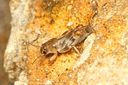
measure 5.5–10 mm in length, roughly the size of a grain of rice. The hind are disproportionately enlarged and typically conceal the folded wings when at rest. The forewings are leathery, reduced to short stubs. The membranous hind wings are pleated and extend slightly beyond the when folded. The overall body form is compact and adapted for burrowing.
Habitat
Sandy or silty substrates along margins of streams, rivers, ponds, and lakes. Burrows extend 2–3 cm below the surface. Requires moist but not saturated soils suitable for tunneling.
Distribution
Recorded from the Americas, including: extreme southern Ontario, Massachusetts, Florida, and southern California in North America; Argentina Northeast; and multiple regions of Brazil (West-central, Northeast, Southeast, North). Most appear to be tropical in distribution.
Diet
Ingests sand particles together with and organic matter adhering to them.
Life Cycle
Females create chambers at the bottom of their tunnels. Specific developmental stages and duration are not well documented.
Behavior
habit: tunnels under sand along water margins. Moves slowly when undisturbed. When disturbed, executes powerful jumps that result in rapid, unpredictable displacement—individuals are difficult to relocate after jumping. Tolerant of close approach when not threatened. Jumping performance involves remarkable acceleration; the biomechanics involve specialized adaptations documented in experimental studies.
Ecological Role
Contributes to substrate turnover in riparian sandy through burrowing activity. Feeding on and organic detritus likely contributes to nutrient cycling in these marginal aquatic environments.
Human Relevance
Of minimal direct economic importance. Occasionally encountered by naturalists and photographers in riparian . Subject of biomechanical research due to exceptional jumping performance.
Similar Taxa
- Gryllotalpidae (true mole crickets)True mole crickets have forelegs modified for digging, whereas Neotridactylus has enlarged hind legs adapted for jumping and lacks specialized digging forelegs.
- Tettigidea (grouse locusts)Grouse locusts share and general body plan but have different wing structure and are in Tetrigidae; they also have an elongated pronotum that extends over the , unlike Neotridactylus.
- Other Tridactylidae generaOther pygmy occur primarily in the Old World tropics; Neotridactylus is distinguished by its New World distribution and specific genitalic .
Misconceptions
Despite the "pygmy ," these insects are not closely related to true mole crickets ( Gryllotalpidae). They are more closely related to short-horned grasshoppers (family Acrididae). The name reflects convergent rather than phylogenetic affinity.
More Details
Jumping biomechanics
Research by Burrows and Picker (2010) in the Journal of Experimental documented the exceptional jumping performance of pygmy mole crickets, revealing acceleration mechanisms that would produce incapacitating G-forces in vertebrates of comparable .
Taxonomic history
The was established by Günther in 1972 to accommodate New World previously placed in other tridactylid genera.