
Neotridactylus apicialis
(Say, 1825)
larger pygmy mole grasshopper, larger pygmy locust, larger sand cricket, larger pygmy mole cricket
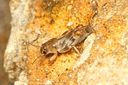
Neotridactylus apicialis is a minute orthopteran in the Tridactylidae, one of only two currently recognized in North America. measure 5.5–10 mm and possess disproportionately enlarged hind legs adapted for powerful jumping. The species inhabits sandy margins of freshwater bodies, where it constructs shallow burrows and exhibits . Despite their , pygmy mole crickets are more closely related to short-horned grasshoppers than to true mole crickets (Gryllotalpidae).
Pronunciation
How to pronounce Neotridactylus apicialis: //ˌniː.oʊ.trɪˈdæktɪləs ˌeɪˌpɪʃiˈælɪs//
These audio files are automatically generated. While they are not always 100% accurate, they are a good starting point.
Identification
The combination of minute size (under 10 mm), enormously enlarged hind that conceal the wings, reduced leathery forewings, and along sandy freshwater margins distinguishes this from all other North American orthopterans. The only other North American tridactylid, Ellipes minuta, is smaller and has different wing proportions. True mole crickets (Gryllotalpidae) have forelegs modified for digging, which pygmy mole crickets lack.
Images
Appearance
are minute, ranging 5.5–10 mm in length—approximately the size of a grain of rice. The hind legs are enormously developed relative to body size, with the hind typically concealing the folded wings when at rest. Forewings are leathery, reduced to short stubs. Hind wings are membranous, pleated, and extend slightly beyond the when folded. Body form is compact and somewhat cylindrical, adapted for burrowing in loose substrates.
Habitat
Sandy or silty margins of streams, rivers, ponds, and lakes. The substrate must be sufficiently loose to permit burrowing. Observed in riparian zones with exposed sandbars and streamside boulders.
Distribution
North America: extreme southern Ontario east to Massachusetts, south to Florida, and west to southern California. Also recorded in South America: Colombia, Ecuador, and Guatemala.
Seasonality
Active have been observed in December in Arizona, suggesting year-round activity in warmer regions. Seasonal patterns in temperate portions of the range are poorly documented.
Diet
Ingests sand particles together with and other organic matter adhering to them. Specific algal or other dietary components have not been identified.
Life Cycle
Females construct subterranean burrows extending 2–3 cm below the surface, with chambers created at the bottom of tunnels. Developmental stages and duration are undocumented.
Behavior
Primarily , tunneling beneath sand along water margins. Moves slowly when undisturbed on the surface. When disturbed, executes powerful jumps that enable rapid escape; the physics of these jumps involve remarkable acceleration. Tolerates close approach when not threatened. Burrows are shallow and temporary structures.
Ecological Role
Functions as a primary consumer in riparian , processing and organic detritus in sandy substrates. Serves as prey for various , though specific predator relationships are undocumented. Contributes to nutrient cycling in the between aquatic and terrestrial .
Human Relevance
No documented economic importance. Occasionally encountered by naturalists and photographers due to its unusual and jumping ability. The cited in biomechanical research on insect jumping performance.
Similar Taxa
- Ellipes minutaThe only other North American tridactylid; smaller in size with different wing proportions.
- Gryllotalpidae (true mole crickets)Superficially similar and habit, but possess modified fossorial forelegs for digging and belong to a different superfamily; pygmy mole crickets lack digging forelegs and jump instead.
Misconceptions
Despite the 'pygmy ,' this and its relatives are not closely related to true mole crickets ( Gryllotalpidae). The name reflects convergent burrowing habits rather than phylogenetic affinity. They are more closely related to short-horned grasshoppers (Acrididae).
More Details
Biomechanics
The jumping performance of pygmy mole crickets has been studied experimentally (Burrows & Picker, 2010, Journal of Experimental ). The acceleration forces generated during escape jumps are extreme; scaled to human proportions, such forces would likely cause loss of consciousness.
Taxonomic note
One of only two in the Tridactylidae currently recognized from North America; the family is predominantly tropical in distribution.