
Campylacantha olivacea
(Scudder, 1875)
Fuzzy Olive-Green Grasshopper, Olive Grasshopper
Species Guides
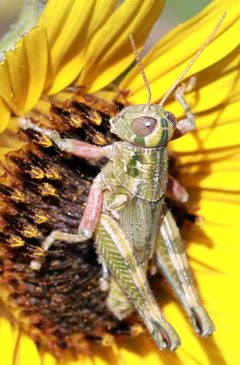
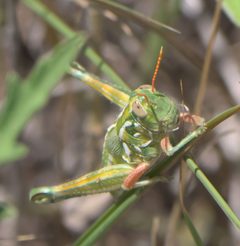
2Campylacantha olivacea is a of spur-throated grasshopper in the Acrididae, commonly known as the fuzzy olive-green or olive grasshopper. The species is characterized by its uniform olive-green to brown body coloration and is classified within Melanoplinae (Catantopinae). Three are recognized: C. o. olivacea, C. o. similis, and C. o. vivax. It is an uncommon species with a scattered distribution in North America.
Pronunciation
How to pronounce Campylacantha olivacea: /ˌkæm.pɪ.ləˈkæn.θə ˌoʊ.lɪˈveɪ.sɪə/
These audio files are automatically generated. While they are not always 100% accurate, they are a good starting point.
Identification
Distinguished from Dactylotum bicolor and other brightly colored Melanoplinae by its uniform olive-green to brown coloration rather than black, orange, and yellow patterning. Hind tibiae are olive-green to brown, not blue-black. Male subgenital plate is not notched or only weakly notched at the tip, contrasting with the deeply notched subgenital plate of Cyrtacanthacridinae . Separated from other uniform-colored Melanoplinae by geographic distribution and male genitalia characteristics (subgenital plate shape and tip structure).
Images
Habitat
Associated with grassland and prairie in the central United States. Specific microhabitat preferences are poorly documented due to the ' rarity.
Distribution
North America: documented from Arizona, Arkansas, Colorado, Illinois, and Missouri. Uncommon in southeast Colorado. Distribution appears scattered and localized across the central United States.
Similar Taxa
- Dactylotum bicolorBright contrasting black, orange, and yellow coloration with blue-black hind tibiae, versus uniform olive-green to brown in C. olivacea. Widespread in eastern Colorado where C. olivacea is uncommon.
- Schistocerca alutaceaLarge size with tegmina length usually over 30 mm and deeply notched male subgenital plate; belongs to Cyrtacanthacridinae rather than Melanoplinae.
- Other Melanoplinae (Melanoplus, Hesperotettix)Similar characteristics including unnotched or weakly notched male subgenital plate and mesosternal lobes not longer than wide, but differ in male genitalia details, coloration patterns, and geographic distribution.
More Details
Taxonomic Classification
Classified in tribe Dactylotini within Melanoplinae (also referred to as Catantopinae in some sources). The Campylacantha is morphologically allied to Dactylotum based on male genitalia structure.
Subspecies
Three recognized: Campylacantha olivacea olivacea (Scudder, 1875) - the nominate subspecies; C. o. similis Scudder & S.H., 1897; and C. o. vivax (Scudder & S.H., 1876). Subspecies distinctions are based on subtle morphological differences in male genitalia and geographic distribution.
Rarity and Data Limitations
Considered uncommon throughout its range. The is documented in survey manuals for Colorado and Wyoming primarily due to its inclusion in identification keys, but detailed biological studies are lacking. Most observations are of males identified through genitalia dissection.