
Opeia obscura
(Thomas, 1872)
obscure grasshopper
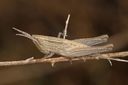
Opeia obscura, commonly known as the obscure grasshopper, is a slant-faced grasshopper in the Acrididae. It is widely distributed across the grasslands of North America and into Central America. The is a feeder on blue grama grass (Bouteloua gracilis) and is considered a late-hatching , with typically hatching in June. While it can contribute to rangeland damage during grasshopper , rarely reach outbreak densities independently.
Pronunciation
How to pronounce Opeia obscura: /oʊˈpaɪə ɒbˈskjʊərə/
These audio files are automatically generated. While they are not always 100% accurate, they are a good starting point.
Identification
can be distinguished from similar slant-faced grasshoppers by the combination of: strongly slanted with invisible lateral foveolae from above; single carina on ; pronotum with parallel lateral carinae and median carina cut once behind the middle; solidly colored pronotal disk without dark stripes or triangles; and the longitudinal dark brown broken band on the tegmina. Nymphs can be separated from the superficially similar Eritettix simplex (velvetstriped ) and Psoloessa delicatula (brownspotted grasshopper) by the entirely pale tan pronotum—E. simplex has a dark velvet band along each side of the pronotum, while P. delicatula has a nearly vertical face rather than a strongly slanting one. O. obscura also hatches approximately one month earlier than these two .
Images
Appearance
are pale tan to pale green in coloration. Males are small-bodied, females medium-sized. The has a strongly slanted with lateral foveolae of the vertex invisible from above; the top of the head bears a single carina. are (sword-shaped). The pronotum has nearly parallel lateral carinae and a median carina that is cut once behind the middle. The disk of the pronotum is solidly colored without dark stripes or triangles. Tegmina display a longitudinal, dark brown, broken band in the center. The hind has a dark stripe in the upper part of the medial area, variable in width and darkness. Hind tibia is pale tan or gray. Nymphs are pale tan with faint markings that become more evident in later instars; the median carina of the pronotum is entire in instars I-III, slightly cut in instar IV, and more so in instar V.
Habitat
Inhabits grasslands of North America, particularly shortgrass and mixedgrass prairies. Thrives in dominated by short grasses, especially blue grama, with patches of mid grasses used for roosting and basking. In tallgrass prairie, scattered may occupy upper ridges vegetated by short grasses. Typically found in areas where blue grama is abundant.
Distribution
Widely distributed in the grasslands of North America, from the shortgrass prairie of Colorado to the mixedgrass prairie of Montana and Wyoming. Recorded from California, Minnesota, Montana, and parts of Mexico (Central and Northeast regions). In Wyoming, found primarily in the mixedgrass prairie of eastern Wyoming. In Arizona, appear as early as April. Not found in mountainous areas west of Boulder, Colorado, indicating limited into high elevations.
Seasonality
Late-hatching . begin hatching in the first to last week of June in Colorado, Montana, and Wyoming; hatching period is typically two weeks but may extend to four weeks. Nymphal development requires 36 to 50 days. appear from late July to early August in northern plains; as early as April in Arizona. Adults persist until October, with attrition from and reducing numbers by late season. One per year.
Diet
grass feeder with strong preference for blue grama (Bouteloua gracilis). Crop contents from Colorado, Kansas, Nebraska, and North Dakota consisted of 85 to 100 percent blue grama. Nineteen other grass have been recorded in crop contents in small amounts, including needle-and-thread, buffalograss, sand dropseed, little bluestem, and western wheatgrass. Trace amounts of sedges, forbs, fungi, and parts have been found. Feeds chiefly on green leaves, cutting leaves near the middle and consuming them from that point to the tip. Not observed to feed on plant litter or bran .
Host Associations
- Bouteloua gracilis - primary food plantblue grama; constitutes 85-100% of diet
- Hesperostipa comata - secondary food plantneedle-and-thread; minor component of diet
- Bouteloua dactyloides - secondary food plantbuffalograss; minor component of diet
- Sporobolus cryptandrus - secondary food plantsand dropseed; minor component of diet
- Schizachyrium scoparium - secondary food plantlittle bluestem; minor component of diet
- Pascopyrum smithii - secondary food plantwestern wheatgrass; minor component of diet
Life Cycle
Hemimetabolous development with three stages: , nymph, and . Eggs are deposited deep in soil (5/8 to 7/8 inch depth) in pods with weak earthen walls; each pod contains 8-10 small (4-4.3 mm) pale tan eggs. Eggs overwinter in and hatch in spring when soil temperatures reach approximately 50-55°F. Nymphs pass through five instars, requiring 36-50 days to reach adulthood under warm conditions. Adults have a pre-reproductive period of one to two weeks before mating. Females deposit eggs in bare ground; one observed oviposition took 100 minutes to complete, followed by 20 minutes to withdraw the and 90 seconds to brush soil over the hole. One annually.
Behavior
Phytophilous that spends most of each day sitting vertically, up, on stems and leaves of grasses. Night is spent 1-2 inches above ground on grasses and sedges. Basking begins approximately one hour after sunrise by adjusting position to expose a side or back to direct sunlight; may also take diagonal positions on blue grama plants or small soil mounds. Feeding begins when ground temperature reaches 85°F and air temperature reaches 70°F. When flushed, nymphs typically jump onto another plant; may jump or make short evasive of 2-5 feet at heights of 3-6 inches. Flight is straight and silent. Under high heat (soil 110-130°F, air ≥90°F), seeks protection by climbing up to 4 inches on midgrasses, taking diagonal positions to reduce sun exposure, or resting in shade under vegetation . Evening activity ends with basking in sunset rays while resting vertically on grasses.
Ecological Role
Primary consumer in grassland ; functions as a herbivore on blue grama grass. At low densities (less than 8 per square yard), may become the in , reaching peak densities of 4 per square yard. Contributes to forage loss on western rangelands through direct consumption and occasional clipping without consumption. Serves as prey for various and including birds, rodents, flies, beetles, and . treatment of areas can eliminate local for up to four years, indicating limited recolonization ability.
Human Relevance
Considered a minor pest of rangeland in western North America. Concentrates feeding on blue grama, an important forage grass for livestock. Has two damaging habits: ingesting green leaves and occasionally cutting and dropping them without consumption. However, rarely reach densities (≥25 per square yard) independently; typically adds 0.3 to 3 grasshoppers per square yard to existing outbreak densities, slightly increasing overall damage. In low- , may become but remains below . Not susceptible to bran of agents such as , limiting management options. Light weight class among range grasshoppers reduces per-capita forage consumption compared to heavier .
Similar Taxa
- Eritettix simplexNymphs co-occur and appear superficially similar, but E. simplex has a dark velvet band along each side of the pronotum while O. obscura is entirely pale tan; both have strongly slanting
- Psoloessa delicatulaNymphs co-occur and appear superficially similar, but P. delicatula has a nearly vertical while O. obscura has a strongly slanting face; O. obscura also hatches approximately one month earlier
- Ageneotettix deorumBoth are slant-faced grasshoppers in the same and may co-occur in mixedgrass prairie; A. deorum is a major with higher vagility and different preferences
More Details
Population Ecology
Usually a subdominant member of in mixedgrass prairie and often in shortgrass prairie. Typical densities range from less than 0.1 to 2.2 per square yard. In eastern Wyoming mixedgrass prairie, found in 18 percent of survey sites (77 of 419 sites) in 1991. fluctuations may follow Parker's model of gradual increase over several years followed by a large increase, though shortgrass prairie populations in Colorado showed different dynamics with 1.7 to 2.7 fold increases over four years.
Dispersal Limitations
have long wings ranging from nearly reaching the end of the to surpassing it by 3 mm, but vagility is less than most long-winged rangeland . Absence from mountains west of Boulder, Colorado indicates little movement from natural grassland . Recolonization of -treated areas is slow, with eliminated for up to four years and only occasional individuals arriving from surrounding untreated rangeland.
Taxonomic Placement
Member of Gomphocerinae (slant-faced grasshoppers), tribe Eritettigini. Distinguished from spurthroated grasshoppers (Melanoplinae) by the absence of a spur between the front legs and from bandwinged grasshoppers (Oedipodinae) by the slanted and colorless hindwings.