
Eritettix simplex
(Scudder, 1869)
velvet-striped grasshopper, velvet-striped locust
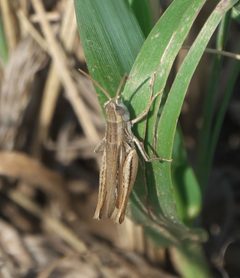
Eritettix simplex, the velvet-striped grasshopper, is a medium-sized slant-faced grasshopper in the Acrididae. It is characterized by distinctive velvet-like dark bands along the lateral carinae of the pronotum and three longitudinal carinae on the . The has an extensive range across North America, with major centers in the Great Plains and Appalachian Mountains. It feeds almost exclusively on grasses and sedges, with blue grama being a highly preferred food plant.
Pronunciation
How to pronounce Eritettix simplex: //ˌɛrɪˈtɛtɪks ˈsɪmˌplɛks//
These audio files are automatically generated. While they are not always 100% accurate, they are a good starting point.
Identification
Distinguished from similar slant-faced grasshoppers by the combination of three carinae, three pronotal carinae with white/cream lateral carinae that are cut once and moderately constricted near middle, and the distinctive velvet-like dark bands along the pronotal lateral carinae. Nymphs identifiable by strongly slanted with pointed fastigium, three head carinae with lateral brown bands continuing on and , and broad flat . Early instars have unicolored pale tan or brown-striped hind ; instars IV-V show distinct brown and pale tan femoral stripes.
Images
Habitat
Primarily tallgrass prairie in the Great Plains, achieving highest densities there. Occupies mid and tall grass stands with blue grama understory. Extends into desert, mixedgrass, shortgrass, and bunchgrass prairies by occupying mesic swales and drainages. In the West, restricted to moist or humid microhabitats due to physiological sensitivity to dry air.
Distribution
North America: two main centers—Great Plains of western North America (larger) and Appalachian Mountains with eastern slopes (smaller). Found from Canada through the United States to Central America. Specific records from Colorado, Delaware, Georgia, Illinois, Kansas, Wyoming, Montana, North Dakota, and Nebraska.
Seasonality
Late-hatching . Hatching begins latter part of July in mixedgrass prairie at 4,000-5,000 feet elevation, continuing for about one month. Nymphs develop through summer and fall, overwinter in third-fourth instars under ground litter, complete development following spring (April-May). peak in May, declining to sparse densities by July.
Diet
feeder on grasses and sedges. Early spring nymphs feed on cool-season plants: bluegrasses, downy brome, junegrass, threadleaf sedge, needleleaf sedge. Diet shifts to warm-season plants as season progresses, particularly blue grama, which is highly preferred and often sole food of . Other substantial foods include hairy grama, sideoats grama, sand dropseed, needleandthread. Summer and fall nymphs feed almost exclusively on blue grama. Twenty-five grass and three sedge species recorded as eaten.
Host Associations
- blue grama - preferred food plantoften sole food of ; summer and fall nymphs feed almost exclusively on this
- Bouteloua gracilis - preferred food plant
- Poa spp. - foodbluegrasses; early spring food
- Bromus tectorum - fooddowny brome; early spring food
- Koeleria macrantha - foodjunegrass; early spring food
- Carex filifolia - foodthreadleaf sedge; early spring food
- Carex duriuscula - foodneedleleaf sedge; early spring food
- Bouteloua hirsuta - foodhairy grama
- Bouteloua curtipendula - foodsideoats grama
- Sporobolus cryptandrus - foodsand dropseed
- Hesperostipa comata - foodneedleandthread
Life Cycle
stage: eggs pale yellow, 4.4 mm long, laid in fragile pods approximately 1 inch long and 1/8 inch diameter, clusters of about 18 eggs. Oviposition into bare ground. Nymphal stage: late-hatching (July), develop through summer and fall for approximately 100 days, overwinter as third-fourth instars under ground litter, complete development following spring (April-May). Nymphal period lasts approximately nine months due to slow fall growth and winter dormancy. stage: appear spring, peak May, decline by July. duration (one-year or two-year) unknown; no thorough study completed.
Behavior
Feeding: normally rests -up on plant, either leaning and raising on hindlegs to attack plant about 1 inch above ground, or jumps/climbs to attack leaf middle. Cuts narrow leaves, holds detached section with front , feeds toward tip. May turn head-down to feed on leaf base. : silent, straight, usually 2-6 feet at 4-12 inches height; lands horizontally with head pointing in flight direction away from intruder. Occasionally turns to intruder after landing. : nymphs and bask in morning sun, exposing side or back perpendicular to rays; nymphs use postures with flexed hindlegs positioned to maximize exposure. Take shelter under ground litter at night. Mating: male follows female, rocks side to side when within one inch, stridulates with one hindleg at a time by rubbing inside against raised tegminal , then rushes forward to mount. Cold : nymphs survive freezing and temperatures to -15°C.
Ecological Role
Herbivore in grassland . Potentially damaging pest of rangeland due to grass/sedge specialization, though typically at low densities. studied as component of competition and fluctuation in prairie ecosystems. Serves as prey base for grassland .
Human Relevance
Economic: potentially damaging rangeland pest due to grass/sedge diet, but densities usually below one per square yard render innocuous. High densities recorded only in Sheyenne National Grasslands, North Dakota sand prairie (peaked at ~7 per square yard in 1960). Spring development timing means range plants usually have adequate moisture, reducing damage potential. Research subject for , cold hardiness, and studies.
Similar Taxa
- Mermiria bivittataAlso slant-faced grasshopper in same ; differs in having two light stripes rather than velvet bands, and different carinae pattern
- Cordillacris occipitalisSlant-faced relative with spotted wings rather than striped pronotum, and different pronotal carinae structure
- Amphitornus coloradusAnother slant-faced grasshopper with striped pattern, but has different pronotal shape and carinae arrangement
More Details
Cold Hardiness
Nymphs are cold-tolerant, surviving freezing and experimental temperatures to -15°C, matching the lower limit of surface ground temperatures in mixedgrass prairie. This physiological allows survival in exposed grassland environments.
Dispersal Evidence
While the did not fly into nonresident mountain in one Colorado study (unlike several other rangeland grasshoppers), long wings and wide geographic range suggest occurs. Positive evidence: numbers doubled over late instars in irrigated shortgrass prairie plots, with individuals evidently immigrating from outside as the species was absent from adjacent unirrigated controls.
Physiological Limitation
Nymphs suffer evaporative water loss in dry air at moderate temperatures, explaining restriction to moist or humid locations in the western portion of range. This physiological response likely limits distribution in arid regions to mesic microhabitats.
Population Dynamics
Ten-year study (1959-1968) in North Dakota sand prairie showed fluctuations from 0.1 to 6.7 grasshoppers per square yard. became in three of ten years. Greatest mortality occurred among late instars during winter and early spring.
Weight Classification
In smallest of three weight divisions of rangeland grasshoppers: males average 108 mg live weight (33 mg dry), females 269 mg live (110 mg dry).