
Mermiria bivittata
(Serville, 1838)
Two-striped Mermiria, Two-striped Slantface Grasshopper, Mermiria Grasshopper
Species Guides
2- Mermiria bivittata bivittata(Twostriped Slantfaced Grasshopper)
- Mermiria bivittata maculipennis(Twostriped Slantfaced Grasshopper)
Mermiria bivittata is a large, long-winged slant-faced grasshopper of the tallgrass prairie. It is a grass-feeder that reaches its highest densities in unplowed native grasslands with big bluestem, yellow indiangrass, and switchgrass. Though capable of densities and consuming more vegetation per individual than many smaller grasshoppers, it rarely becomes a significant agricultural pest due to generally low densities and abundant forage production in its preferred .
Pronunciation
How to pronounce Mermiria bivittata: /mɛrˈmɪriə baɪvɪˈtɑtə/
These audio files are automatically generated. While they are not always 100% accurate, they are a good starting point.
Identification
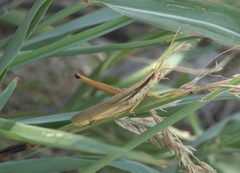
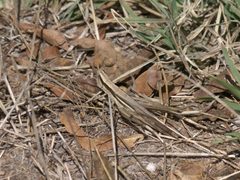
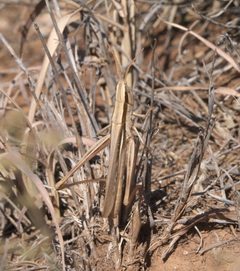
distinguished from sympatric Mermiria by four characters: pronotum lacks lateral carinae (disk rounds onto lateral lobe); three cut pronotal disk margin; no ivory stripes on occiput or pronotal disk; and single (not two or zero) white streak on tegmen. Mermiria texana has ivory stripes on occiput/pronotum and two tegmen streaks. Mermiria picta lacks all ivory markings and has well-developed lateral carinae cut by two sulci. Nymphs identifiable by strongly slanted , triangular lateral foveolae, pronotum with disk rounding onto lateral lobe, hind with darker upper medial area, and yellow/tan/green body densely spotted brown.
Images
Habitat
Primarily tallgrass prairie, especially unplowed native grassland with big bluestem, yellow indiangrass, and switchgrass. Frequently inhabits these grasses on slopes and hills. Also found in small stands of tall grasses within mixedgrass, shortgrass, bunchgrass, and desert prairies, and in luxuriant stands of midgrasses in mixedgrass prairie.
Distribution
Widely distributed in North America from Central America through the United States; center of distribution in tallgrass prairie. Documented in Alabama, Arizona, Arkansas, Colorado, and Georgia.
Seasonality
Late-hatching . First instars appear early May in eastern Kansas tallgrass prairie; early to mid June in eastern Wyoming mixedgrass prairie. Hatching period lasts two weeks or longer. present from mid-summer through fall.
Diet
Exclusive grass-feeder. Documented consumption of 18 grass and threadleaf sedge, including: big bluestem, yellow indiangrass, switchgrass, sideoats grama, tall dropseed, prairie sandreed, western wheatgrass, silver beardgrass, prairie dropseed, little bluestem, sand bluestem, blue grama, downy brome, smooth brome, sand dropseed, needleandthread, hairy grama, and Bermuda grass (introduced). Feeds on green leaves, attacking from vertical -up position on wide leaves or horizontal position on recumbent leaves.
Host Associations
- Andropogon gerardii - food plantbig bluestem
- Sorghastrum nutans - food plantyellow indiangrass
- Panicum virgatum - food plantswitchgrass
- Bouteloua curtipendula - food plantsideoats grama
- Sporobolus compositus - food planttall dropseed
- Calamovilfa longifolia - food plantprairie sandreed
- Pascopyrum smithii - food plantwestern wheatgrass
- Bothriochloa barbinodis - food plantsilver beardgrass
- Sporobolus heterolepis - food plantprairie dropseed
- Schizachyrium scoparium - food plantlittle bluestem
- Andropogon hallii - food plantsand bluestem
- Bouteloua gracilis - food plantblue grama
- Bromus tectorum - food plantdowny brome
- Bromus inermis - food plantsmooth brome
- Sporobolus cryptandrus - food plantsand dropseed
- Hesperostipa comata - food plantneedleandthread
- Bouteloua hirsuta - food planthairy grama
- Cynodon dactylon - food plantBermuda grass, preferred in caged tests
- Carex filifolia - food plantthreadleaf sedge
Life Cycle
Hemimetabolous. Females oviposit in bare ground near plants at depths of 1.25–1.75 inches. mass contains 14–18 eggs, 7.2 mm long, tan or two-toned tan and yellow; held together by froth spots without pod wall. Long froth plug (1.25 inches) above eggs. Minimum nymphal period 40 days (males); males have four instars, females five. Males emerge before females due to fewer instars and smaller size requirements for .
Behavior
Phytophilous—spends days and nights perched on grass. Rests vertically -up on leaves or culms at 8–12 inch heights at night. Basks 2–4 hours after sunrise by adjusting position to receive radiant heat on one side. Descends plants by backing down, crawls to new leaves, or jumps between plants; immediately crawls up if landing on ground. Preens and to remove dust. Moves to shady side of plants during high temperatures. Quiescent from approximately 8:30 p.m. to 7 a.m.; rain and cool temperatures extend inactivity. Strong, adept flyer with silent 2–12 feet at 9–36 inch heights when flushed; capable of turning to land vertically on upright culms or veering to land in vegetation. Courtship: male approaches female with burst of 2–5 femoral stridulations.
Ecological Role
Primary consumer in tallgrass prairie . At densities around one per square yard, has negligible measurable impact on aboveground vegetation . Fire-maintained grass favors this graminivorous over forb- or mixed-feeding grasshoppers by reducing competition from forbs and shrubs. densities fluctuate around low levels; limiting factors remain unidentified. Cut leaf sections that fall uneaten become ground litter in tallgrass habitat.
Human Relevance
Potentially damaging pest of valuable forage grasses. Reached densities in eastern Kansas native grass pastures in 1939. Individual consumption (3.4 g dry weight lifetime) exceeds that of bigheaded grasshopper (Aulocara elliotti, 2.0 g). Rarely becomes significant pest because densities usually remain light and grass production is plentiful in tallgrass prairie. No significant difference in vegetation between plots with 5 versus 11 grasshoppers per square yard in quantitative studies.
Similar Taxa
- Mermiria texanaOverlaps geographically and seasonally in western North America. Distinguished by ivory stripe on sides of occiput and pronotal disk, and two longitudinal white streaks on tegmen (one above hindleg base, one above ) versus one streak in M. bivittata.
- Mermiria pictaOverlaps geographically and seasonally in western North America. Distinguished by lack of ivory stripes on occiput/pronotum, lack of tegmen streaks (M. bivittata has one), and well-developed lateral carinae on pronotal disk cut by two (M. bivittata lacks lateral carinae entirely).
- Mermiria intertextaDistributed in eastern United States along Atlantic and Gulf coasts; does not overlap with M. bivittata in western and central regions.
More Details
Subspecies
Two recognized: Mermiria bivittata bivittata and Mermiria bivittata maculipennis.
Activity Budget
In sandhills grassland of central Nebraska, daylight activity budget: 88% quiescent, 10% feeding, 1% moving over 13.5 hours.
Dispersal
No direct evidence of long-distance or , despite good capacity, extensive range, and occupation of small in drier grasslands suggesting dispersal occurs. Not recorded as accidental in mountains west of Boulder, Colorado, despite presence in adjacent plains and foothills.