
Mermiria bivittata maculipennis
Bruner, 1889
Twostriped Slantfaced Grasshopper
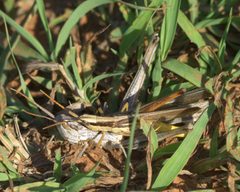
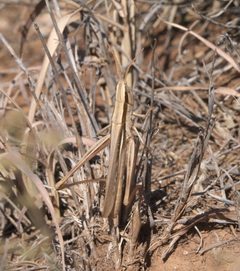
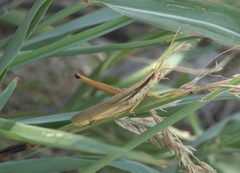
Mermiria bivittata maculipennis is a of the twostriped slantfaced grasshopper, a large, long-winged widely distributed in North America with its center of distribution in the tallgrass prairie. It is a specialized grass-feeder inhabiting tall grass , particularly big bluestem, yellow indiangrass, and switchgrass. The subspecies is characterized by specific wing patterning as indicated by the epithet 'maculipennis' (spotted wings). It is a late-hatching with relatively slow nymphal development, and while capable of reaching densities, it rarely becomes a significant economic pest due to generally low densities in its productive grassland .
Pronunciation
How to pronounce Mermiria bivittata maculipennis: /mɛrˈmɪriə baɪvɪˈtɑːtə ˌmækjʊlɪˈpɛnɪs/
These audio files are automatically generated. While they are not always 100% accurate, they are a good starting point.
Identification
Distinguished from by: 1) pronotal disk rounding off onto lateral lobe without lateral carinae; 2) pronotal disk margin cut by three ; 3) absence of ivory stripes on sides of occiput and pronotal disk; and 4) presence of one longitudinal white or ivory streak on tegmen. Mermiria texana has ivory stripes on occiput and pronotal disk and two white streaks on tegmen. Mermiria picta lacks ivory stripes and tegmen streaks entirely, and has well-developed lateral carinae on pronotal disk cut by two sulci. Nymphs identifiable by strongly slanted , triangular lateral foveolae invisible from above, and narrow brown band along side of continuing on edge of lateral lobe.
Images
Habitat
Primarily tallgrass prairie, specifically dominated by big bluestem (Andropogon gerardii), yellow indiangrass (Sorghastrum nutans), and switchgrass (Panicum virgatum). Frequently inhabits these grasses on slopes and hills. Also occurs in small stands of tall grasses within mixedgrass, shortgrass, bunchgrass, and desert prairies, as well as luxuriant stands of midgrasses in mixedgrass prairie. Requires bare ground nearby for oviposition.
Distribution
Widely distributed in North America with center of distribution in the tallgrass prairie. Eastern Kansas, western Nebraska, northeastern Texas, eastern Wyoming. Extends into mixedgrass and shortgrass prairie regions through small tall grass stands. Not found in mountains west of Boulder, Colorado despite presence in adjacent plains and foothills.
Seasonality
Late-hatching . First instars appear early May in tallgrass prairie of eastern Kansas; early to mid June in mixedgrass prairie of eastern Wyoming. Hatching period lasts two weeks or longer. present from mid-summer through fall.
Diet
Obligate grass-feeder. Documented feeding on 18 grass plus threadleaf sedge (Carex filifolia). Primary include big bluestem, little bluestem, sand bluestem, yellow indiangrass, sideoats grama, tall dropseed, prairie sandreed, western wheatgrass, silver beardgrass, prairie dropseed, blue grama, downy brome, smooth brome, sand dropseed, needleandthread, and hairy grama. Caged preference tests showed selection of Bermuda grass and prairie dropseed over big bluestem and silver beardgrass. Feeds on green leaves, cutting sections 1-2 inches long and consuming from edge to midrib or entire sections of narrow leaves.
Host Associations
- Andropogon gerardii - primary big bluestem
- Sorghastrum nutans - primary yellow indiangrass
- Panicum virgatum - primary switchgrass
- Andropogon hallii - sand bluestem
- Schizachyrium scoparium - little bluestem
- Bouteloua curtipendula - sideoats grama
- Sporobolus composus - tall dropseed
- Calamovilfa longifolia - prairie sandreed
- Pascopyrum smithii - western wheatgrass
- Bothriochloa saccharoides - silver beardgrass
- Sporobolus heterolepis - preferred prairie dropseed; preferred in caged tests
- Bouteloua gracilis - blue grama
- Bromus tectorum - downy brome
- Bromus inermis - smooth brome
- Sporobolus cryptandrus - sand dropseed
- Hesperostipa comata - needleandthread
- Bouteloua hirsuta - hairy grama
- Cynodon dactylon - preferred Bermuda grass; preferred in caged tests
- Carex filifolia - threadleaf sedge; only non-grass documented
Life Cycle
deposited in bare ground near plants at depths of 1.25-1.75 inches. Egg mass contains 14-18 eggs with no pod wall; eggs held together by spots of froth. Eggs tan or two-toned tan and yellow, 7.2 mm long. Long froth plug of 1.25 inches above eggs. Minimum nymphal period 40 days for males. Females have five instars, males have four. Late-hatching with extended hatching period of two weeks or more. Slow nymphal development attributed to cooler temperatures in luxuriant grass and above-ground location on tall grass.
Behavior
Phytophilous spending most of time perched on grass. Rests vertically -up on leaves or culms at heights of 8-12 inches at night. Basks for 2-4 hours after sunrise by adjusting position to receive radiant heat on one side. Descends from perches by backing down, crawls onto other leaves, or jumps between plants. If landing on ground, immediately crawls up nearby grass. Preens and frequently. Moves to shady side of grass plants during high temperatures. Quiescent from approximately 8:30 p.m. to 7 a.m.; rain and cool temperatures extend . Strong, adept flyer with silent 2-12 feet at heights of 9-36 inches when flushed. Flight may be straight or sinuous. Takes off from vegetation, usually lands on vegetation but may land on litter or bare ground. Able to turn at end of flight to land vertically on upright culm, or veer to land within vegetated areas.
Ecological Role
Primary consumer in tallgrass prairie . Functions as a grass-feeder contributing to nutrient cycling through herbivory and leaf litter production. In tallgrass prairie, cut leaves often remain uneaten and become ground litter. Studies indicate limited impact on above-ground even at densities of 5-11 grasshoppers per square yard. Fire-maintained grass favor this graminivorous over forb- or mixed-feeders by reducing competition from forbs and shrubs.
Human Relevance
Potential pest of forage grasses in tallgrass prairie. Reaches densities occasionally (e.g., eastern Kansas 1939). Individual consumption estimated at 3.4 gm dry weight of grass per lifetime, exceeding that of Aulocara elliotti (2.0 gm). Rarely becomes significant pest due to generally low densities (typically under one per square yard) and abundant grass production in tallgrass prairie. Quantitative studies showed no significant difference in above-ground vegetation between plots with 5 versus 11 grasshoppers per square yard. Large size makes it conspicuous but economic impact usually minor.
Similar Taxa
- Mermiria texanaOverlaps geographically and seasonally in the West; distinguished by ivory stripes on sides of occiput and pronotal disk, and two longitudinal white streaks on tegmen (one above base of hindleg, one above ) versus one streak in M. bivittata.
- Mermiria pictaOverlaps geographically and seasonally in the West; lacks ivory stripes on occiput and pronotal disk and lacks tegmen streaks entirely; has well-developed lateral carinae on pronotal disk cut by two .
- Mermiria intertextaDistributed in eastern United States along Atlantic and Gulf coasts; not overlapping with western maculipennis.
More Details
Subspecies status
Mermiria bivittata maculipennis was described by Bruner in 1889. The Catalogue of Life currently lists this as a synonym, though it is treated here as a valid based on the source material. The epithet 'maculipennis' (spotted wings) refers to distinctive wing markings separating it from the nominate subspecies.
Activity budget
Time budget study in sandhills grassland of central Nebraska showed: quiescent 88% of daylight hours, feeding 10%, moving 1% of 13.5 hour daylight period.
Male courtship
Male approaches female and stridulates with burst of two to five strokes of the . No detailed information available on mounting, copulation, or timing of female mating and oviposition.