
Mermiria
Stål, 1873
mermiria grasshoppers, slant-faced grasshoppers
Species Guides
4- Mermiria bivittata(Two-striped Mermiria)
- Mermiria intertexta(Coastal Toothpick Grasshopper)
- Mermiria picta(lively mermiria)
- Mermiria texana(Texas mermiria)
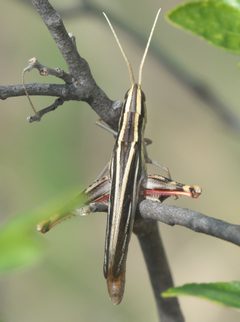
Mermiria is a of slant-faced grasshoppers in the Acrididae, comprising at least four described distributed across North America. These grasshoppers are characterized by their strongly slanted , long wings, and association with tallgrass prairie . The genus includes economically significant species that feed on native and introduced grasses.


Pronunciation
How to pronounce Mermiria: /mɛrˈmɪriə/
These audio files are automatically generated. While they are not always 100% accurate, they are a good starting point.
Identification
Members of Mermiria possess a strongly slanted and . -level identification relies on specific characters: presence or absence of ivory stripes on the sides of the occiput and pronotal disk; number of longitudinal white streaks on the tegmina (one or two); development of lateral carinae on the pronotal disk; and whether cut the pronotal disk margin. Mermiria bivittata has one white streak on the tegmen and lacks ivory stripes; M. texana has two white streaks and ivory stripes; M. picta lacks both streaks and stripes and has well-developed lateral carinae.
Images
Habitat
Primarily associated with tallgrass prairie . Mermiria bivittata inhabits stands of big bluestem, yellow indiangrass, and switchgrass, often on slopes and hills. Small stands of tall grasses in mixedgrass, shortgrass, bunchgrass, and desert prairies also provide suitable . The occupies luxuriant midgrass stands in mixedgrass prairie as well.
Distribution
Widely distributed in North America. Mermiria bivittata ranges across the continental United States with its center in the tallgrass prairie. Mermiria texana and M. picta overlap geographically with M. bivittata in western regions. Mermiria intertexta is distributed along the Atlantic and Gulf coasts of the eastern United States. GBIF records indicate presence in Alabama, Arizona, Arkansas, Colorado, and Florida.
Seasonality
Late-hatching . Mermiria bivittata first instars appear in early May in eastern Kansas tallgrass prairie and early to mid June in eastern Wyoming mixedgrass prairie. Hatching periods may extend two weeks or longer within a . Nymphal development is relatively slow; males complete development in a minimum of 40 days with four instars, females with five instars.
Diet
Exclusively graminivorous. Mermiria bivittata feeds on at least 18 grass including big bluestem, little bluestem, sand bluestem, sideoats grama, blue grama, hairy grama, tall dropseed, prairie dropseed, sand dropseed, yellow indiangrass, prairie sandreed, western wheatgrass, needleandthread, downy brome, smooth brome, and Bermuda grass. Also consumes threadleaf sedge. Feeds on green leaf tissue, producing characteristic semi-elliptical damage 1-2 inches long.
Host Associations
- Andropogon gerardii - food plantbig bluestem
- Sorghastrum nutans - food plantyellow indiangrass
- Panicum virgatum - food plantswitchgrass
- Bouteloua curtipendula - food plantsideoats grama
- Bouteloua gracilis - food plantblue grama
- Sporobolus heterolepis - food plantprairie dropseed
- Cynodon dactylon - food plantBermuda grass, preferred in cage tests
- Calamovilfa longifolia - food plantprairie sandreed
- Pascopyrum smithii - food plantwestern wheatgrass
- Hesperostipa comata - food plantneedleandthread
- Carex filifolia - food plantthreadleaf sedge
Life Cycle
Hemimetabolous development with , nymph, and stages. Females oviposit in bare ground near plants at depths of 1.25 to 1.75 inches. Egg masses contain 14-18 eggs without a pod wall; eggs held together by froth spots. Eggs tan or two-toned tan and yellow, 7.2 mm long. Long froth plug of 1.25 inches extends above eggs. Males stridulate during courtship with bursts of two to five femoral strokes.
Behavior
Phytophilous spending most of time perched on grass vegetation. Nymphs and rest vertically -up on leaves or culms at heights of 8-12 inches overnight. Basking involves adjusting position to receive radiant heat for 2-4 hours before feeding. Movement includes backing down perches, crawling between leaves, or jumping between plants. Strong, adept fliers with wings extending to tip; flushed cover 2-12 feet at 9-36 inches height, silent and straight or sinuous. Can turn in flight to land vertically on upright stems.
Ecological Role
Primary consumer in grassland . Mermiria bivittata functions as a subdominant in tallgrass prairie , typically occurring at densities around one per square yard or less. Contributes to nutrient cycling through grass consumption and leaf litter production. Fire-maintained tallgrass prairie favors this graminivorous species over forb-feeding or mixed-feeding grasshoppers by reducing competition from forbs and shrubs.
Human Relevance
Mermiria bivittata is a potentially damaging pest of valuable forage grasses. Individual consumption averages 3.4 gm dry weight of grass per lifetime, exceeding that of some co-occurring pest . densities occurred in eastern Kansas native grass pastures in 1939. However, significant economic damage is rare because densities usually remain light and grass production is plentiful in tallgrass prairie. Quantitative studies showed no significant reduction in above-ground vegetation even at elevated densities.
Similar Taxa
- Aulocara elliottiBoth are large, economically significant grass-feeding grasshoppers of western grasslands. Aulocara has a big-headed appearance and different pronotal structure.
- Phoetaliotes nebrascensisCo-occurs in tallgrass prairie and is often the in where Mermiria is subdominant. Phoetaliotes differs in facial angle and wing pattern.
- Opeia obscuraAnother slant-faced grasshopper in the same Gomphocerinae, similar in general form but differing in size, coloration, and detailed pronotal structure.
More Details
Taxonomic history
established by Stål in 1873. Four currently recognized: Mermiria bivittata (Serville, 1839), Mermiria intertexta Scudder, 1899, Mermiria picta (F. Walker, 1870), and Mermiria texana Bruner, 1889.
Population ecology
fluctuate around low densities in tallgrass prairie, rarely exceeding one per square yard. Food supply is not limiting; the factor or factors that limit population size remain unidentified.
Activity budget
In daylight hours, Mermiria bivittata spends 88% of time quiescent, 10% feeding, and 1% moving. Activity patterns are strongly influenced by temperature and solar radiation.